


In the world of wide-area motion imagery (WAMI), accurately tracking multiple moving objects over large scenes is a complex challenge. Corvus ISR’s latest benchmark results showcase how advanced tracking algorithms can significantly improve identity consistency in synthetic scenes with perfect ground truth data. Their publicly available public tracker benchmark compares two models under identical conditions, highlighting profound improvements in tracking quality.

Get the latest gadgets delivered free with Prime
- Fast, free delivery on millions of items
- Prime Video, Amazon Music and more included
- Member-only deals all year
The baseline model, dubbed v1, employs a straightforward greedy nearest-neighbour approach, making simple two-pass associations with fixed velocity predictions and a 2-second coasting period. Despite its simplicity, it serves as a solid foundation for tracking in dense scenes. The newer model, v2, introduces an auction-based method, which uses a three-tier association process, velocity-consistency gating, and confidence decay mechanisms—delivering a notable reduction in identity switches.
Results reveal that v2 decreases the number of ID switches per minute by over 42% across different scenarios. For example, in the baseline setup with 150 moving objects, switches dropped from 2,042 to 1,183. Similarly, with increased density to 400 objects, errors fell from 14,032 to 8,040. These figures are particularly meaningful because the tracking scenarios are synthetic, with perfect ground truth, ensuring that the reported errors are genuine measurements rather than marketing hype.
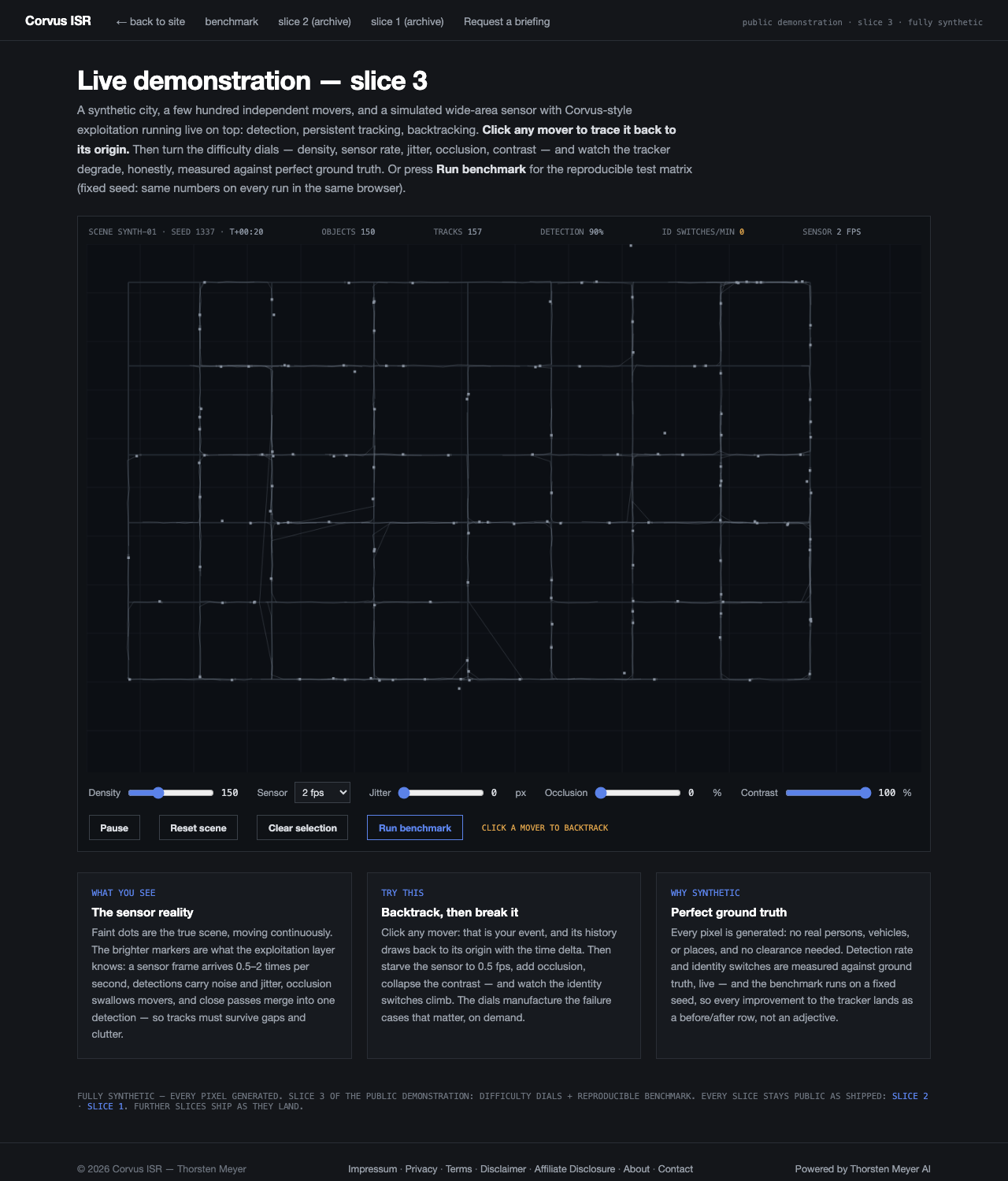
In addition to accuracy improvements, v2 maintains real-time performance, averaging around 1.2 milliseconds per sensor tick at a density of 400 objects. Even at worst-case conditions, it stays within a 5-millisecond processing window—easily manageable within typical surveillance systems. Importantly, all this can be tested directly in a browser via the live demo, where anyone can run the benchmark without sign-up or NDA, making it transparent and accessible for tech enthusiasts and industry professionals alike.
The key takeaway is that advanced auction-based tracking can dramatically reduce identity errors even under challenging conditions. As the benchmark explicitly publishes the number of errors, it underscores that even state-of-the-art systems still commit thousands of mistakes per minute, highlighting the ongoing need for innovation in multi-object tracking technology. Corvus ISR’s synthetic environment ensures that these metrics are precise and reproducible, setting a new standard for transparency in the field.
Ultimately, this development demonstrates how AI-driven algorithms and clever association strategies are pushing the boundaries of real-time surveillance. If you’re interested in seeing the results firsthand, you can explore the public benchmark and reproduce it live. Run the benchmark yourself and witness the impact of these cutting-edge tracking techniques.
multi-object tracking surveillance system
As an affiliate, we earn on qualifying purchases.
As an affiliate, we earn on qualifying purchases.
real-time motion tracking camera
As an affiliate, we earn on qualifying purchases.
As an affiliate, we earn on qualifying purchases.
As an affiliate, we earn on qualifying purchases.
As an affiliate, we earn on qualifying purchases.
Halloween Picks
halloween
As an affiliate, we earn on qualifying purchases.