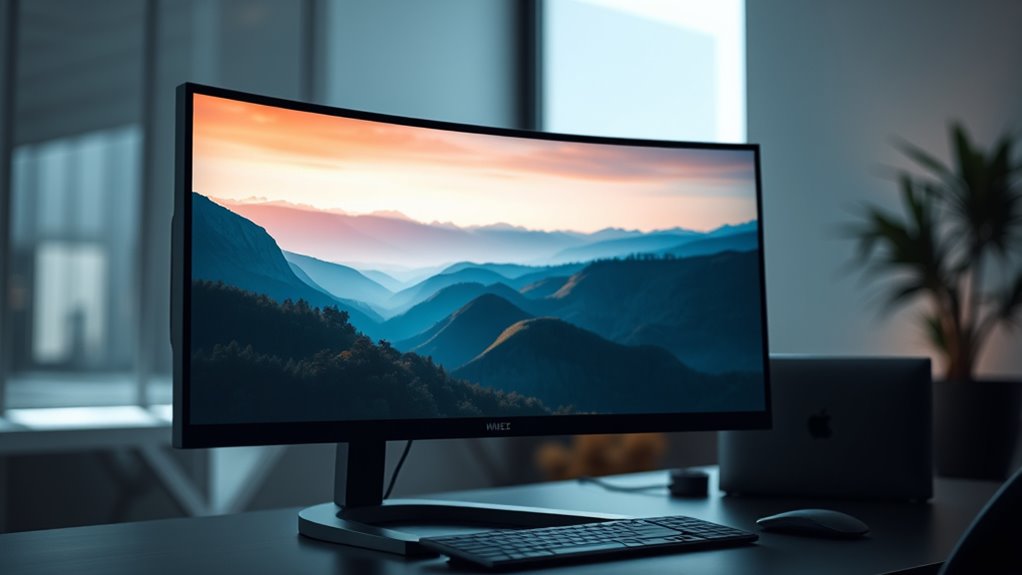

Curved monitors can boost your comfort by reducing eye strain, improving viewing angles, and making multitasking easier. They also provide a more immersive experience with wider fields of view and better image quality, especially on larger screens. However, they may distort straight lines, cost more upfront, and pose mounting challenges. If you want to understand how these factors balance out for your use, keep exploring the details ahead.

Get the latest gadgets delivered free with Prime
- Fast, free delivery on millions of items
- Prime Video, Amazon Music and more included
- Member-only deals all year
Key Takeaways
- Curved monitors enhance immersion, reduce eye strain, and improve reading speed, making them ideal for long-term use and multitasking.
- They can cause distortion of straight lines and may be less suitable for tasks requiring high precision and color accuracy.
- The ergonomic design aligns with natural eye curvature, decreasing fatigue and supporting better visual comfort.
- Higher upfront costs and compatibility challenges with standard mounts are important considerations for potential buyers.
- Overall, their benefits for immersive viewing and productivity can outweigh drawbacks, especially for gaming, multimedia, and extended work sessions.
Enhanced Visual Comfort and Reduced Eye Strain
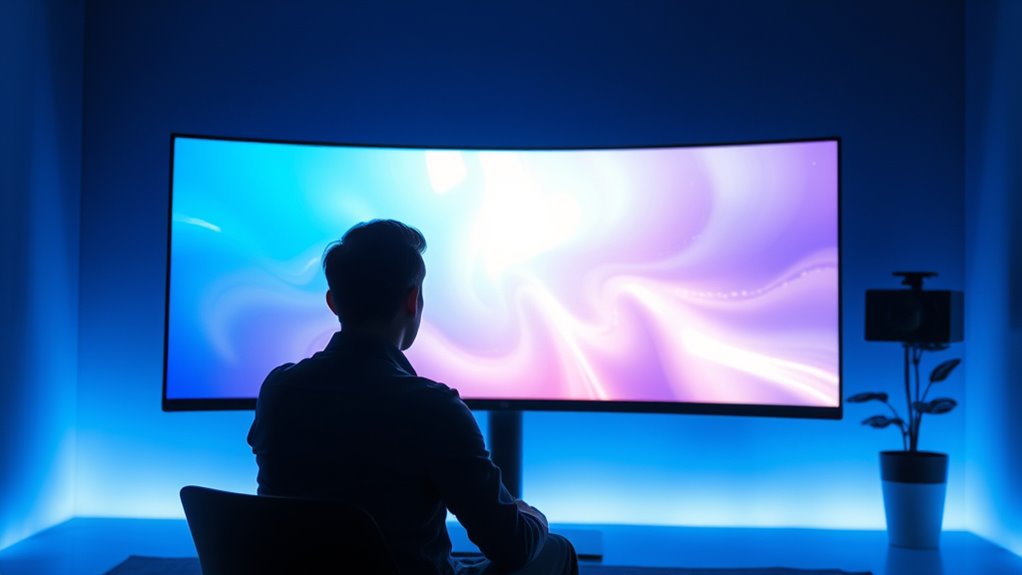
Curved monitors can substantially enhance your visual comfort and reduce eye strain during extended computer use. Their natural curvature aligns with the shape of your eyes, ensuring a more consistent viewing distance across the screen. This means less eye movement and refocusing, which helps prevent fatigue. The design also minimizes distortion at the edges, maintaining uniform image quality and color accuracy. Unlike flat screens, curved displays keep your eyes focused on a single, continuous surface, reducing the need for excessive eye adjustments. This ergonomic benefit allows you to work longer without discomfort. Additionally, understanding contrast ratio can help you choose a display that offers better depth and clarity for your visual comfort. Incorporating ergonomic principles in your workspace setup can further optimize comfort and reduce strain during prolonged use. Being aware of blue light emissions from monitors can also help you select screens that minimize eye irritation and improve overall visual well-being. Moreover, selecting a monitor with adjustable brightness settings can further enhance your comfort and reduce eye fatigue over time. Considering screen size and resolution can also impact how comfortably you view content for extended periods.
Improvements in Reading Speed and Task Efficiency
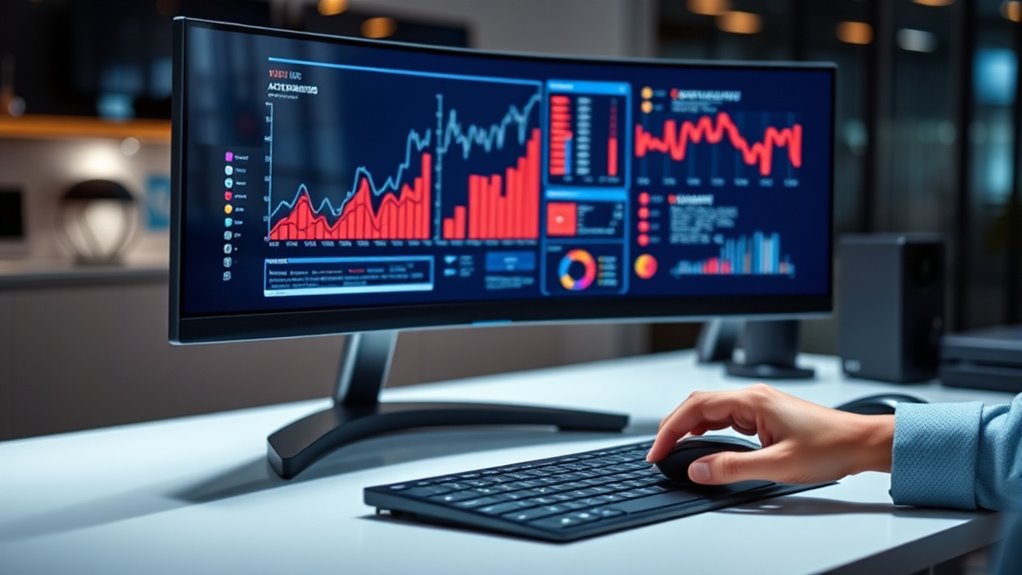
You’ll notice that reading on a curved monitor can be about 7% faster, helping you get through tasks quicker. The natural shape reduces mental strain, making it easier to process information without fatigue. Plus, multitasking becomes smoother, so managing multiple applications feels more efficient. Additionally, the ergonomics of curved screens can help minimize neck and eye strain during extended use.
Faster Reading Performance
Research shows that curved monitors can substantially enhance reading speed and overall task efficiency. The natural curvature aligns with your eyes, reducing the need for constant refocusing and eye movement. This setup makes scanning and reading large blocks of text faster and less tiring. With a curved display, you can process information more smoothly, leading to quicker comprehension and decision-making. The immersive effect helps you stay focused on your work, minimizing distractions. Plus, managing multiple applications becomes easier because the curved shape maintains clarity across the entire screen. Overall, you’ll notice a boost in productivity, especially during long reading sessions or multitasking. This increased efficiency can save you time and reduce mental fatigue, making curved monitors a smart choice for demanding tasks. Additionally, the reading techniques associated with curved screens can further optimize your workflow and comfort.
Reduced Mental Effort
Because the natural shape of curved monitors aligns with the human eye, they reduce the mental effort needed to process visual information. This alignment helps you focus more easily on tasks without constantly adjusting your gaze or refocusing. Studies show that users read text about 7% faster on curved screens, thanks to smoother visual flow. The reduced need to shift focus lowers mental fatigue, making it easier to stay engaged with complex tasks. As a result, you can complete work more efficiently, with less cognitive strain. Multitasking becomes simpler because multiple applications stay clear and accessible without overwhelming your attention. Overall, curved monitors help you work longer with less mental exhaustion, boosting productivity and maintaining focus throughout extended sessions. Additionally, the standardization of design in curved monitors allows for more consistent user experiences across different brands and models.
Enhanced Multitasking
Enhanced multitasking on curved monitors stems from their ability to reduce mental effort and improve visual clarity across the entire display. This means you can switch between applications smoothly, with less eye fatigue. The natural curvature aligns with your eye’s shape, making it easier to read and process multiple windows simultaneously.
| Task Type | Benefit | Example |
|---|---|---|
| Reading documents | Faster reading speed and comprehension | Reviewing reports quickly |
| Managing multiple apps | Clear visual separation, less confusion | Editing spreadsheets while chatting |
| Data analysis | Quicker data interpretation | Comparing charts side-by-side |
This setup helps you stay focused, increase efficiency, and complete tasks with less fatigue, especially during long work sessions.
Immersive Experience and Expanded Field of View

Curved monitors create a more immersive experience by wrapping the display around your field of view, making you feel more engaged with the content. This design draws you deeper into games, videos, or work tasks, enhancing the overall experience. The wider field of view helps you see more of your workspace without turning your head, improving focus and reaction times. You’ll notice how the wraparound effect makes visuals feel more natural and expansive. This is especially true for gaming and multimedia, where the sense of being inside the scene heightens immersion. Additionally, ultra-wide formats provide ample space for multitasking, boosting productivity. The ergonomic benefits of curved monitors can also reduce neck strain by aligning the display more naturally with your line of sight. Proper ventilation considerations ensure the longevity of your monitor and optimal performance in your setup. Proper monitor placement also helps reduce glare and reflections, further enhancing your viewing experience. Incorporating adjustable stand features can help optimize viewing angles and comfort for prolonged use. A well-designed setup that considers ergonomic principles can further enhance comfort during extended use.
Minimization of Visual Distortion and Color Shifting
Visual distortion is a common issue with flat monitors, especially near the edges, where the natural curvature of the human eye causes images to appear stretched or warped. Curved monitors address this problem by matching the eye’s shape, providing a more uniform viewing experience. This design reduces the distortion and color shifting often seen on flat screens, particularly at the edges. With a curved screen, colors stay consistent from center to edge, ensuring better image quality and true color reproduction. Larger displays benefit most, as distortion becomes more noticeable on flat screens. By minimizing these issues, curved monitors deliver sharper, more accurate visuals, making everything from photo editing to gaming more precise. This results in a clearer, more vibrant picture across the entire display.
Cost Considerations and Investment Value
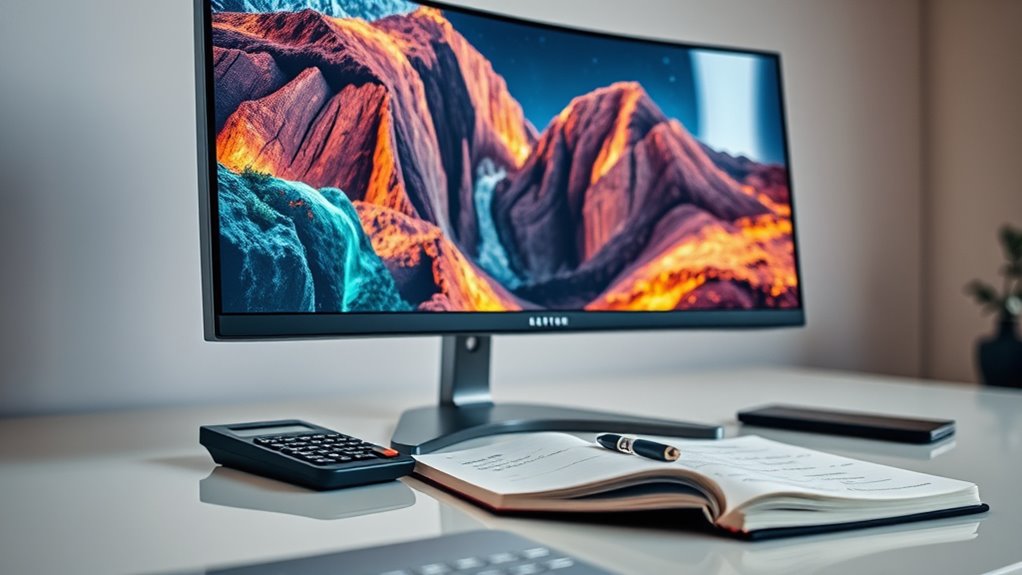
While curved monitors offer significant benefits in reducing distortion and improving image quality, they do come with higher upfront costs. You might find the initial investment steeper compared to flat displays, but the long-term gains can justify it. Consider these points:
Curved monitors may cost more upfront but offer long-term benefits in comfort and productivity.
- Your health and comfort can improve, reducing eye strain and fatigue over time
- Increased productivity and faster reading speeds can lead to better work results
- The immersive experience enhances gaming and multimedia enjoyment
- Larger, high-quality displays may boost your workflow efficiency
- The cost savings from reduced eye fatigue and increased work output can offset higher purchase prices
- Investing in vetted curved monitors ensures you get reliable quality and performance that can maximize your investment. Additionally, choosing a monitor with ergonomic features can further enhance comfort during extended use.
- Moreover, selecting a monitor with adaptive brightness can help maintain optimal visual comfort in various lighting conditions, aligning with your circadian support needs.
- When selecting a curved monitor, consider the field-of-view and how it can influence your overall viewing experience and productivity. Incorporating visual ergonomics into your setup can further reduce strain and improve long-term comfort.
Ultimately, if you spend many hours at your computer, the investment could pay off through improved comfort and performance.
Practical Benefits for Gaming and Multimedia Use
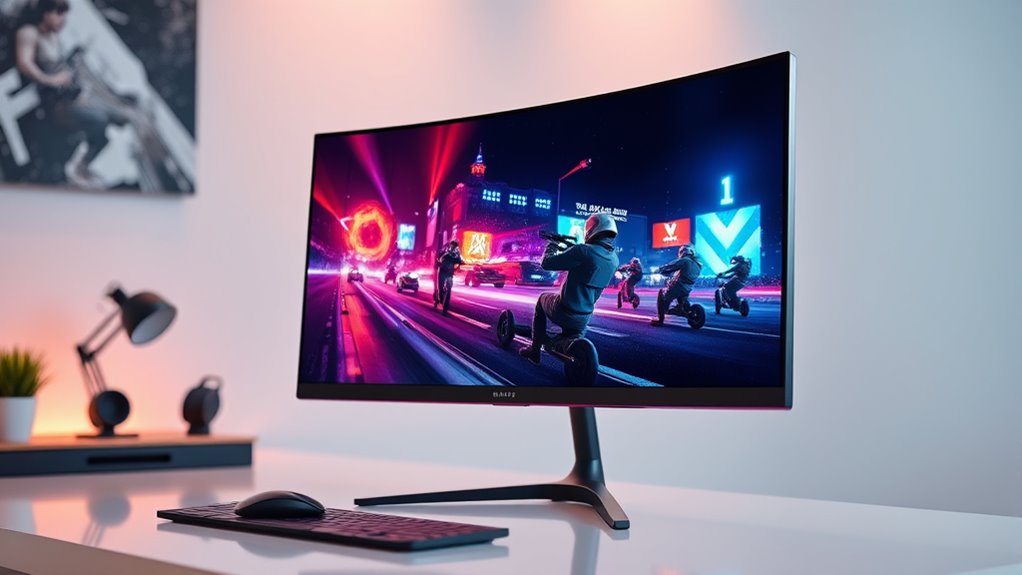
If you enjoy gaming or multimedia entertainment, a curved monitor can markedly enhance your experience by providing a more immersive and engaging display. The curved design wraps around your field of view, making scenes feel more lifelike and intense. This wraparound effect helps you notice details at the edges without moving your head, giving you a competitive edge in fast-paced games. For multimedia, it creates a panoramic viewing experience, perfect for movies and videos, making you feel like you’re part of the action. The wider field of view reduces blind spots and enhances depth perception, making visuals more compelling. Additionally, visual immersion can reduce eye strain by promoting more natural viewing angles during extended use. Maintaining optimal screen calibration ensures that colors and contrast remain accurate, further enriching your viewing experience. Overall, curved monitors deliver a richer, more mesmerizing experience that pulls you into your digital entertainment like never before.
Suitability for Professional Work and Multitasking
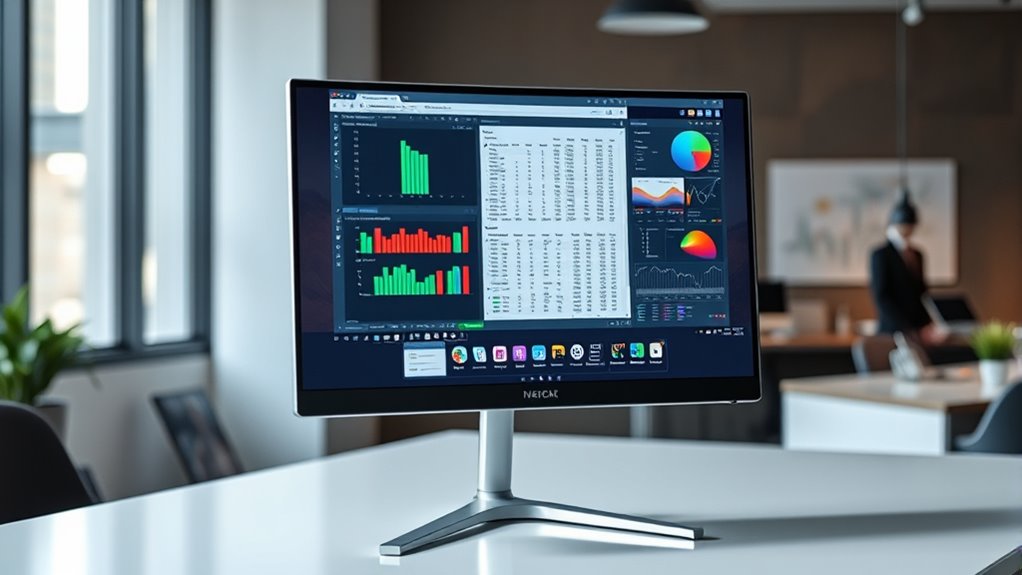
Curved monitors are particularly well-suited for professional work and multitasking because their design enhances your ability to manage multiple applications efficiently. The natural curvature keeps your focus consistent across the entire screen, reducing eye strain and minimizing head movement. This means you can work longer without fatigue. Additionally, the wider field of view helps you see more at once, increasing productivity. Multi-tasking becomes smoother, especially with large spreadsheets or multiple documents. The immersive experience also makes it easier to stay engaged with complex tasks. Incorporating attention to detail into your workflow can further improve accuracy and efficiency when using curved monitors.
Limitations for Precision Tasks and Flat Surface Needs
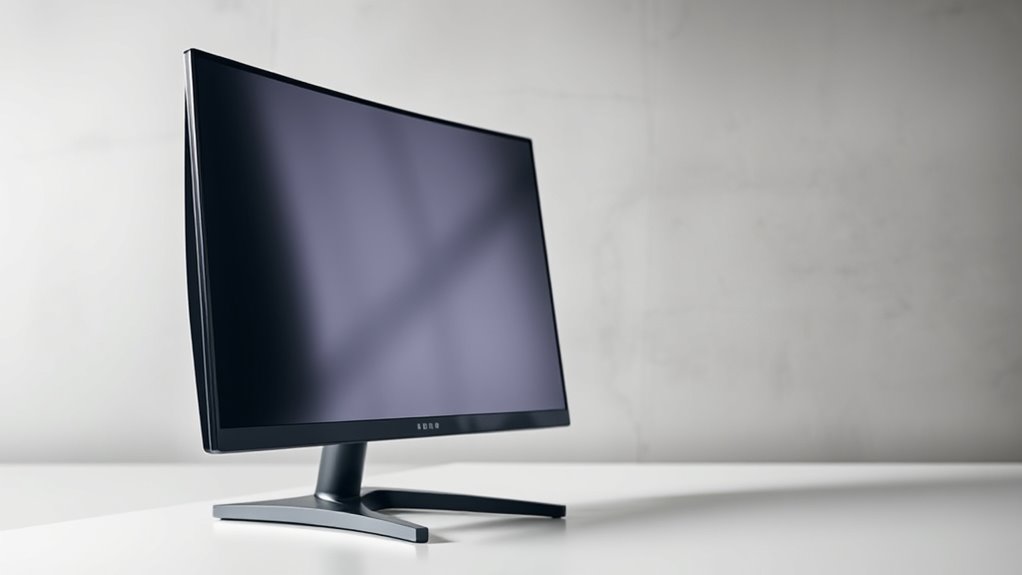
Despite their many benefits, curved monitors often fall short for tasks that require high precision or accuracy. The curved shape can distort straight lines and measurements, making it difficult to work with CAD drawings, detailed design, or technical schematics. For tasks demanding exact alignment, flat monitors provide a more reliable, distortion-free surface. Additionally, flat screens are easier to calibrate for color accuracy, which is essential for professional photo editing and printing. Wall mounting is simpler with flat monitors, offering better stability and alignment in multi-monitor setups. If your work involves precise measurements, straight edges, or color-critical tasks, a flat display ensures you won’t encounter the distortions or calibration issues that can arise with curved screens.
Installation and Compatibility Challenges
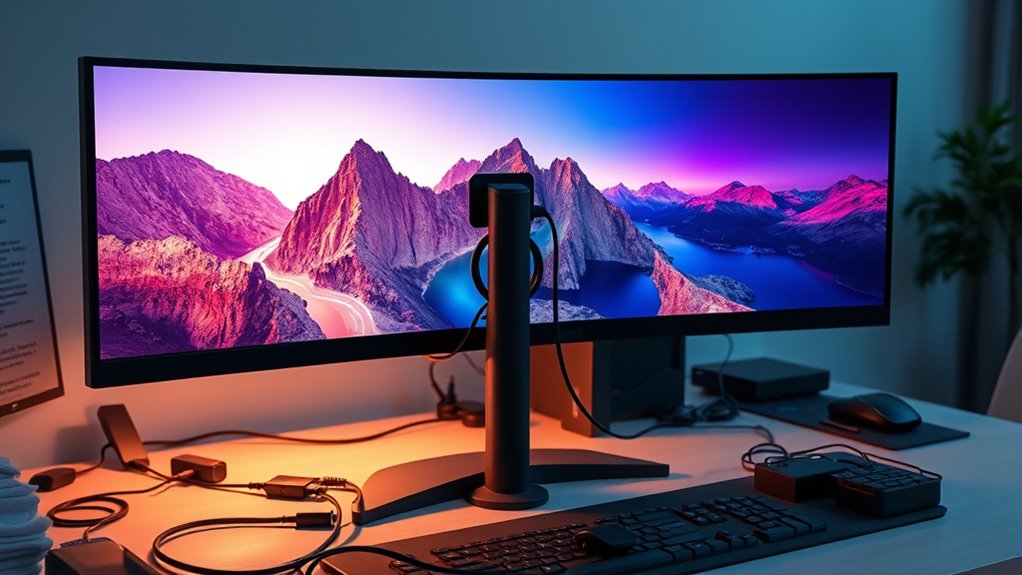
Installing curved monitors can be tricky because their unique shape often requires specialized mounting solutions. Compatibility issues may arise with standard VESA mounts or existing desk setups, forcing you to find alternative options. These challenges can add time and expense to your setup process, especially if your workspace isn’t designed for curved displays. Additionally, some home security systems may offer better compatibility and easier installation options, making them more suitable for various workspace configurations. Proper mounting techniques and adjustable stands can help mitigate some of these issues and improve your overall setup experience. Being aware of workspace ergonomics and how your setup influences comfort can also help prevent potential issues down the line. Considering display calibration and how it affects image quality can further enhance your viewing experience and reduce eye strain.
Mounting Difficulties
Mounting a curved monitor can present distinct challenges compared to flat screens, mainly due to their unique shape and design. You might find that standard mounts don’t fit securely or align properly with the monitor’s curvature, leading to stability issues. Compatibility with your existing mounting arm or wall bracket can also be problematic, requiring adapters or custom solutions. Additionally, the curvature can limit adjustability, making it harder to position the screen for ideal viewing angles.
- Compatibility with VESA mounts may be limited or require adapters
- Standard mounting arms might not support the monitor’s weight or shape
- Adjusting tilt and swivel can be restricted by the curved design
- Wall mounting options may be less flexible or more complex
- Ensuring a stable, level setup demands extra attention to mounting hardware
Compatibility Issues
Compatibility issues can arise when setting up a curved monitor, as its unique shape may not align seamlessly with standard mounting solutions. You might find that wall mounts or arm mounts designed for flat screens don’t fit properly. The curvature can interfere with VESA mounting brackets, requiring adapters or custom solutions. Additionally, some stands may lack compatibility, leading to unstable setups or the need for replacement.
| Mount Type | Compatibility Challenge | Solution |
|---|---|---|
| Wall Mounts | VESA bracket misalignment | Use VESA adapters or specialized mounts |
| Desk Stands | Fitment issues with curved bases | Choose stands designed for curved monitors |
| Adjustable Arms | Limited range of motion | Select arms supporting curved screens |
| Wall Brackets | Incompatibility with curved shape | Opt for custom or adjustable brackets |
Long-Term Benefits Versus Initial Investment
While curved monitors often come with a higher initial cost, many users find that the long-term benefits justify the investment. They can reduce eye strain, improve comfort, and boost productivity over time. If you spend hours at your computer daily, these benefits can lead to less fatigue and better focus. The investment pays off especially for professionals who multitask or work with large data sets, needing extended screen time.
- Lower eye strain and fatigue over time
- Increased productivity and faster reading speeds
- Enhanced immersion for gaming and multimedia
- More consistent image quality with less distortion
- Long-term cost savings through improved comfort and efficiency
Frequently Asked Questions
Are Curved Monitors Compatible With All Types of Computer Setups?
Yes, curved monitors are compatible with most computer setups. You can connect them via HDMI, DisplayPort, or USB-C, depending on your monitor and computer ports. They work with Windows, macOS, and Linux systems. Just confirm your graphics card supports the resolution and refresh rate of the curved monitor. Some setups may need adapters or specific cables, but overall, they integrate smoothly with a wide range of devices.
Do Curved Screens Cause Reflections or Glare Issues?
Yes, curved screens can cause reflections or glare issues, especially if the monitor’s surface is glossy or placed near bright light sources. You might notice reflections from windows or lamps, which can be distracting. To minimize this, choose monitors with matte finishes or position your screen away from direct light. Adjusting the angle of your monitor or using curtains can also help reduce glare and improve your viewing experience.
How Do Curved Monitors Affect Color Accuracy for Design Work?
Are curved monitors good for color accuracy in design work? They generally maintain consistent color reproduction across the screen, thanks to their uniform curvature that minimizes distortion. You’ll notice fewer shifts in brightness or color at the edges, making them suitable for detailed tasks. However, some models might still have slight color inconsistencies, so selecting high-quality displays with proper calibration guarantees your designs stay true to color.
Are Curved Monitors Suitable for Use in Multi-Monitor Configurations?
Curved monitors are suitable for multi-monitor setups, especially if you want a more immersive and seamless experience. They reduce glare and distortion at the edges, making shifts between screens smoother. However, alignments can be tricky, and some apps may not display perfectly across curves. You’ll need to evaluate physical space and mounting options, but overall, curved displays can enhance productivity and visual comfort in multi-screen arrangements.
What Are the Maintenance and Cleaning Requirements for Curved Displays?
A stitch in time saves nine. To keep your curved display looking its best, regularly dust it with a microfiber cloth to prevent dirt buildup. Use a gentle, screen-specific cleaner and avoid harsh chemicals that can damage the surface. Always turn off the monitor before cleaning, and avoid applying excessive pressure. With proper care, your curved monitor stays clear and vibrant, ensuring ideal viewing and longevity.
Conclusion
Like stepping into a new domain, a curved monitor invites you to embrace a more immersive experience, much like sailing around a bend in a river. While it offers comfort and depth, consider whether the investment aligns with your journey. Weigh the benefits against the hurdles, and picture yourself at the helm, steering your digital world with clarity. Ultimately, it’s your voyage—choose the display that guides you smoothly to your destination.
Fall Picks
fall essentials
As an affiliate, we earn on qualifying purchases.