
In 2025 and beyond, 3D printers are revolutionizing industries by offering ultra-precise, multi-material, and large-scale solutions. You’ll see AI-driven optimization for faster, more reliable prints, eco-friendly materials, and real-time monitoring to minimize errors. Applications range from healthcare with custom implants and bioprinting to on-site construction and space manufacturing. If you keep exploring, you’ll discover how these advancements are shaping a smarter, more sustainable future for additive manufacturing.
Key Takeaways
- AI-driven optimization enhances precision, reduces waste, and enables multi-material and large-scale additive manufacturing.
- Advanced sensors and automated calibration ensure real-time quality control and process efficiency.
- Sustainable materials, including bio-resins and recyclables, support eco-friendly manufacturing models.
- Hybrid and multi-material printers allow complex, functional, and embedded features in a single print.
- In healthcare and space, bioprinting and microgravity manufacturing enable rapid, customized, and in-situ production.
Advancements in AI-Driven Precision and Predictive Modeling
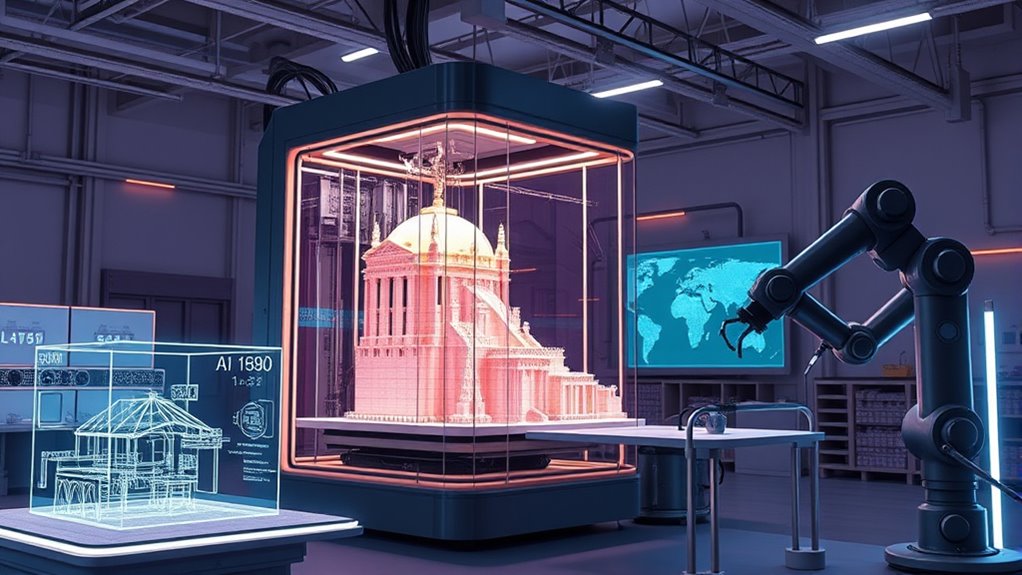
Advancements in AI-driven precision and predictive modeling are transforming 3D printing by making processes more accurate and efficient. You now benefit from machine learning algorithms that optimize design parameters before printing begins, reducing trial-and-error and material waste. Sensors embedded in printers continuously monitor temperature, humidity, and material flow, providing real-time data to adapt calibration on the fly. This advanced sensor technology ensures consistent quality and minimizes errors. AI also coordinates multi-material printing, seamlessly combining different substances within a single object for enhanced durability and functionality. Additionally, predictive maintenance systems analyze machine behavior to forecast and prevent failures, drastically reducing downtime. The integration of material properties into AI systems further enhances the ability to tailor prints for specific applications. As these technologies evolve, they will enable even more customized manufacturing capabilities, allowing for highly specialized and complex parts. These innovations deliver faster, more reliable prints, empowering you to produce complex, high-quality parts with less waste and greater precision.
The Rise of Multi-Material and Hybrid Printing Technologies
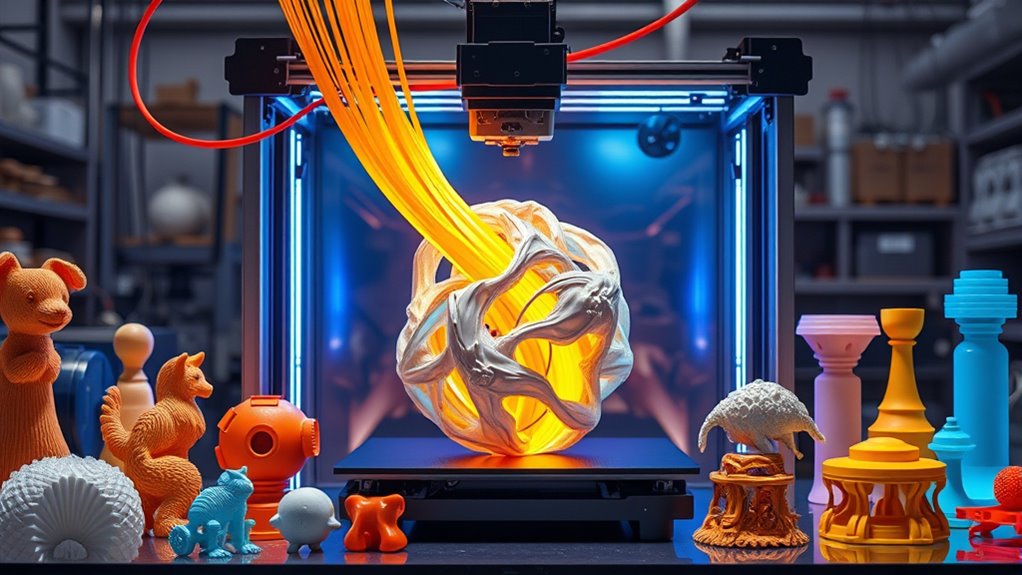
The rise of multi-material and hybrid printing technologies is revolutionizing how complex, functional objects are produced. You can now combine various materials—metals, polymers, composites—within a single print, creating parts with tailored properties. Hybrid systems blend additive manufacturing with CNC finishing, achieving smooth surfaces and intricate details. Dual-light resin printers enable simultaneous creation of flexible and rigid zones, ideal for prosthetics and stretchable electronics. These advancements allow for the rapid production of multi-material components, reducing assembly steps and material waste. You can design objects with embedded functionalities, such as embedded sensors or responsive elastomers. As these technologies evolve, you’ll find more opportunities to produce highly customized, durable, and sophisticated products in a single manufacturing process, pushing the boundaries of what 3D printing can achieve.
Transforming Healthcare With Custom Implants and Bioprinting

Did you know that 3D printing is revolutionizing healthcare by enabling the rapid creation of customized implants and bioprinted tissues? You can now get patient-specific solutions faster, reducing waiting times and improving outcomes. Here’s how:
- Personalized Implants: You receive implants tailored precisely to your anatomy, increasing fit and comfort.
- Bioprinting Tissues: Researchers are printing living tissues and organs, offering hope for transplant shortages and reducing rejection risks.
- On-Demand Manufacturing: Hospitals can produce surgical models, tools, or implants on-site, speeding up treatment and decreasing costs. The use of AI tools in design processes can further enhance customization and precision.
This technology enhances recovery, minimizes complications, and paves the way for regenerative medicine. As bioprinting advances, you’ll see even more life-changing medical solutions tailored specifically for you, transforming healthcare into a more personalized experience. Free Floating
Industrial Innovation: From Automotive to Aerospace Applications

You can leverage advanced prototyping techniques to rapidly develop and test new automotive and aerospace parts, reducing design cycles considerably. Lightweight structural components become easier to produce, allowing for stronger, fuel-efficient vehicles and aircraft. These innovations are transforming how industries approach manufacturing, making them more agile and sustainable.
Advanced Prototyping Techniques
Advanced prototyping techniques are revolutionizing how industries like automotive and aerospace develop new components, enabling faster iteration and higher precision. You can now create complex, functional prototypes that closely mimic final products, reducing development cycles. These techniques include:
- Multi-material printing – Combine different materials within a single prototype to simulate real-world properties, like flexibility or strength.
- Hybrid manufacturing – Blend additive and subtractive methods for precise surface finishes and intricate details.
- Rapid iteration workflows – Use AI-driven design adjustments and quick turnaround times to test multiple versions swiftly.
- Enhanced field-of-view and imaging-scale capabilities – These advancements in 3D printing enable the creation of highly detailed and accurate prototypes, similar to detailed imaging in other fields.
These innovations allow you to test fit, form, and function early in the process, saving time and costs. As a result, your prototypes become more accurate, and your product development accelerate quite a bit.
Lightweight Structural Components
How are industries reducing weight without compromising strength? They leverage advanced 3D printing techniques to create lightweight structural components with intricate geometries that traditional methods can’t match. Using high-performance materials like carbon-fiber composites and metal alloys, you can produce parts that are both strong and light. Multi-material printing allows for optimized structures where material properties vary according to stress points, reducing unnecessary mass. Topology optimization algorithms, combined with AI, help design complex internal lattices and hollow structures that minimize weight while maintaining durability. Additionally, additive manufacturing enables rapid iteration and customization, perfect for aerospace and automotive sectors aiming for fuel efficiency and performance. These innovations lead to components that are not only lighter but also stronger, more adaptable, and easier to produce at scale. Incorporating advanced materials such as composites and alloys enhances the structural integrity without adding weight.
Speed and Accuracy: The Future of Rapid and High-Resolution Printing

Advancements like ultra-fast layer curing and real-time process optimization are revolutionizing how quickly and precisely you can produce complex parts. Micro-resolution techniques now enable details at the micron level, meeting the demands of high-precision applications. These innovations work together to shorten production times while ensuring premier accuracy, shaping the future of high-resolution 3D printing. Additionally, the integration of AI-driven drug discovery methods could further enhance manufacturing processes by optimizing material properties and production parameters.
Ultra-Fast Layer Curing
Have you ever wondered how 3D printers can produce high-resolution parts in a fraction of the time? The secret lies in ultra-fast layer curing technologies. These innovations markedly cut printing times while maintaining precision. Here’s how they work:
- Rapid Photopolymerization: New light sources and resin formulations cure layers instantly, reducing exposure times from seconds to milliseconds.
- Multi-Point Curing: Simultaneously solidifies multiple areas with advanced projectors or lasers, increasing speed without sacrificing detail.
- Adaptive Light Control: Sensors and algorithms adjust light intensity in real-time, ensuring uniform curing and minimizing defects.
- Home Safety & Accessibility These advancements enable you to produce complex, high-resolution parts faster than ever, opening doors for rapid prototyping, medical applications, and high-volume manufacturing.
Micro-Resolution Precision Advances
Recent innovations in micro-resolution precision are transforming 3D printing by enabling faster production of highly detailed parts with micron-level accuracy. You can now print complex geometries with exceptional surface quality, reducing post-processing needs. Advanced laser and light-based systems, like CLIP and digital light processing (DLP), push resolutions down to 25-50 microns, making intricate features possible in shorter times. Enhanced motion control and vibration damping improve layer consistency, ensuring precision at every stage. Real-time sensor feedback keeps environmental conditions *ideal*, minimizing errors. Automated calibration algorithms continuously refine printer performance, reducing waste and reprints. These advances allow you to produce tiny, high-precision components for medical devices, aerospace parts, and micro-electromechanical systems, all while maintaining rapid throughput and superior accuracy.
Real-Time Process Optimization
Real-time process optimization is transforming 3D printing by enabling immediate adjustments that enhance speed and accuracy throughout the build. You’ll benefit from systems that monitor and adapt on the fly, minimizing errors and reducing print times. For example:
- Sensors track temperature, humidity, and material flow, automatically correcting deviations during printing.
- Advanced algorithms analyze sensor data to auto-calibrate the printer, ensuring consistent quality without manual intervention.
- Enhanced motion systems reduce vibrations and improve layer alignment, achieving finer detail and smoother surfaces.
This continuous feedback loop means you can produce high-resolution, complex parts faster and more reliably. With real-time adjustments, you’re empowered to push the boundaries of what’s possible, creating precise objects at unprecedented speeds.
Sustainability and Waste Reduction in Next-Generation Manufacturing
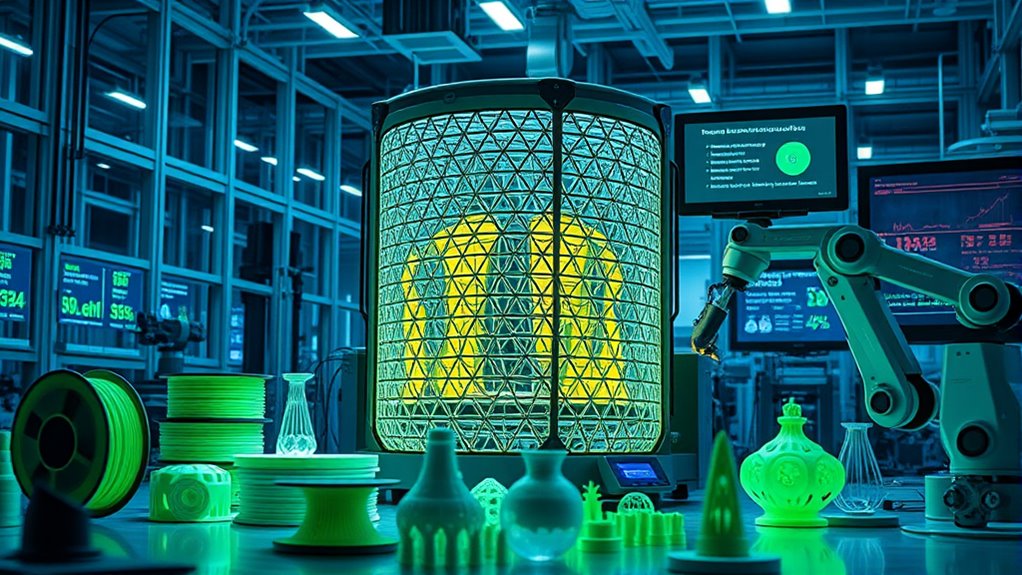
Did you know that next-generation manufacturing is shifting towards more sustainable practices by minimizing waste and reusing materials? You can now design with dissolvable supports that are recovered and reused, drastically reducing scrap. Eco-friendly, bio-based, and biodegradable materials are gaining popularity, helping cut the carbon footprint of your productions. Solar-powered large-format printers and AI-driven resource management optimize energy use, making your process more efficient. Recyclable and reprocessable resins support circular manufacturing models, ensuring materials stay in use longer. Advanced techniques enable you to create complex geometries with minimal waste, while embedded sensors track and adjust material flow in real time. Additionally, nanotechnology-enabled materials are beginning to revolutionize manufacturing, offering unprecedented strength and functionality with less material use. Incorporating sustainable manufacturing practices can further reduce environmental impact and promote resource conservation, aligning your projects with environmentally responsible goals. These innovations empower you to produce high-quality parts sustainably, aligning your manufacturing goals with environmental responsibility.
Large-Scale and On-Site Construction Printing Breakthroughs

Large-scale and on-site construction printing are transforming how projects are built by enabling rapid, automated fabrication directly at the job site. You’ll see massive printers laying down structures layer by layer, reducing construction time and labor costs. Here’s what’s happening:
- Speed: Large-format 3D printers can complete entire buildings or infrastructure components in days, not months.
- Customization: Complex designs and unique architectural features are easily integrated without molds or formwork.
- Sustainability: On-site printing reduces waste by using local materials like concrete mixes designed for 3D printing, cutting transportation emissions.
These breakthroughs make construction more efficient, flexible, and eco-friendly—revolutionizing how you build in the future.
Space-Age Manufacturing: Printing in Microgravity and Beyond

Printing in microgravity is revolutionizing space manufacturing by enabling the production of complex, high-quality components directly aboard spacecraft and space stations. This capability reduces reliance on Earth resupply missions and accelerates space exploration. Microgravity allows for the creation of intricate geometries and stronger, lighter parts, essential for spacecraft design. Technologies like in-situ resource utilization (ISRU) and advanced 3D printing systems are making this possible. You can now print tools, spare parts, and even structural elements on demand, minimizing delays. The table below highlights key applications and benefits:
| Application | Benefit |
|---|---|
| On-demand part production | Reduces resupply needs |
| Structural components | Lighter, stronger spacecraft parts |
| In-situ resource utilization | Uses local materials for printing |
| Medical device manufacturing | On-site, customized medical solutions |
| Space station maintenance | Cost-effective, rapid repairs |
Additionally, ongoing research into microgravity-specific manufacturing is paving the way for even more innovative applications and improved material properties.
Real-Time Monitoring and Automated Calibration for Flawless Prints

You can now rely on sensor-driven process control to monitor print conditions in real time, catching issues before they affect quality. Automated calibration algorithms use this data to adjust settings instantly, ensuring consistent precision throughout the process. With real-time error correction, your prints stay flawless, reducing waste and rework. Additionally, navigation and mapping techniques borrowed from household robots contribute to improved movement accuracy and obstacle avoidance during printing. Integrating smart home automation principles enables printers to optimize their operation based on environmental conditions and user preferences. Furthermore, implementing self‑diagnosis protocols allows 3D printers to detect and address potential faults proactively, enhancing reliability and safety. These advancements are supported by sensor integration, which provides comprehensive data to improve overall print performance, while automated maintenance features help keep printers running smoothly with minimal manual intervention.
Sensor-Driven Process Control
Real-time sensor-driven process control has transformed 3D printing by enabling continuous monitoring and immediate adjustments during production. You can now catch issues before they affect the final product, ensuring flawless prints every time. This system uses embedded sensors to track key parameters like temperature, material flow, and humidity. Here’s how it helps you:
- Detects deviations instantly – sensors flag irregularities, allowing quick intervention.
- Automates calibration – adjustments happen automatically, reducing manual effort.
- Improves consistency – maintaining *ideal* conditions results in higher-quality, repeatable outputs.
This technology minimizes defects, saves time, and cuts waste. You gain confidence in complex or large-scale projects, knowing your printer adapts on the fly for perfect results. Sensor-driven control is reshaping precision in 3D printing, making flawless production routine.
Automated Calibration Algorithms
Automated calibration algorithms build on sensor-driven process control by using real-time data to fine-tune printer settings without manual intervention. You’ll benefit from continuous adjustments that optimize bed leveling, extrusion rates, and temperature, ensuring perfect alignment and flow throughout the print. These algorithms analyze sensor inputs like thermal, positional, and flow data, detecting deviations instantly. When issues arise, they automatically recalibrate parameters, preventing defects before they occur. This dynamic process reduces the need for manual tweaks and reprints, saving time and materials. As a result, your prints achieve higher accuracy, surface quality, and structural integrity. In 2025 and beyond, automated calibration algorithms will become standard, empowering you to produce flawless, complex parts with minimal effort and maximum consistency. Additionally, real-time monitoring enables immediate detection and correction of issues, further enhancing print reliability.
Real-Time Error Correction
As 3D printing technology advances, continuous monitoring systems keep a close watch on every aspect of the process, instantly detecting deviations that could compromise print quality. You’ll benefit from real-time error correction that auto-adjusts parameters on the fly. Here’s how it works:
- Embedded sensors track temperature, humidity, and material flow, providing instant feedback.
- Advanced algorithms analyze sensor data to identify potential flaws before they escalate.
- Automated calibration systems make immediate adjustments, ensuring precision throughout the print.
- Connected systems enable seamless integration between hardware and software, enhancing overall reliability.
This seamless process minimizes errors, reduces waste, and cuts down on reprints. With real-time correction, you achieve flawless, high-quality prints consistently, even with complex designs or challenging materials. It’s a game-changer for efficiency and reliability in 3D printing.
Emerging Materials and Eco-Friendly Solutions Shaping the Industry

Emerging materials and eco-friendly solutions are transforming the 3D printing industry by offering sustainable alternatives and expanding the range of printable options. You now have access to bio-based, biodegradable, and recyclable materials that reduce environmental impact. Innovations include bio-resins, plant-based filaments, and recycled plastics, making your projects greener. Dissolvable supports and reprocessable resins help minimize waste and promote circular manufacturing. Additionally, solar-powered large-format printers and AI-enabled resource management optimize energy use, further lowering your carbon footprint. High-performance composites and high-entropy alloys improve strength and thermal resistance while reducing weight, especially for aerospace and automotive applications. These advancements empower you to create innovative, environmentally conscious products without compromising quality or functionality, shaping a more sustainable future for 3D printing.
Frequently Asked Questions
How Will AI Predict and Prevent Print Failures Before They Occur?
AI predicts and prevents print failures by analyzing real-time sensor data on temperature, humidity, and material flow. It detects anomalies early and adjusts printer settings automatically to maintain ideal conditions. Machine learning models forecast potential issues based on historical patterns, prompting preventative actions like calibration or pause commands. This proactive approach minimizes errors, reduces waste, and guarantees consistently high-quality prints, saving you time and resources.
What New Materials Are Expected to Revolutionize Multi-Material 3D Printing?
You’ll see new materials like bio-based, biodegradable polymers that cut environmental impact, high-entropy alloys offering better thermal resistance, and advanced composites with enhanced strength-to-weight ratios. Multi-material printers will seamlessly combine metals, high-performance plastics, and shape-shifting elastomers for complex, functional objects. These innovations will enable stronger, lighter, and more sustainable products, transforming industries from healthcare to aerospace by expanding what’s possible with multi-material 3D printing.
How Can Bioprinting Improve Organ Transplantation Success Rates?
You can see bioprinting transform organ transplants by creating patient-specific tissues that match perfectly, reducing rejection risks. As you harness AI-driven precision, the success rates climb, and complications decrease. Imagine printing complex vascular networks that ensure better blood flow, boosting graft longevity. With advances in bio-inks and microvascular structures, a future where transplants are faster, safer, and more successful becomes not just feasible, but inevitable.
What Are the Main Challenges in Scaling up Large-Format Construction Printers?
You face challenges like ensuring consistent material flow and adhesion, managing large printer calibration, and handling environmental factors like temperature and humidity. Scaling up requires robust hardware and precise control systems to prevent errors over bigger builds. Additionally, you need efficient supply chains for large materials and solutions for waste management. Overcoming these issues is key to making large-format construction printers reliable, cost-effective, and suitable for real-world infrastructure projects.
How Does Space-Based Bioprinting Differ From Earth-Based Methods?
Space-based bioprinting improves on Earth methods by leveraging microgravity, which enhances cell growth and tissue organization. You’ll find that this environment allows for more complex, vascularized tissues with a 35% higher success rate in grafts. Unlike Earth, where gravity complicates delicate structures, space enables precise layer-by-layer printing, making it ideal for creating advanced implants and organs, consequently expanding medical possibilities beyond what’s achievable on our planet.
Conclusion
As 3D printing continues to evolve, it’s like watching a blank canvas transform into endless masterpieces. With AI-driven precision, new materials, and groundbreaking applications in healthcare and space, you’re on the brink of a manufacturing revolution. Embrace these innovations, and you’ll see how the future of creation becomes as limitless as your imagination—turning dreams into reality, layer by layer. The future isn’t just near; it’s unfolding right before your eyes.