
TL;DR

Get the latest gadgets delivered free with Prime
- Fast, free delivery on millions of items
- Prime Video, Amazon Music and more included
- Member-only deals all year
Qblox says it has integrated NVIDIA DGX Spark with its quantum system controller using NVIDIA NVQLink, measuring round-trip latency below 7.2 microseconds on DGX Spark. The company says the setup can support GPU-assisted calibration and quantum error correction, but it has not disclosed independent test results or details of a deployed quantum system using the integration.
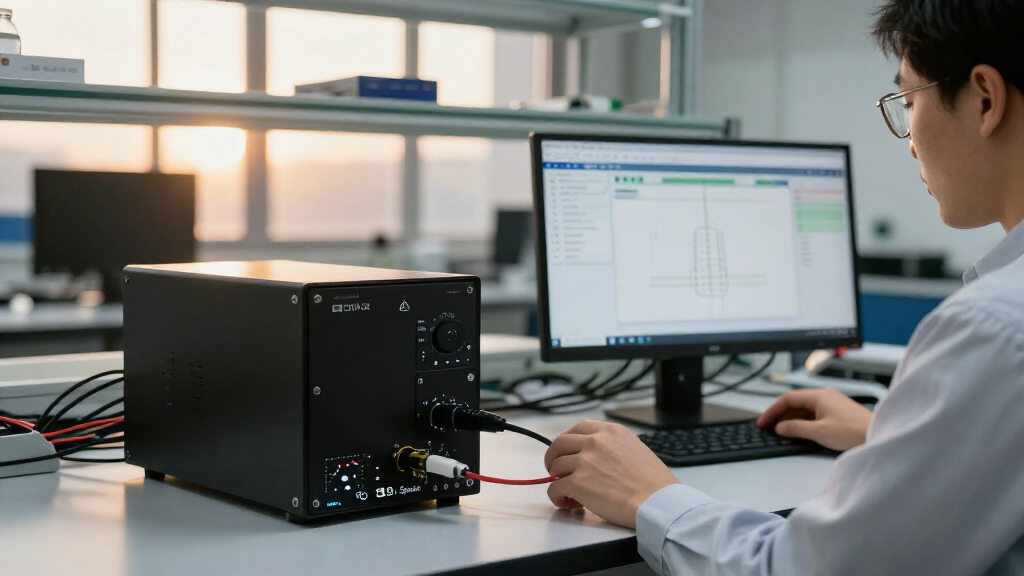
Qblox has connected NVIDIA’s DGX Spark computer to its quantum system controller using NVIDIA NVQLink, reporting round-trip latency below 7.2 microseconds on DGX Spark. The company says the integration links GPU computing with quantum control for real-time tasks such as calibration and error correction, although the announcement does not describe a customer deployment or independently verified results.
Qblox also reported round-trip latency below 4.0 microseconds using an NVIDIA RTX PRO 6000 Blackwell GPU. The company presented both figures as measured hardware performance from its integration, which connects the GPU to Qblox’s quantum system controller through NVQLink. It did not specify the full test setup, measurement method, workload, or whether the two results were obtained under directly comparable conditions.
The system combines Qblox’s Q1 sequence processors and LINQ with GPU computing. Qblox says this arrangement can bring GPU acceleration into the control loop: calibration routines could update qubit parameters while experiments are running, and syndrome data from quantum error-correction procedures could be sent to GPU-based decoders with low latency. These are described as supported workloads and intended capabilities; the announcement does not provide results from a particular calibration or error-correction experiment.
The integration uses NVIDIA CUDA-Q for development, with Qblox and NVIDIA describing a path from a desktop setup to GPU servers as quantum systems grow. NVIDIA characterizes DGX Spark as a desktop AI computer for quantum researchers. The companies say code developed on the system is designed to carry over to larger GPU infrastructure, but the announcement provides no migration benchmarks or details on compatibility across specific systems.
GPUs Enter the Quantum Control Loop
Quantum processors require classical equipment to send control signals, read measurements and respond to errors. Connecting a GPU to that system could let some computational work happen during an experiment rather than after it. That matters for proposed techniques such as in-run calibration and real-time error decoding, where delays can affect how quickly a system responds to changing conditions or detected errors.
The reported latency figures provide a concrete performance point for Qblox’s integration, rather than just an architectural description. However, latency alone does not establish that the system improves quantum-computing results, supports a particular number of qubits, or meets the demands of a practical error-correction workload. The announcement is a hardware integration milestone, not evidence that large-scale, fault-tolerant quantum computing has been achieved.
For researchers, a desktop development setup could lower the barrier to testing hybrid quantum-classical software before moving workloads to larger GPU servers. That potential depends on how faithfully the desktop environment reproduces the performance and software behavior of larger systems. Neither company supplied comparative cost, performance, or scaling data in the announcement.
Products Worth Considering

Apple iPad Air 13-inch (M4), 128GB, Wi-Fi 7, Space Gray

Sony WH-1000XM6 Wireless Noise-Canceling Over-Ear Headphones, Blue, Bundle

Bose QuietComfort Ultra Earbuds (2nd Gen), Deep Plum
As an affiliate, we earn on qualifying purchases.
From NVQLink Plans to Measured Hardware
The announcement follows earlier work between Qblox and NVIDIA. Qblox said its NVQLink work was announced in October 2025, followed by its support for the NVIDIA CUDA-Q real-time API in March 2026. The companies describe the October 2026 results as a move from an integration architecture to measured hardware performance.
NVQLink is the connection used here to link GPU computing with quantum control equipment. CUDA-Q is the software framework named for developing workloads across quantum and classical computing resources. In this announcement, the practical focus is on coordinating those resources with Qblox’s controller, rather than on a new quantum processor or a reported advance in qubit performance.
“Quantum computers will scale only as fast as the classical control systems around them.”
— Niels Bultink, Qblox CEO and co-founder
Test Conditions and Deployment Remain Open
The announcement does not detail how Qblox measured round-trip latency, what the term covers in the test, or which software and hardware configurations were used beyond naming the RTX PRO 6000 Blackwell and DGX Spark. It also does not say whether the results were independently checked or provide a comparison with alternative control systems.
Qblox and NVIDIA describe use cases including GPU-assisted calibration and quantum error correction, but have not identified a customer system running these workloads in production or published results from a specific quantum experiment. The number and type of qubits involved, the size of error-correction workloads, availability, pricing and support arrangements are also not given. The release does not establish that the desktop configuration can meet the requirements of every quantum-control task.
Evidence From Workload Testing
The next evidence to watch for is testing that reports the conditions behind the latency measurements and demonstrates performance on named workloads. Results from calibration during an experiment or GPU-based decoding of quantum error-correction data would help clarify how the integration performs beyond the connection itself.
Qblox and NVIDIA have not announced a release date, customer rollout, or a schedule for additional benchmarks. Their stated plan is to support development on DGX Spark and allow the same code to move to GPU servers as quantum systems scale. Whether that workflow works across larger systems, and what performance it delivers, remains to be shown.
Key Questions
What did Qblox announce?
Qblox said it integrated NVIDIA DGX Spark with its quantum system controller using NVQLink, and reported round-trip latency below 7.2 microseconds on DGX Spark.
What latency did Qblox report on the RTX PRO 6000 Blackwell?
Qblox reported round-trip latency below 4.0 microseconds on an NVIDIA RTX PRO 6000 Blackwell. The announcement does not provide enough test detail to compare that result directly with the DGX Spark measurement.
What could the integration be used for?
Qblox says the GPU link can support real-time hybrid workloads, including calibration that updates qubit parameters during experiments and GPU-based decoding of quantum error-correction data. The release does not report results from a specific experiment using those functions.
Has Qblox shown that the system improves quantum-computing performance?
Not in the information provided. The announcement reports latency measurements and describes intended capabilities, but does not give data showing improved quantum results, a production deployment, or performance at a stated qubit scale.
Can researchers move code from DGX Spark to larger GPU systems?
Qblox and NVIDIA say the same code is designed to carry from desktop development to GPU servers as systems grow. The announcement does not include migration benchmarks or specify which larger configurations have been tested.
Source: rss