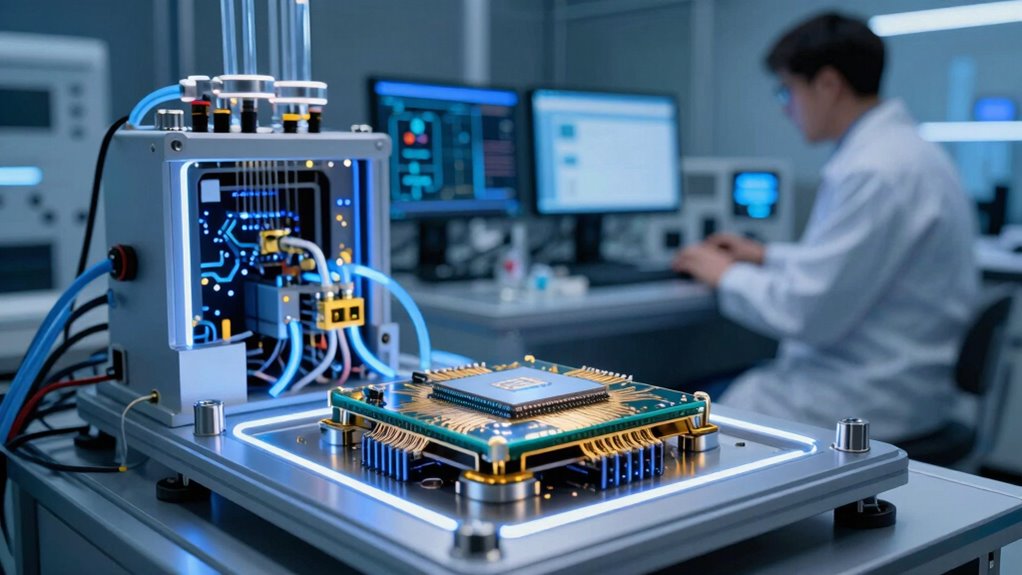

Quantum computing uses qubits that can be in multiple states at once, thanks to superposition and entanglement, making it powerful for specific tasks like cryptography and materials science. However, it’s still fragile, costly, and difficult to scale, so major changes in everyday technology are unlikely soon. Classical computers will handle most tasks for now. Keep exploring to discover how this exciting technology might evolve and influence the future.

Get the latest gadgets delivered free with Prime
- Fast, free delivery on millions of items
- Prime Video, Amazon Music and more included
- Member-only deals all year
Key Takeaways
- Quantum computing will not replace classical computers for everyday tasks anytime soon.
- It is likely to revolutionize specific fields like cryptography and material science first.
- Practical, large-scale quantum systems remain limited by technical challenges such as decoherence.
- Quantum computing’s impact will be gradual, serving as a specialized tool rather than a general-purpose replacement.
- Significant breakthroughs are needed before quantum technology can be widely applied outside research.

Have you ever wondered how computers could solve complex problems faster than ever before? That’s the promise of quantum computing, a revolutionary approach that leverages the strange laws of quantum mechanics. Unlike classical computers that use bits as ones or zeros, quantum computers use quantum bits or qubits, which can exist in multiple states simultaneously thanks to superposition principles. This means that, in theory, quantum computers can process a vast number of possibilities at once, making them incredibly powerful for specific tasks like cryptography, optimization, and simulating molecular interactions.
Quantum entanglement is another key concept behind quantum computing. When qubits become entangled, their states become interconnected in such a way that measuring one instantly reveals information about the other, regardless of distance. This phenomenon enables quantum algorithms to perform complex calculations more efficiently than classical ones. While superposition principles allow qubits to be in many states simultaneously, entanglement links those states in a way that amplifies computational power. These principles together form the foundation of what makes quantum computing so promising, although they also introduce significant technical challenges. In addition, understanding how to maintain the stability of entangled states is crucial for advancing the field.
Entanglement links qubit states, boosting quantum computing’s power but also adding technical challenges.
Despite its potential, quantum computing isn’t likely to overhaul everyday technology anytime soon. Most current quantum systems are still experimental and fragile, easily disturbed by environmental noise—a problem known as decoherence. Maintaining qubits in their delicate superposition states requires extremely low temperatures and precise control, which makes scaling up these systems a formidable task. For now, quantum computers are mostly used for research and specialized applications rather than general-purpose computing. Additionally, the current hardware limitations mean that quantum error correction remains a major hurdle to practical implementation. Understanding these quantum hardware challenges is essential for appreciating the future trajectory of this technology. Furthermore, ongoing research into quantum stability aims to address these issues and improve the reliability of future quantum devices. As the field advances, innovations in quantum materials may also play a role in overcoming some of these obstacles.
What quantum computing is not likely to change soon is the way your everyday laptop or smartphone operates. Classical computers will continue to handle most tasks, from browsing the internet to running applications, because they’re more reliable, accessible, and cost-effective. Quantum computers excel at specific problems that involve complex calculations or vast data sets, but they aren’t replacing traditional computers for general use. Instead, they’re seen as powerful tools for particular niches, like cryptography or materials science, once the technology matures.
As an affiliate, we earn on qualifying purchases.
Frequently Asked Questions
Will Quantum Computers Replace Classical Computers Entirely?
No, quantum computers won’t replace classical ones entirely anytime soon. You’ll still rely on classical computers for everyday tasks. Quantum entanglement and Qubit stability are key challenges, making it tough for quantum tech to handle general computing reliably. Instead, quantum computers will complement classical ones, tackling specific problems like complex simulations or cryptography. You’ll see a hybrid approach, where each type does what it does best.
How Affordable Will Quantum Computing Become in the Next Decade?
Imagine a future where quantum computing becomes as common as your smartphone—that’s what’s possible with ongoing quantum hardware advancements. In the next decade, costs will drop markedly thanks to innovations and increased demand, making quantum tech more affordable. As cost reduction accelerates, more industries will access quantum power, transforming everything from cryptography to drug discovery. You’ll likely see quantum computing shift from exclusive to everyday, just like classical computers did.
Can Quantum Computers Solve All Complex Problems Instantly?
Quantum computers can’t solve all complex problems instantly. They rely on quantum algorithms to tackle specific tasks efficiently, but hardware limitations, like qubit stability and error rates, restrict their capabilities. While they excel at certain problems, many others still require classical computers. Overcoming hardware challenges will be essential for quantum computing to reach its full potential, but instant solutions for all complex problems remain unlikely in the near future.
What Industries Will Benefit Most From Quantum Computing Soon?
You’ll see industries like pharmaceuticals, finance, and logistics benefit most soon, as they seek quantum advantage. These sectors can revolutionize drug discovery, optimize complex financial models, and improve supply chain efficiency. Quantum computing’s industry impact will accelerate problem-solving and innovation, giving early adopters a competitive edge. While widespread use remains years away, these fields are poised to experience significant changes as quantum technology matures.
Are Quantum Computers Secure Against Hacking?
Quantum computers aren’t yet secure against hacking. They threaten cryptography vulnerabilities, making sensitive data more susceptible to sophisticated security breaches. While quantum tech can challenge traditional encryption, robust post-quantum cryptography is evolving to counteract these challenges. You need to stay vigilant, as this rapid technological revolution could soon shift the security landscape, turning current protections into potential pitfalls if you don’t adapt.
quantum computer simulation software
As an affiliate, we earn on qualifying purchases.
As an affiliate, we earn on qualifying purchases.
Conclusion
As you stand at the edge of the quantum frontier, remember that this groundbreaking technology is like a mighty river, flowing with potential but still carving its course. While it promises to reshape our world, it’s not an overnight voyage. Patience and persistence are your oars, guiding you through the swirling currents of discovery. Keep your eyes on the horizon—big changes are coming, but they’ll arrive like the dawn, slow and steady yet bright with promise.
quantum entanglement educational kit
As an affiliate, we earn on qualifying purchases.
As an affiliate, we earn on qualifying purchases.
As an affiliate, we earn on qualifying purchases.
Halloween Picks
halloween
As an affiliate, we earn on qualifying purchases.