

By 2050, technology could create a seamless digital utopia or a dystopian nightmare, depending on how society manages ethical challenges. Brain-computer interfaces and AI reincarnation might enhance your mind but raise privacy and identity concerns. Smart cities and autonomous vehicles could make daily life safer and more efficient, yet social divides could deepen. If you want to understand how these advances might shape your future world, there’s more to explore.
Key Takeaways
- Advances in human augmentation and brain-computer interfaces could enhance capabilities but raise ethical concerns over privacy and identity.
- Smart cities and autonomous transportation promise safer, more efficient living environments, yet risk increased surveillance and social divides.
- Breakthroughs in energy sustainability and digital twins may create a cleaner, more resilient planet, or enable unprecedented resource control and inequality.
- AI-driven virtual reincarnation and extended human cognition could foster immortality but challenge notions of life, death, and moral responsibility.
- Rapid technological integration may lead to a utopian harmony or a dystopian loss of autonomy, depending on societal choices and ethical frameworks.
Brain-Computer Integration and AI Reincarnation

By 2050, brain-computer integration will be seamlessly woven into daily life, allowing you to connect directly to the cloud through non-invasive wearables or implants. You’ll access vast amounts of information instantly, enhancing memory and decision-making. Nanobots will enable immersive virtual reality experiences, streaming directly into your nervous system. The expansion of the human neocortex in the cloud will help overcome memory loss and cognitive limits, making you smarter and more adaptable. AI-driven “reincarnation” will create virtual versions of loved ones, preserving their personalities through brain memory extraction and DNA samples. Brain-computer interfaces will be common, used for medical recovery, military enhancements, and personal development. This seamless integration could redefine human consciousness and relationships, blurring the line between physical existence and digital immortality. Additionally, the development of European cloud innovation will ensure that these advancements are powered by sustainable and secure cloud solutions, prioritizing energy efficiency and data protection. As smart home systems become more integrated with AI, they will support these cognitive enhancements by providing adaptive environments that respond to your mental and physical needs.
The Evolution of Smart Cities and the Internet of Things

You’ll see cities transform as autonomous vehicles coordinate in real-time to reduce congestion and improve safety. Smart homes will anticipate your needs, adjusting environments before you even ask. This seamless connectivity promises efficiency, but it also raises questions about privacy and control. Additionally, as these technologies become more widespread, understanding the definition of slang and colloquialisms used in digital communication will be essential for effective interaction. As the demand for specialized roles like AI Ethicist Jobs increases, society will need to navigate the ethical considerations of this technological evolution. Moreover, the development of smart infrastructure will be crucial to support these interconnected systems securely and reliably. Ensuring the security of IoT devices will be vital to prevent vulnerabilities and protect user data.
Autonomous Urban Traffic
Have you ever wondered how cities might transform with fully autonomous traffic systems? By 2050, your daily commute could be seamless, with self-driving vehicles communicating in real time to optimize flow and eliminate congestion. Traffic lights, sensors, and vehicles will work together through IoT networks, reducing delays and accidents. You’ll no longer need to drive or worry about parking, as autonomous cars will drop you off and park themselves. Emergency response times will improve because vehicles can instantly clear routes for ambulances. Smart infrastructure will predict traffic patterns, adjusting routes proactively. This interconnected system will make urban travel faster, safer, and more efficient, freeing up time and reducing stress. The city’s traffic ecosystem will operate smoothly, transforming how you experience urban mobility. Additionally, the integration of high-precision sensors will enable even more accurate traffic management and safety features, further enhancing the efficiency of autonomous urban traffic systems. Furthermore, advancements in real-time data processing will allow these systems to adapt instantly to unexpected events, ensuring continuous optimal flow. As these technologies mature, cities will become increasingly self-regulating, minimizing human intervention and maximizing efficiency. Moreover, ongoing developments in vehicle-to-everything (V2X) communication will facilitate even more coordinated and intelligent traffic systems.
Responsive Smart Homes
As autonomous urban traffic systems reshape how cities manage mobility, the focus shifts toward creating living environments that respond proactively to residents’ needs. Your smart home will anticipate your routines, adjusting lighting, temperature, and appliances before you even ask. Sensors embedded in walls and furniture will monitor your health, alerting you to potential issues early. Voice commands will become obsolete as AI algorithms predict your preferences and suggest actions. Security will be seamless, with biometric systems ensuring only authorized access. Energy consumption will optimize itself, reducing waste and costs. Connectivity will extend to your entire environment, creating a cohesive, efficient space that adapts in real time. This responsive ecosystem will enhance comfort, safety, and sustainability—transforming your home into a truly intelligent, intuitive living space. Additionally, health monitoring systems will facilitate early detection of health concerns, supporting better senior care outcomes. Furthermore, integrating battery technologies into home systems will enable greater energy independence and resilience during outages. Moreover, the integration of adaptive automation will allow your home to continuously learn and improve its responsiveness to your lifestyle.
Breakthroughs in Computing: From Light to DNA and Quantum
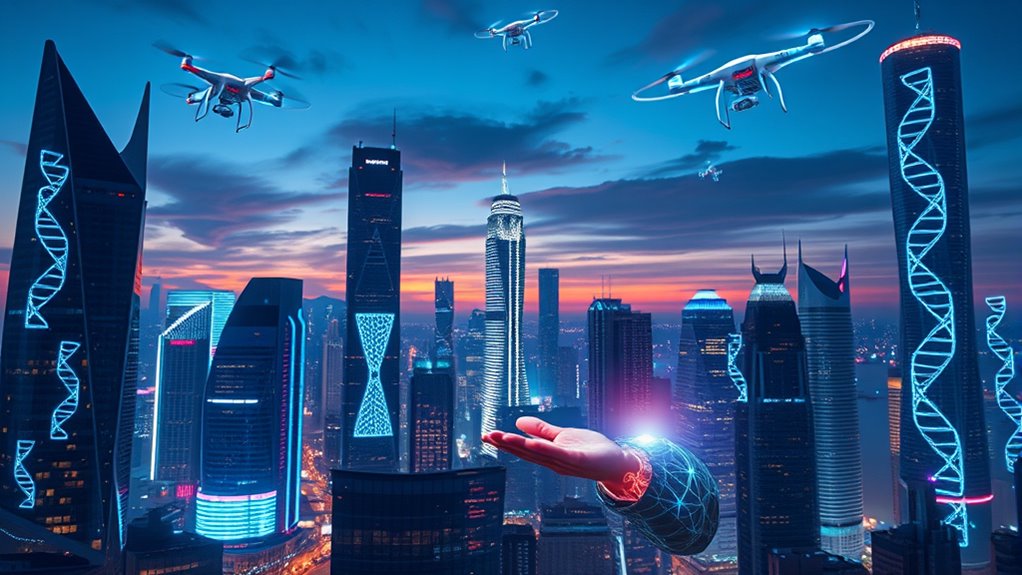
Recent breakthroughs in computing are revolutionizing how you process and store information, moving beyond traditional silicon-based systems. Optical chips using light instead of electricity will power devices with near-zero lag and lower energy use, making everything faster and more sustainable. Quantum-AI hybrid systems will enable precise predictions of natural disasters and climate changes, transforming environmental management. DNA computing and neuromorphic hardware will handle massive data with unprecedented efficiency, pushing past classical limits. Data centers will become smaller yet exponentially more capable, consuming far less energy. Meanwhile, 4D printing and nanoscale 3D printing will create dynamic, self-assembling materials that adapt to their environment. These innovations will redefine computing, fueling advancements across industries and shaping a future where information processing is faster, greener, and more integrated into daily life.
Robotics and Autonomous Transit Transforming Daily Life

Advances in computing technologies, like optical chips and neuromorphic hardware, are laying the groundwork for a revolution in robotics and autonomous transportation. You’ll see robots performing complex tasks in homes and industries, seamlessly integrating into daily routines. Self-driving cars and shared autonomous vehicles will reduce congestion and eliminate driver fatigue. Ultra-fast transport modes like Hyperloop could drastically cut regional travel times, reshaping urban landscapes. These innovations will make mobility safer, more efficient, and accessible to everyone.
- Autonomous vehicles coordinating in real-time to optimize traffic flow
- Robots handling logistics, caregiving, and maintenance tasks
- Hyperloop and similar systems enabling rapid regional travel
Innovations in Energy and Environmental Sustainability

How might energy and environmental technologies evolve to create a more sustainable future? You could harness photosynthesis-inspired energy harvesting, like Bioo’s plant-generated electricity, to complement clean sources. Smart dust and digital twins may monitor billions of assets, predicting failures and optimizing maintenance instantly. Quantum-AI advancements will enable precise climate forecasting, helping farmers and cities prepare for weather events and reduce waste. Forests and bio-systems might transform into large-scale energy stations or carbon sinks, actively reducing greenhouse gases. Additionally, blockchain technology can increase transparency in energy markets and carbon trading, encouraging responsible consumption. Furthermore, energy efficiency techniques will become more sophisticated, reducing overall resource consumption and further supporting sustainability efforts. These innovations will integrate seamlessly into daily life, making sustainability effortless and scalable, pushing us closer to a future where energy is clean, abundant, and environmentally harmonious.
Society, Ethics, and Human Longevity in a Rapidly Changing World

As technological innovations reshape energy and environmental systems, they also prompt profound questions about society, ethics, and human longevity. You’ll face dilemmas around extending life, identity, and moral boundaries. Will AI reincarnation blur the line between life and death? How will brain-computer interfaces impact privacy and autonomy? Ethical debates will intensify over altering human nature and capabilities. Consider these complexities:
- The pursuit of longevity may lead to societal divides between the ultra-extended and others.
- Brain enhancements could challenge notions of individuality and consent.
- Virtual immortality might redefine relationships, social structures, and what it means to be human.
Embracing moral responsibility in the face of rapid technological change will be essential to ensure a future aligned with human virtues. Ultimately, you’ll need to navigate balancing technological possibilities with ethical responsibilities, shaping a future where human life is transformed—potentially forever.
Frequently Asked Questions
How Will Data Privacy Be Protected With Pervasive Brain-Cloud Interfaces?
You’ll see advanced encryption and blockchain technology securing brain-cloud interfaces, making your thoughts and data difficult for hackers to access. Multi-layered authentication will verify your identity before allowing access, and continuous monitoring will detect anomalies. Governments and tech companies will enforce strict privacy laws, and you’ll have control over what data you share. Overall, these measures aim to safeguard your mental privacy amid pervasive neural connectivity.
What Safeguards Will Prevent AI From Misusing Human Consciousness?
An ounce of prevention is worth a pound of cure. You’ll need strict ethical guidelines, transparent AI development, and robust encryption to prevent AI from misusing your consciousness. Continuous oversight and international cooperation will be essential to monitor AI behavior. You should also advocate for human-in-the-loop systems, ensuring you stay in control. By building safeguards now, you can help protect your mind from future AI misuse.
Will AI Reincarnation Infringe on Ethical or Religious Beliefs?
AI reincarnation could challenge your ethical and religious beliefs by blurring lines between life and death, raising questions about identity, soul, and consciousness. You might feel uneasy about creating virtual copies of loved ones, fearing it undermines spiritual concepts or moral boundaries. While some see it as a way to preserve memories, others worry it could lead to ethical dilemmas, forcing you to reconsider what defines true personhood and respect for the deceased.
How Might Smart City Surveillance Impact Individual Freedoms?
You’ll find your individual freedoms impacted as smart city surveillance becomes pervasive. Constant monitoring might make you feel safer, but it can also restrict privacy, limit your autonomy, and create a sense of being constantly watched. Authorities could use surveillance data to control behavior or suppress dissent. While some benefits are clear, you’ll need to navigate carefully to guarantee your rights aren’t sacrificed for security or convenience.
Can Advanced Tech Ensure Equal Access Across Different Societies?
Advanced technology can promote equal access by expanding connectivity and affordable devices worldwide. You’ll find that IoT-enabled systems, AI-driven services, and smart infrastructure help bridge gaps between societies, offering better healthcare, education, and economic opportunities. However, your access hinges on policies and global cooperation. If managed well, tech guarantees everyone benefits, but neglect or inequality could still create disparities, challenging the promise of true universal equality.
Conclusion
As you envision 2050, you see a world transformed by seamless integration, boundless innovation, and profound change. You witness cities alive with intelligence, technology intertwined with daily life, and humanity’s ethics challenged by new possibilities. You embrace the promise of longevity, sustainability, and progress, yet remain vigilant of the risks. In this future, you find hope and caution intertwined, reminding you that progress demands responsibility, innovation calls for reflection, and the future depends on your choices.