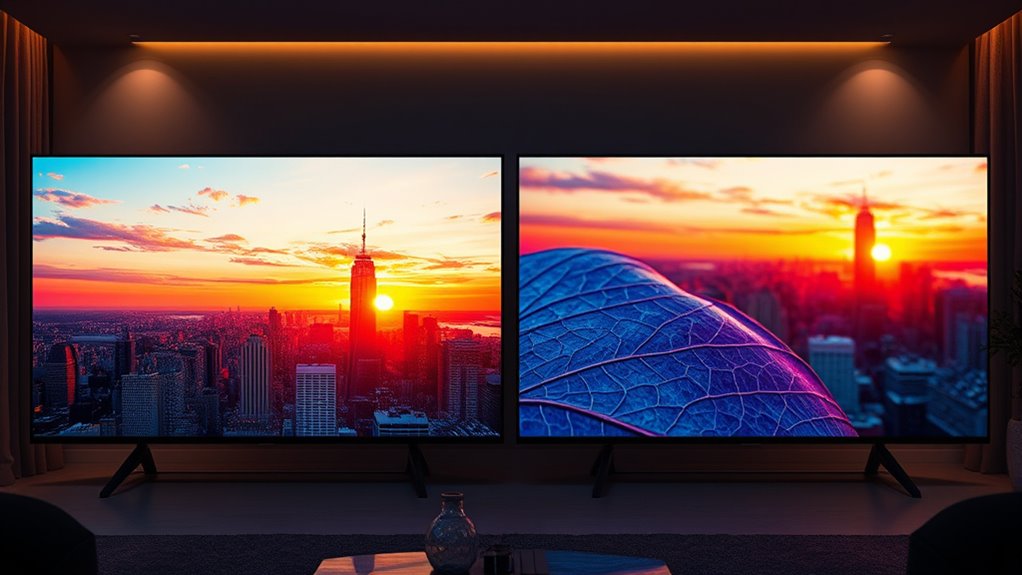

The human eye has limits when it comes to perceiving the difference between 4K and 8K TVs. If you sit at a normal distance and your screen isn’t very large, you probably won’t notice much difference in clarity or detail. Higher resolutions matter most for very large screens or if you sit close. Want to discover how your viewing setup might influence what you see? Keep exploring to find out more.

Get the latest gadgets delivered free — and shop member deals
- Fast, free delivery on millions of items
- Access to Prime Big Deal Days deals on October 6–7
- Prime Video, Amazon Music and more included
Key Takeaways
- Higher resolutions like 8K offer sharper images, but the difference depends on screen size, viewing distance, and content quality.
- Visual acuity limits how much detail your eyes can perceive, especially at typical viewing distances.
- Most viewers may not notice significant differences between 4K and 8K unless seated very close or viewing on a large screen.
- Content quality and source material are crucial; poor-quality content diminishes the benefits of higher resolution.
- Cost, available content, and viewing conditions often make 4K a more practical choice for most consumers.
Understanding the Resolution Difference: 4K Vs 8K

Have you ever wondered how 4K and 8K TVs differ in clarity? The main difference lies in resolution. 4K TVs have a resolution of 3840 x 2160 pixels, offering about 8.3 million pixels. In contrast, 8K TVs double that resolution to 7680 x 4320 pixels, with roughly 33.2 million pixels. This means 8K screens pack four times the pixel density of 4K displays. Higher resolution translates into sharper images, more detail, and better clarity, especially on larger screens. However, the benefits depend heavily on content quality and viewing distance. If you’re sitting close or watching highly detailed footage, 8K can provide a noticeable improvement. But for most typical viewing scenarios, the difference might not be immediately obvious. Additionally, resolution impact plays a significant role in how noticeable these differences are in real-world viewing experiences. It’s also worth noting that display technology continues to evolve, potentially enhancing perceived differences beyond just resolution.
How Human Vision Perceives Detail and Clarity

Understanding how human vision perceives detail and clarity is essential to grasping the benefits of higher-resolution TVs. Your eyes detect fine details through a small central area called the fovea, where visual acuity is highest. As you view an image, your brain combines information from your eyes to create a sharp, clear picture. However, there’s a limit to what your eyes can distinguish; beyond a certain point, increased resolution offers diminishing returns. Factors like your viewing distance and screen size influence how much detail you actually perceive. When you sit close enough or have a large screen, higher resolutions can make a noticeable difference. But if you’re farther away, your eyes may not detect the additional detail that 8K offers over 4K. Additionally, electric dirt bikes have become a popular choice for outdoor enthusiasts seeking powerful yet eco-friendly transportation options. Recognizing the limitations of human vision helps consumers make informed decisions about whether investing in higher-resolution TVs is worthwhile for their viewing experience. For example, the visual acuity of an average person determines how clearly they can distinguish fine details at various distances. Moreover, advancements in display technology continue to push the boundaries of what is perceptible to the human eye.
Screen Size and Viewing Distance: Their Impact on Perception

The size of your screen and how close you sit to it greatly influence the level of detail you perceive. When you sit closer, your eyes can pick up more pixels, making even lower-resolution screens appear sharper. Larger screens demand more distance to maintain clarity; sitting too close can cause pixelation or a pixelated “screen door” effect. For 4K and 8K TVs, a bigger screen benefits from increased viewing distance, allowing you to enjoy the extra detail without noticing individual pixels. Conversely, if you sit too far, the resolution difference becomes less noticeable, regardless of screen size. Adjusting your seating position ensures you maximize the benefits of higher resolutions without sacrificing image sharpness or immersion. Proper distance is key to perceiving the full quality of your TV. Additionally, understanding the resolution capabilities helps you choose the right size and placement for an optimal viewing experience. Being aware of visual acuity can also influence how much detail you can perceive at different distances.
The Role of Content Quality and Source Material

High-quality content and source material are essential for experiencing the full potential of 4K and 8K TVs. If your content is blurry, pixelated, or poorly encoded, even the sharpest display won’t make a difference. To truly appreciate the resolution, focus on sources that are native 4K or 8K, with high bitrates and proper formatting. Streaming services, Blu-ray discs, and professional content often provide better quality than compressed online videos. Keep in mind that the clarity of the image depends heavily on the original material’s quality. Additionally, understanding affiliate disclosure and content source transparency can help you make informed choices about where your content originates from. Recognizing the importance of content quality is crucial, as even the best display cannot compensate for subpar source material. For example, a net worth of TV content providers can influence the overall streaming quality and availability of high-resolution options. Furthermore, ensuring that your source material is native 4K or 8K is vital for experiencing true high resolution. The compression techniques used during streaming can also significantly impact image clarity, regardless of resolution.
Technological Challenges in Display Manufacturing

Manufacturing advanced 4K and 8K displays presents significant technological challenges that impact production efficiency and cost. Producing these high-resolution screens requires extremely precise pixel alignment and uniformity, which pushes the limits of current manufacturing techniques. Developing ultra-fine pixel structures demands advanced materials and meticulous processes to prevent defects and ensure durability. Additionally, creating large panels with consistent quality involves complex layering and calibration, increasing complexity and expense. Managing heat dissipation and power consumption at these resolutions also poses challenges, as higher pixel counts generate more heat and require more efficient components. Overall, these hurdles drive up manufacturing costs and make large-scale production more difficult, which can delay rollout and increase the prices you see in stores.
Real-World Viewing Experiences and User Feedback

You’ll notice how your viewing environment affects the clarity and detail of 4K and 8K TVs. Many users report that lighting, room size, and seating distance influence how sharp images appear. Perceived visual quality varies, making real-world experiences essential to understanding the differences. Additionally, understanding image resolution can help set realistic expectations for what these TVs can deliver in various settings. Considering factors like visual perception can further clarify why some viewers notice differences more than others. Recognizing how display technology interacts with ambient conditions can also impact perceived image quality and overall viewing satisfaction. The choice of display type can significantly alter how image clarity is perceived in different environments.
Viewing Environment Impact
While 8K TVs offer higher resolution, their real-world viewing experience depends heavily on your environment. Factors like room size, lighting, and seating distance influence how noticeable the differences are. If your room is small or brightly lit, you might not see much benefit from the extra pixels. Proper placement and controlled lighting can enhance sharpness and color accuracy, making the upgrade worthwhile. Keep in mind, even with an 8K TV, sitting too close or too far can diminish visual quality. To optimize your experience, adjusting viewing conditions such as ambient light and seating position is essential. Position your seating at an appropriate distance from the screen. Control ambient lighting to reduce glare and reflections. Use a high-quality viewing angle for consistent picture quality. Considering visual acuity can help you determine if the higher resolution will make a noticeable difference for your eyes. Adjusting these elements helps you get the most out of your TV, regardless of resolution.
Perceived Visual Clarity
Although 8K TVs boast higher pixel counts, many viewers find that the perceived improvement in clarity varies based on real-world conditions. If you’re sitting at a typical viewing distance, the difference between 4K and 8K may be subtle. Your eyes might not notice a significant boost in sharpness unless you’re very close to the screen or viewing on a large display. User feedback often highlights that image quality depends heavily on content resolution, source quality, and lighting conditions. In everyday situations, the extra pixels of an 8K TV might not translate to a noticeable difference. Ultimately, your perception of clarity depends on how close you sit, what you watch, and your visual acuity. Many find 4K perfectly sufficient for an immersive experience without the premium cost of 8K. Additionally, connected technology in modern TVs enhances overall viewing quality, making incremental pixel improvements less critical for most users.
Cost Considerations and Value for Money

You’ll want to think about the significant price difference between 4K and 8K TVs and whether the extra cost fits your budget. Think about whether the higher resolution offers enough long-term value to justify the investment. If budget is a concern, there are more affordable options that still deliver great picture quality. Additionally, considering reliable display options can help ensure you make a smart and satisfying purchase. It’s also worth noting that visual perception varies from person to person, so some viewers may not notice a clear difference in resolution. Moreover, understanding display technology can assist in choosing a TV that best suits your viewing preferences and environment, especially as advancements in smart home integration continue to enhance overall entertainment experiences.
Price Gap and Affordability
The price difference between 4K and 8K TVs is significant, making affordability a key factor for most buyers. 8K models tend to cost at least double, sometimes more, than their 4K counterparts. This gap can strain your budget, especially since 8K TVs are still relatively new and less common. You’ll pay a premium for the higher resolution, even though content options are limited. To make an informed choice, consider these points:
- 4K TVs generally offer better value for your money today.
- 8K models might be a luxury purchase, better suited for early adopters.
- The price gap is likely to decrease over time as technology becomes more mainstream.
Long-Term Investment Value
While 8K TVs come with a hefty price tag today, considering their long-term value involves more than just initial costs. You should evaluate whether the extra investment offers future-proofing, better durability, or enhanced features that last. 8K TVs may retain their relevance longer as content and technology improve, potentially increasing resale value. However, if most content remains in 4K, the benefit might not justify the cost now. Here’s a quick comparison:
| Aspect | 4K TV | 8K TV | Long-Term Perspective |
|---|---|---|---|
| Initial Cost | Lower | Higher | Higher upfront, possibly better for future-proofing |
| Content Availability | Widely available | Limited, growing slowly | Less immediate value |
| Durability & Longevity | Good | Potentially longer-lasting | Depends on build quality |
| Resale Value | Moderate | Potentially higher | May retain value longer |
| Future Compatibility | Good | Better, more future-proof | Likely to stay relevant longer |
Budget-Friendly Alternatives
If you’re aiming to enjoy quality visuals without breaking the bank, exploring budget-friendly alternatives to 8K and 4K TVs can offer excellent value for money. You don’t need to spend a fortune to get a decent viewing experience. Look for models with high refresh rates, good color accuracy, and smart features that fit your needs. Sometimes, mid-range 4K TVs from reputable brands provide great picture quality at a lower price point. Additionally, consider purchasing slightly older models, which often drop in price when new versions arrive. This way, you get solid performance without overspending. Remember, a higher resolution isn’t always necessary for an enjoyable experience, especially if your budget is limited.
- Mid-range 4K TVs from reputable brands
- Slightly older or previous-generation models
- TVs with strong smart features and good color accuracy
Future-Proofing: Is 8K a Wise Investment?

As technology advances rapidly, investing in an 8K TV might seem like a way to future-proof your entertainment setup. However, consider whether 8K content is widely available now or in the near future. While an 8K TV can handle higher resolutions and potentially stay relevant longer, it may be overkill for current streaming services and broadcasts. Additionally, prices for 8K models are still relatively high, and the technology isn’t yet fully mainstream. If you’re looking for a device that will remain useful for years, weigh whether the extra cost aligns with your viewing habits. Sometimes, opting for a top-tier 4K TV offers better value, especially since content and technology are still evolving. Think about your long-term needs before making a leap.
The Limitations of the Human Eye in High-Resolution Viewing

The human eye has a limited ability to distinguish fine details, which means that beyond a certain resolution, increasing pixels offers diminishing returns. Your eyes can only process so much detail at a given distance, so cramming in more pixels doesn’t always translate to a clearer picture. Factors like screen size, viewing distance, and visual acuity affect what you can perceive. As resolution climbs, the difference becomes less noticeable unless you sit very close or have exceptional eyesight. Recognizing these limits helps you avoid overspending on higher resolutions that won’t enhance your viewing experience.
- Your ability to see detail depends on how far you sit from the screen
- Higher resolutions might be unnecessary for typical viewing distances
- Visual acuity varies, influencing perception of ultra-high resolutions
Making the Right Choice: Factors to Consider When Upgrading

When considering an upgrade to your TV, it’s essential to evaluate several key factors to guarantee you make the right choice. First, assess your viewing environment—large screens benefit from higher resolutions, but room size and seating distance matter. Think about your budget; 8K TVs tend to be more expensive, so determine if the extra detail justifies the cost. Compatibility is also paramount—ensure your existing devices and streaming services support 4K or 8K content. Consider future-proofing; investing in a higher-resolution TV may save you from upgrading again soon. Finally, evaluate content availability—while 8K content is growing, most shows and movies are still in 4K. Balancing these factors ensures you select a TV that fits your needs, preferences, and viewing habits.
Frequently Asked Questions
Can 8K TVS Display True 8K Content Consistently?
Yes, 8K TVs can display true 8K content consistently, but it’s rare to find native 8K sources. Most content you see will be upscaled from lower resolutions, which can improve detail but doesn’t match true 8K quality. To experience the full benefits, you’ll need genuine 8K videos or streams, but keep in mind that current mainstream content is still limited, so your viewing experience may not fully showcase 8K’s potential yet.
Do High-Resolution TVS Lead to Increased Eye Strain?
Imagine your eyes as delicate tools—when faced with high-resolution TVs, they might strain like overworked muscles. Yes, you could experience increased eye strain, especially if you sit too close or view for long periods. Higher resolution can sharpen images, but it also demands more from your eyes. To prevent discomfort, take regular breaks, adjust brightness, and maintain proper distance, ensuring your viewing experience remains comfortable.
How Does Ambient Lighting Affect Perceived Picture Quality?
Ambient lighting markedly influences how you perceive picture quality. Bright rooms can wash out images, reducing contrast and making colors less vibrant, while dim lighting enhances contrast and detail. To enjoy ideal picture quality, you should adjust your room’s lighting to be softer and indirect. Avoid glare and reflections on your screen, which can distort colors and details, and create a more immersive viewing experience.
Are There Any Health Risks Associated With Ultra-High Resolution Screens?
There are no significant health risks directly linked to ultra-high resolution screens. However, prolonged viewing can cause eye strain, dryness, or headaches, especially if you don’t take regular breaks or if the brightness and contrast are too high. To protect your eyes, follow the 20-20-20 rule, adjust your screen settings, and maintain proper distance. Your eyes won’t be harmed by higher resolutions alone.
Will Future Streaming Services Support 8K Content Widely?
Will streaming services soon support stunning 8K content? Certainly, streaming services are steadily stepping toward supporting super-sharp 8K streams. As technology advances and bandwidths broaden, you’ll likely see more providers pushing past 4K to deliver dazzling, detailed displays. However, widespread 8K streaming still depends on infrastructure improvements, device affordability, and content creation. So, while it’s on the horizon, don’t expect 8K everywhere overnight—be patient and prepare to upgrade.
Conclusion
Choosing between 4K and 8K is like selecting a painting for a grand gallery—you might admire every brushstroke up close, but from a distance, the details blur into harmony. Your eyes are the discerning curator, determining if the extra pixels truly add depth or simply fill space. Ultimately, the right choice depends on your space, content, and expectations. Remember, sometimes less is more, and clarity comes not just from resolution but from the experience you seek.
Fall Picks
fall essentials
As an affiliate, we earn on qualifying purchases.