For Ethernet audio, my first choice depends on whether you need to monitor Dante audio, put several analog sources on a network, or record microphones at the network edge. The Focusrite RedNet X2P is the most complete pick for a small recording setup because it combines two mic preamps with headphone and line outputs. The MAXSQUARE MSQ-3900D gives you four XLR inputs and Dante/AES67 support, while the Focusrite RedNet AM2 is the cleaner fit when your main job is listening to a Dante feed through headphones and sending a stereo line signal onward.

Get the latest gadgets delivered free with Prime
- Fast, free delivery on millions of items
- Prime Video, Amazon Music and more included
- Member-only deals all year
These are not interchangeable USB interfaces with Ethernet added. Each depends on a compatible Dante or AES67 network, so the right choice turns on your routing plan, input count, and monitoring needs. I rank the X2P first for its broader recording utility, the MSQ-3900D second for its four-input network bridge, and the AM2 third because it is a focused output device rather than a microphone-input interface.
Complete the kit



Key Takeaways
- The Focusrite RedNet X2P is my best overall pick for compact recording: it has two Red Evolution preamps plus headphone and stereo line outputs.
- The MAXSQUARE MSQ-3900D is the only option here with four analog XLR inputs, and its Dante/AES67 support suits multichannel network input duties.
- The Focusrite RedNet AM2 is for Dante monitoring and stereo output, not for connecting microphones or building an input rig.
- All three require a Dante- or AES67-compatible network workflow; Ethernet alone does not make them plug-and-play USB interfaces.
- Power options differ: the AM2 and MSQ-3900D support PoE, while the MSQ-3900D also accepts USB-C and the AM2 includes an external supply.
| Focusrite RedNet X2P 2×2 Dante Ethernet Audio Interface with Mic Preamps | 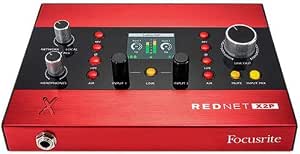 | Best Overall for Compact Dante Recording | Connectivity: Ethernet | Channel configuration: 2×2 | Microphone preamps: 2 Red Evolution | VIEW LATEST PRICE | See Our Full Breakdown |
| MAXSQUARE MSQ-3900D 4-Channel Dante Analog Audio Network Interface |  | Best for Four-Channel Analog Network Input | Channels: 4 | Inputs: Four 3-pin XLR | Connectivity: Ethernet | VIEW LATEST PRICE | See Our Full Breakdown |
| Focusrite RedNet AM2 Stereo Dante Headphone Amplifier and Line Output Interface with PoE |  | Best for Dante Headphone Monitoring | Brand and model: Focusrite RedNet AM2 | Connectivity: Dante | Outputs: 1/4-inch TRS headphone and XLR line | VIEW LATEST PRICE | See Our Full Breakdown |
| Ethernet audio interface | Connectivity | Power | Weight | Warranty |
|---|---|---|---|---|
| Focusrite RedNet X2P 2×2 Dante | Ethernet | — | — | — |
| MAXSQUARE MSQ-3900D 4-Channel | Ethernet | PoE class 0 or USB Type-C | 10.56 ounces | One-year limited |
| Focusrite RedNet AM2 Stereo Da | Dante | PoE or included external power supply | 1.8 pounds | Three years |
More Details on Our Top Picks
Focusrite RedNet X2P 2×2 Dante Ethernet Audio Interface with Mic Preamps
The RedNet X2P earns my top spot because it does more than place a signal on an Ethernet network: it also gives a small recording or production position two Red Evolution mic preamps, a stereo headphone amplifier, and stereo line output. That mix is more flexible than the AM2, which is designed around headphone and line monitoring rather than mic input. Compared with the MAXSQUARE, the X2P has fewer listed analog inputs, but its preamp-and-monitoring combination makes it the stronger choice when a couple of microphones need to join a Dante workflow.
For a compact room, remote recording position, or networked studio station, the 2×2 arrangement can keep the local setup simple. Two microphone inputs cover a pair of vocalists, a stereo source, or a small interview configuration, while the headphone and line outputs support local monitoring and connection to other equipment. Its stated support up to 96 kHz matches the MSQ-3900D’s ceiling, but the key distinction is not sample rate: it is whether you need preamps at the endpoint or four XLR input channels without the same preamp details being specified.
The tradeoff is that two channels impose a real limit. If you need four analog XLR sources connected at once, the MSQ-3900D is the better fit. If your network only needs a headphone station and stereo feed, the simpler AM2 may cover the job without paying for input capability you will not use. I would also check operating-system and Dante compatibility before buying: the supplied specification lists Windows support, and this is a network audio device rather than a direct USB interface. The product details do not state the same broad power choices listed for the other two products, so I would confirm installation power requirements for the intended setup.
Within this group, the X2P is the most balanced option for a buyer who needs both local microphone capture and monitoring. It is not the highest-input-count choice, nor is it the most narrowly focused playback unit. Its value is the combination of functions in one network endpoint, with the compromise that buyers needing more than two mic channels will need another device or a different architecture.
Pros:- Two Red Evolution microphone preamps provide local mic input.
- Stereo headphone amplification and stereo line output support monitoring and onward connection.
- Supports sample rates up to 96 kHz.
- Combines capture and monitoring functions in a compact 2×2 network device.
Cons:- Two channels are less suitable than the MSQ-3900D for connecting four analog sources at once.
- Requires an Ethernet audio workflow and compatible Dante setup rather than functioning as a simple USB interface.
- The listed operating-system support is Windows, so other platform needs should be checked before purchase.
Best for: Small studios, recording stations, and mobile networked rigs that need two microphone preamps plus local headphone and stereo line monitoring.
Not ideal for: Buyers who need four or more analog inputs, want a conventional direct-to-computer USB interface, or cannot confirm compatibility with their Dante network and operating system.
- Connectivity:Ethernet
- Channel configuration:2×2
- Microphone preamps:2 Red Evolution
- Audio input:XLR
- Maximum sample rate:96 kHz
- Headphone output:Stereo headphone amplifier
- Line output:Stereo
- Listed operating system:Windows
Our verdict“I recommend the RedNet X2P as the most versatile pick here when two mic preamps and local monitoring matter more than a four-input count.”
MAXSQUARE MSQ-3900D 4-Channel Dante Analog Audio Network Interface
The MAXSQUARE MSQ-3900D is the natural pick when the main task is moving several analog sources onto an IP audio network. Its four 3-pin XLR inputs give it twice the listed input count of the RedNet X2P, making it more practical for a small panel, a group of microphones, or a multi-source installation where input density matters more than integrated headphone monitoring. It supports both Dante and AES67 RTP, which gives network planners more protocol flexibility than a Dante-only brief suggests for the other models.
Support for 44.1, 48, and 96 kHz covers common production and installation rates, with uncompressed, low-latency transmission described in the product information. That does not make every network setup automatically compatible; the receiving devices, routing, and network configuration still need to support the chosen format. For a fixed installation, the MSQ-3900D’s PoE or USB Type-C power can simplify placement. PoE may reduce the need for a local power outlet, while USB-C offers another option where a suitable PoE network is unavailable.
Its role differs sharply from the RedNet AM2. The AM2 gives you headphone amplification and stereo line outputs for listening and monitoring; the MAXSQUARE is centered on four-channel analog input. The X2P, meanwhile, supplies two specified mic preamps and a more clearly described local monitoring path. The MSQ-3900D’s listing does not identify headphone or line outputs, so buyers wanting an all-in-one record-and-monitor endpoint should not assume those functions are present.
The tradeoffs are mostly about fit and support confidence. Four inputs are useful only if your workflow needs them, and a buyer who needs a single headphone feed may find the AM2 more direct. The MSQ-3900D has a one-year limited warranty, shorter than the three-year warranty listed for the AM2. It also depends on a compatible Dante or AES67 environment, so it is not a shortcut around network planning. I rank it second because it offers the strongest input count and protocol breadth, but its narrower output information makes it less versatile as a self-contained workstation interface than the X2P.
Pros:- Four XLR inputs handle more analog sources than either Focusrite option lists.
- Supports Dante and AES67 RTP network audio.
- Accepts PoE or USB Type-C power for flexible placement.
- Aluminum housing and support for sample rates up to 96 kHz.
Cons:- A compatible Dante or AES67 network and routing setup is required.
- The one-year limited warranty is shorter than the AM2’s stated three-year warranty.
- The supplied specifications do not list headphone or stereo line outputs.
Best for: Installers and production teams that need four analog XLR inputs sent over a Dante or AES67 network, with PoE or USB-C power options.
Not ideal for: Buyers seeking headphone monitoring, specified mic-preamp features, a direct USB recording interface, or a longer stated warranty.
- Channels:4
- Inputs:Four 3-pin XLR
- Connectivity:Ethernet
- Audio formats:Dante, AES67 RTP
- Supported sample rates:44.1 kHz, 48 kHz, 96 kHz
- Power:PoE class 0 or USB Type-C
- Housing:Aluminum
- Weight:10.56 ounces
- Warranty:One-year limited
Our verdict“I would choose the MSQ-3900D when four analog inputs and Dante/AES67 flexibility outweigh the need for built-in local monitoring.”
Focusrite RedNet AM2 Stereo Dante Headphone Amplifier and Line Output Interface with PoE
The RedNet AM2 is the most focused option in this roundup: it takes a Dante network role and gives the listener a stereo headphone output plus XLR line outputs. Its appeal is not input count; no analog mic inputs are listed. Instead, it suits a control-room position, studio station, or other endpoint where someone needs to hear network audio and feed a stereo signal to additional equipment. That makes it a different category of solution from the X2P, which can capture two microphones, and the MSQ-3900D, which brings four XLR inputs onto a network.
Independent headphone and line level controls help when the two output paths need different listening levels. The headphone amplifier is described as able to drive high-impedance headphones, which is useful for users whose cans need more drive than a basic output can provide. A mute switch supports quick silencing, while PoE or the included external power supply gives more placement flexibility than a device tied to only one power method. The stated monitor-quality digital conversion positions it for listening tasks, although buyers should make decisions based on their full signal chain rather than the phrase alone.
Compared with the MSQ-3900D, the AM2 gives up multichannel analog input and AES67 support details in exchange for a clearly specified headphone-and-line monitoring layout. Compared with the X2P, it is less capable for microphone recording but may be the more appropriate endpoint when microphones are already entering the network elsewhere. Its three-year warranty is longer than the one-year limited warranty listed for the MAXSQUARE, which can matter for a permanently installed monitoring point.
The main drawback is its dependence on a Dante-compatible setup. It is not a way to connect headphones directly to a computer over ordinary USB, and it will not replace a mic-preamp interface for someone recording sources locally. I place it third overall because its purpose is narrower than the two input-oriented alternatives, not because it is a weaker choice for its intended job. If all you need is network-fed stereo monitoring, that narrower focus is an advantage; if you need to add microphones or multiple analog inputs, choose the X2P or MSQ-3900D instead.
Pros:- Drives high-impedance headphones.
- Independent headphone and line output level controls.
- Stereo headphone output and XLR line outputs serve separate monitoring paths.
- Can use PoE or the included external power supply and has a stated three-year warranty.
Cons:- Requires a Dante-compatible network audio setup.
- No analog microphone inputs are listed, so it cannot replace the X2P for local mic capture.
- Its monitoring-focused design is less suitable than the MSQ-3900D for multiple analog inputs.
Best for: Dante users who need a dedicated headphone listening point with stereo XLR line output, independent level controls, and PoE or external power.
Not ideal for: Anyone who needs analog microphone inputs, four-channel capture, AES67 support, or a simple USB interface for direct computer connection.
- Brand and model:Focusrite RedNet AM2
- Connectivity:Dante
- Outputs:1/4-inch TRS headphone and XLR line
- Power:PoE or included external power supply
- Weight:1.8 pounds
- Warranty:Three years
- Headphone function:Supports high-impedance headphones
- Controls:Independent headphone and line levels; mute switch
Our verdict“I recommend the RedNet AM2 for a dedicated Dante headphone and stereo line-monitoring position, not as a general recording interface.”
How We Picked
I ranked these products by how well they serve distinct Ethernet audio jobs, not by treating every device as a general-purpose studio interface. The leading questions were: does the unit bring analog inputs onto a network, provide local recording preamps, or deliver dependable monitoring from a Dante system? That distinction matters because a two-preamp interface and a headphone endpoint solve different problems even if both use Ethernet.
I also compared each model’s channel count, connection formats, power choices, and output options. The RedNet X2P takes the top position because it combines two mic preamps, headphone monitoring, and stereo line output in one compact network device. The MSQ-3900D ranks next for its four XLR inputs and support for Dante and AES67, which give it a clear multichannel role. The RedNet AM2 ranks third for this particular roundup because it is purpose-built for playback and monitoring, with no analog mic inputs listed.
I treated network compatibility as a practical requirement, not a minor footnote. Dante and AES67 devices need a suitable network and routing setup; they do not substitute for a conventional USB interface connected directly to a computer. I also weighed documented limitations, including the MSQ-3900D’s one-year limited warranty and the AM2’s dependence on a Dante-compatible system. The provided information does not specify every workflow detail for the X2P, so I avoid assuming features beyond its listed preamps, outputs, Ethernet connection, and 96 kHz ceiling.
| Ethernet audio interface | Connectivity | Power | Warranty |
|---|---|---|---|
| Focusrite RedNet X2P 2×2 Dante | Ethernet | — | — |
| MAXSQUARE MSQ-3900D 4-Channel | Ethernet | PoE class 0 or USB Type-C | One-year limited |
| Focusrite RedNet AM2 Stereo Da | Dante | PoE or included external power supply | Three years |
Factors to Consider When Choosing Best Ethernet Audio Interfaces
Choosing an Ethernet audio interface starts with the signal direction. These three models cover microphone capture, multichannel input, and network monitoring, but none should be treated as a generic Ethernet replacement for a USB interface. I would map the sources and listening points first, then match the device to the endpoint that needs to connect.
Decide whether audio needs to enter or leave the network
If you need to send microphones or other analog sources into a network, start with the RedNet X2P or MSQ-3900D. The X2P lists two Red Evolution mic preamps, which makes it the more direct choice for a small recording position. The MSQ-3900D has four XLR inputs and is the better fit when channel count or AES67 support leads the decision. For a listener who only needs to receive network audio and monitor it, the RedNet AM2 is purpose-built around headphone and line outputs. Choosing by signal direction prevents paying for inputs when the actual task is playback, or buying an output-only device when microphones need to be captured locally.
Count real input channels, not just network channels
Input count defines how many analog sources can be connected at the device. The MSQ-3900D lists four XLR inputs, while the X2P lists a 2×2 configuration and two mic preamps. The AM2 lists headphone and line outputs, not analog inputs. For two-person recording or a compact stereo capture position, the X2P is the most balanced choice. For four analog sources on one endpoint, the MAXSQUARE is the clear match from this group. If inputs already connect elsewhere in the Dante system, the AM2 can serve as a separate monitoring endpoint instead.
Treat Dante and AES67 compatibility as part of the purchase
Ethernet is the physical connection; it does not by itself define how audio is discovered, clocked, or routed. The AM2 requires a Dante-compatible setup, and the MSQ-3900D specifies Dante and AES67 RTP. Before choosing, check that your network, software, and receiving devices support the intended protocol and routing workflow. Also confirm computer operating-system compatibility: the X2P information supplied here lists Windows support. If the plan is to plug an interface into a computer and begin recording without network configuration, these network devices may not be the right category.
Match local monitoring features to the station
The AM2 is the most explicit headphone endpoint, with a stereo headphone amplifier, support for high-impedance headphones, independent level controls, and a mute switch. The X2P also has a stereo headphone amplifier, alongside its mic preamps and stereo line output, making it more useful when recording and listening happen at the same station. The MSQ-3900D’s supplied information focuses on networked analog inputs and does not list headphone or line outputs. If a performer or operator needs a local headphone feed, verify that the chosen unit provides one or plan a separate monitoring device.
Plan power and installation before mounting an endpoint
The AM2 supports PoE or its included external power supply; the MSQ-3900D supports PoE or USB Type-C. Those choices can simplify placement where power outlets are limited, but PoE depends on suitable network power equipment. The available X2P information does not state its power options, so confirm that detail for the installation rather than assuming it matches the other RedNet device. Physical placement, cable runs, access to a power source, and the need for independent level controls can matter as much as the channel count in a fixed room.
Compare warranty terms and documented features
The listed warranty terms differ: the AM2 specifies three years, while the MSQ-3900D specifies a one-year limited warranty. No warranty term was provided for the X2P in the supplied specifications, so I would check the seller or manufacturer documentation. Feature details also vary in specificity. The X2P lists two named mic preamps and stereo outputs; the MSQ-3900D lists four XLR inputs and supported network formats; the AM2 lists headphone and line monitoring controls. Base the choice on confirmed functions that match your signal path, and ask for clarification where a required input, output, or power detail is not listed.
Frequently Asked Questions
What is an Ethernet audio interface?
An Ethernet audio interface sends or receives audio through a network connection, commonly using a system such as Dante or AES67. Unlike a typical USB interface, it is designed to route audio across compatible network devices, which can support distributed recording, playback, and monitoring positions. The three products here serve different roles: the X2P provides two mic preamps and monitoring outputs, the MSQ-3900D accepts four analog XLR inputs, and the AM2 focuses on headphone and stereo line output.
Can I connect these directly to a computer like a USB interface?
Do not assume that Ethernet makes these plug-and-play USB alternatives. Each one is intended for a compatible network-audio workflow, where device discovery, routing, and system support need to be in place. The X2P listing names Windows support, while the AM2 calls for a Dante-compatible setup and the MSQ-3900D supports Dante and AES67. Check the required software, operating system, network equipment, and routing method before buying, especially if you expect a single cable straight to a computer to provide the complete setup.
Which model should I choose for recording microphones?
For a two-microphone recording position, the Focusrite RedNet X2P is the clearest match because it lists two Red Evolution mic preamps along with headphone and stereo line outputs. The MSQ-3900D provides four XLR inputs, so it suits a higher input count, but the supplied description does not identify its preamp design or local monitoring outputs. The AM2 is not the pick for microphone capture because its listed role is headphone amplification and line output.
Do these interfaces require PoE?
No single answer applies to all three. The AM2 can run on PoE or the included external power supply, and the MSQ-3900D accepts PoE or USB Type-C. The available X2P specifications do not state a power method, so I would confirm its installation requirements before purchasing. PoE can reduce the need for a nearby outlet, but it depends on compatible network power equipment; it does not replace the need for a suitable Dante or AES67 audio network.
Is the MSQ-3900D or RedNet X2P better for four sources?
The MSQ-3900D is the stronger match when four analog XLR sources must enter the network through one device, because it explicitly lists four XLR inputs. The X2P lists two Red Evolution mic preamps and is better suited to a small two-mic recording station with local headphone and line monitoring. If the four sources need microphone preamps, monitoring, or a particular input specification, verify those details with the manufacturer; the product information provided here does not describe the MSQ-3900D’s preamp design or monitoring outputs.
Conclusion
For a compact studio or remote recording point that needs two mic preamps and local monitoring, I would choose the Focusrite RedNet X2P. If four analog sources must reach a Dante or AES67 network, the MAXSQUARE MSQ-3900D is the most direct fit, with the tradeoff that headphone and line outputs are not listed. For a control room or listening station that already receives audio over Dante, I would pick the Focusrite RedNet AM2 for its headphone amplifier, stereo XLR outputs, independent levels, and PoE option. The best choice is the one that matches the direction and channel count of your network signal path; none should be bought as a substitute for a conventional USB interface without confirming the required network workflow.
Halloween Picks
halloween
As an affiliate, we earn on qualifying purchases.