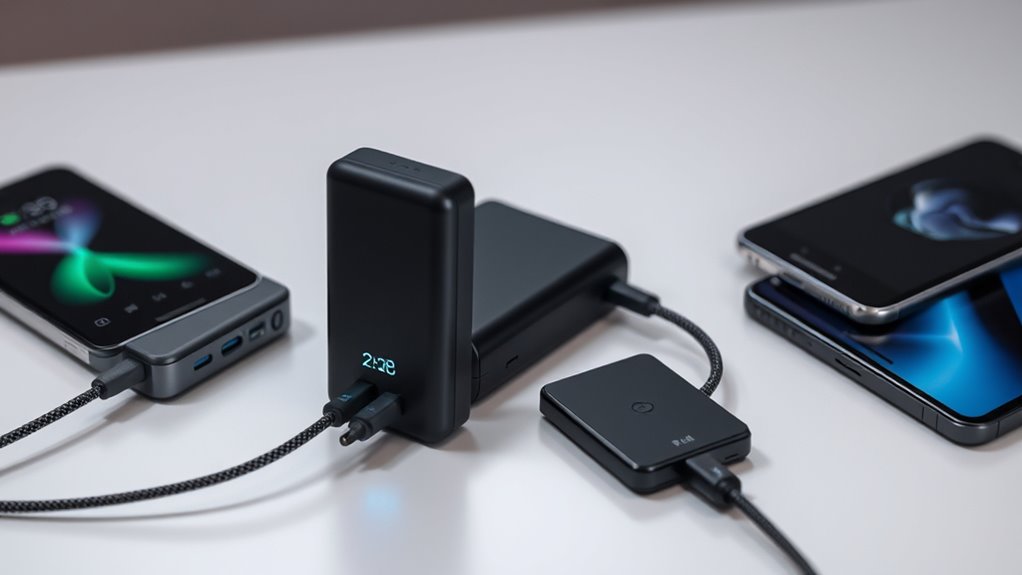

If you’re searching for a dual battery charger with USB C, the first thing to figure out is which kind of “battery” you actually need to charge. That question splits this category in half, and it’s the single biggest decision you’ll make. On one side are rechargeable cell chargers like the Nitecore UMS2, which charges two loose 18650, 21700, AA, or AAA batteries through a USB-C input and shows live health data on an LCD screen. On the other side are dual-port USB-C wall chargers like the Anker 523 Nano 3 and the 120W GaN 2-pack, which charge two devices at once rather than two bare cells.

Get the latest gadgets delivered free with Prime
- Fast, free delivery on millions of items
- Prime Video, Amazon Music and more included
- Member-only deals all year
The tradeoffs worth knowing upfront: raw speed costs money and outlet space, port flexibility usually means lower per-port wattage, and the Nitecore’s fastest charging speeds only unlock when you pair it with a separate 9V QC2.0+ power source. I’ve ordered these five picks so the ranking reflects different buyer situations, from the enthusiast who needs cell-level diagnostics to the traveler who just wants two fast ports in a pocket-size brick.
Complete the kit



Key Takeaways
- The Nitecore UMS2 is the only true dual-slot battery charger here — if you charge loose 18650 or 21700 cells, it’s the clear pick; skip it if you only charge devices.
- Among dual-port USB-C wall chargers, the 120W GaN 2-pack delivers the most watts per dollar and includes cables, while the Anker 523 wins on size and brand trust.
- The Twelve South PlugBug trades price for four ports, 120W total output, and Apple Find My tracking — the premium pick for Apple-heavy households.
- The Aioneus 40W is the budget multi-device option, but its 20W USB-C ceiling rules out serious laptop charging.
- Total wattage matters less than how power splits across ports — check per-port output, not just the headline number, before buying.
| Nitecore UMS2 Intelligent Dual-Slot USB-C Battery Charger with Organizer |  | Best Overall for Loose Rechargeable Cells | Slots: 2 | Input: USB-C, 5V | Max Charging Current: 3000mA single slot / 4000mA total | VIEW ON AMAZON | See Our Full Breakdown |
| 120W Fast Charger USB C – 2 Pack 65W PD Dual Port GaN Type C Charging Block |  | Best Value for High-Wattage Dual-Port Charging | Total Wattage: 120W (65W per port) | Ports: 2x USB-C | Technology: GaN, PD fast charging | VIEW ON AMAZON | See Our Full Breakdown |
| Anker 523 Nano 3 47W Dual-Port GaN Fast Charger (USB-C) |  | Best Compact Pick for Travel | Max Output: 47W total | Ports: 2x USB-C (27W + 20W) | Technology: GaN, ActiveShield 2.0 | VIEW ON AMAZON | See Our Full Breakdown |
| Twelve South PlugBug 120W USB-C Charger Block, 4-Port Charging Hub |  | Best Premium Pick for Multi-Device Households | Ports: 4x USB-C | Total Power: 120W with dynamic distribution | Charging Tech: USB PD fast charging | VIEW ON AMAZON | See Our Full Breakdown |
| Aioneus 40W USB C Charger Block, 4-Port (Dual USB-C + Dual USB-A) PD+QC Fast Wall Charger |  | Best Budget Pick for Everyday Device Charging | Total Power: 40W | Ports: 2x USB-C + 2x USB-A | Max USB-C Output: 20W | VIEW ON AMAZON | See Our Full Breakdown |
| dual battery charger usb c | Ports |
|---|---|
| Nitecore UMS2 Intelligent Dual | — |
| 120W Fast Charger USB C | 2x USB-C |
| Anker 523 Nano 3 47W Dual-Port | 2x USB-C (27W + 20W) |
| Twelve South PlugBug 120W USB- | 4x USB-C |
| Aioneus 40W USB C Charger Bloc | 2x USB-C + 2x USB-A |
More Details on Our Top Picks
Nitecore UMS2 Intelligent Dual-Slot USB-C Battery Charger with Organizer
If your search for a dual battery charger with USB C means charging bare rechargeable cells — the kind that power flashlights, vape devices, headlamps, and hobby electronics — the Nitecore UMS2 is the most complete tool in this lineup. Its two slots handle an unusually broad range of chemistry and size: Li-ion, IMR, LiFePO4, Ni-MH, and Ni-Cd across everything from 21700 and 18650 down to AA, AAA, and even C and D cells. That flexibility is what separates it from every wall charger here, none of which can touch a loose battery at all.
The LCD display is the feature that justifies the top spot for enthusiasts. It shows real-time charging current, voltage, and battery health per slot, which turns charging from guesswork into diagnostics. The intelligent circuitry selects current and voltage automatically, protecting both aging cells and fresh high-drain IMRs. One honest catch: reaching the full 3000mA single-slot speed requires a separate 9V QC2.0+ USB power source — with a basic 5V adapter, you get slower charging. The included organizer case is a genuinely useful bonus compared with the bare-brick approach of the Anker and Aioneus picks.
Pros:- Charges nearly every common rechargeable cell type and size across two slots
- LCD display shows per-slot health, current, and charging status in real time
- Up to 3000mA per slot for fast cell recovery with a QC2.0+ source
- Includes a practical organizer case for travel and storage
Cons:- Full charging speed requires a separate 9V QC2.0+ power source
- Only two slots — heavy users with many cells will want more capacity
Best for: Flashlight enthusiasts, vapers, photographers, and anyone who charges loose 18650/21700 or AA/AAA rechargeable cells
Not ideal for: Anyone who only needs to charge phones, tablets, or laptops — this does nothing a wall charger does
- Slots:2
- Input:USB-C, 5V
- Max Charging Current:3000mA single slot / 4000mA total
- Battery Types:Li-ion, IMR, LiFePO4, Ni-MH, Ni-Cd
- Sizes Supported:18650, 21700, 20700, 16340, 14500, AA, AAA, C, D, and more
- Display:LCD with real-time status
- Weight:5.56 oz
- Bundle:Organizer case included
Our verdict“The only genuine dual-slot battery charger in this roundup, and the one to buy if loose rechargeable cells are part of your daily life.”
120W Fast Charger USB C – 2 Pack 65W PD Dual Port GaN Type C Charging Block
This two-pack of 65W dual-port GaN chargers wins the value argument by attacking it from both directions: you get two complete charging bricks plus four USB-C cables (two 10-foot, two 3.3-foot) for what a single premium unit often costs. Each block pushes up to 65W per port, which is enough to fast-charge a MacBook Air, a Samsung Galaxy S25, or an iPad without compromise — a clear step up from the Aioneus 40W, whose 20W USB-C ceiling would leave a laptop crawling.
GaN construction keeps the bricks compact and cooler-running than older silicon chargers of equivalent wattage, and UL certification covers the safety basics. The included long cables are the quietly practical part of the deal: a 10-foot reach changes where you can actually use a charging device, and most competitors here ship with no cable at all. The tradeoff versus the Twelve South PlugBug is port count — two ports per brick means a device-heavy desk still needs both units occupied. And because there’s no USB-A anywhere, legacy gear is out of luck.
Pros:- 65W per port is enough for laptops, not just phones
- Two chargers and four cables included — excellent cost per port
- GaN design keeps size and heat down
- 10-foot cables dramatically extend usable reach
Cons:- USB-C only — no compatibility with USB-A legacy devices
- Two ports per unit may not cover multi-device households on its own
Best for: Budget-conscious buyers who need genuine laptop-grade charging in two locations, plus cables included
Not ideal for: Households charging four-plus devices from one outlet, or anyone with older USB-A-only accessories
- Total Wattage:120W (65W per port)
- Ports:2x USB-C
- Technology:GaN, PD fast charging
- Cables Included:4x USB-C (10FT x2, 3.3FT x2)
- Compatibility:MacBook, iPhone, Galaxy S25 series, tablets, all USB-C devices
- Safety:UL Certified
- Input Voltage:110V
Our verdict“The best watts-per-dollar pick in the roundup, ideal if you want serious charging speed in two rooms without buying twice.”
Anker 523 Nano 3 47W Dual-Port GaN Fast Charger (USB-C)
The Anker 523 Nano 3 makes the case that physical size is a feature. At roughly the footprint of a basic 20W single-port charger, it squeezes out 47W across two USB-C ports (27W + 20W), which covers an iPhone plus iPad simultaneously or a MacBook Air on its own. Compared with the 120W 2-pack, it gives up raw power and free cables — but it wins on pocketability and on Anker’s reputation for longevity, backed here by an 18-month warranty.
What earns this pick its compact crown is ActiveShield 2.0, Anker’s temperature-monitoring system that checks thermal conditions millions of times per day. For a charger that lives in a travel bag or gets left plugged in overnight, that layer of protection has real value beyond the spec sheet. The honest limitation mirrors the Aioneus: 47W total means a power-hungry 16-inch MacBook Pro under load will drain faster than it charges. And like the Aioneus, no cable ships in the box, so factor that into the price comparison against the 2-pack.
Pros:- Barely bigger than a standard 20W single-port charger
- 27W + 20W split handles phone-and-tablet pairs well
- ActiveShield 2.0 monitors temperature continuously
- Trusted brand with an 18-month warranty
Cons:- 47W total is marginal for larger laptops under heavy use
- No charging cable included
Best for: Travelers and minimalists who want one tiny brick that fast-charges a phone and tablet or tops up a MacBook Air
Not ideal for: Owners of large pro laptops or anyone who wants cables included in the purchase
- Max Output:47W total
- Ports:2x USB-C (27W + 20W)
- Technology:GaN, ActiveShield 2.0
- Cable Included:No
- Warranty:18 months
- Best Use:iPhone + iPad, MacBook Air
Our verdict“The best pick when size matters most — a genuinely pocketable dual-port charger from a brand with a strong reliability record.”
Twelve South PlugBug 120W USB-C Charger Block, 4-Port Charging Hub
The Twelve South PlugBug is the answer to a different question than the rest of this list: what if one outlet could replace four chargers? Its four USB-C ports share 120W dynamically, so a MacBook can pull heavy wattage while an iPhone and AirPods trickle alongside it — a setup neither the Anker 523 (two ports) nor the 120W 2-pack (two ports per brick) can match from a single socket. For an Apple-heavy desk or nightstand, that consolidation is the whole point.
Two features justify the premium price. The slim body with folding prongs makes it more travel-friendly than fixed-prong bricks, and Apple Find My integration means a charger left in a hotel room shows up on the same map as your other Apple gear — a genuinely unique feature none of the other four picks offer anything like. The drawbacks are straightforward: it costs meaningfully more per watt than the 2-pack, and it’s USB-C only, so anything with a USB-A plug needs an adapter.
Pros:- Four USB-C ports sharing 120W from a single outlet
- Apple Find My integration locates a lost or left-behind charger
- Slim body with folding prongs packs flat for travel
- Dynamic power distribution prioritizes hungrier devices
Cons:- Meaningfully pricier per watt than the 2-pack alternative
- USB-C only, so legacy USB-A gear needs adapters
Best for: Apple households and frequent travelers who want one hub to charge a laptop, phone, tablet, and earbuds at once
Not ideal for: Budget-focused buyers or anyone with several older USB-A devices
- Ports:4x USB-C
- Total Power:120W with dynamic distribution
- Charging Tech:USB PD fast charging
- Design:Slim body, folding prongs
- Special Feature:Apple Find My integration
- Compatibility:iPhone, iPad, MacBook, USB-C devices
Our verdict“The premium consolidation play — buy it when replacing four separate chargers matters more than the price per watt.”
Aioneus 40W USB C Charger Block, 4-Port (Dual USB-C + Dual USB-A) PD+QC Fast Wall Charger
The Aioneus 40W plays a different game than everything above it: instead of chasing wattage, it chases port variety at a low price. Two USB-C ports (up to 20W each) sit alongside two USB-A ports, so a mixed collection of phones, earbuds, e-readers, and older cables can all charge from one outlet. That USB-A inclusion is something none of the other four picks offer, and for households with legacy gear it removes the adapter-hunting entirely.
Realistically, 20W per USB-C port puts an iPhone at 50% in about 30 minutes — perfectly fine — but it’s not laptop territory. The 120W 2-pack and the PlugBug both handle MacBook-class charging where this one simply can’t, so the choice between them comes down to whether your devices include a computer. Build quality doesn’t feel budget-grade, though: the fireproof ABS+PC housing carries ETL, UL, FCC, and RoHS certifications, and an 18-month replacement warranty backs it. The one recurring annoyance is that no cable ships in the box, unlike the 2-pack’s four-cable bundle.
Pros:- Four ports with both USB-C and USB-A for mixed-device households
- 20W USB-C fast charging brings an iPhone to 50% in 30 minutes
- ETL/UL/FCC/RoHS certified with fireproof construction
- 18-month worry-free replacement warranty
Cons:- 20W per USB-C port is too slow for laptops
- No cable included
Best for: Budget buyers charging mostly phones, tablets, earbuds, and USB-A accessories from one outlet
Not ideal for: Laptop owners or anyone who needs more than 20W from a USB-C port
- Total Power:40W
- Ports:2x USB-C + 2x USB-A
- Max USB-C Output:20W
- Protocols:PD, QC
- Certifications:ETL, UL, FCC, RoHS
- Material:Fireproof ABS + PC
- Warranty:18 months
- Cable Included:No
Our verdict“The cheapest sensible way to charge four everyday devices at once — as long as none of them is a laptop.”
How We Picked
Because “dual battery charger USB C” covers two different product categories, I judged every pick against the same four criteria rather than comparing apples to oranges. The first was charging flexibility: how many batteries or devices can charge simultaneously, and how intelligently the charger splits power between slots or ports when both are in use. The second was per-port performance — a 120W headline means little if a single port can’t push enough watts to a laptop, so I prioritized real per-slot and per-port output figures.
The third criterion was safety and build quality. UL, ETL, and FCC certifications, GaN thermal efficiency, and features like Anker’s ActiveShield temperature monitoring all carry weight here, because chargers run unattended for hours. The fourth was value beyond the brick itself: included cables, warranty length, and whether extras like the Nitecore’s organizer case or the PlugBug’s Find My integration genuinely add usefulness. Finally, I factored in who each product is not for — a great cell charger is a poor laptop charger, and I made those boundaries explicit rather than pretending one product does everything.
Factors to Consider When Choosing Dual Battery Charger Usb C
Before picking from the five chargers above, it helps to understand the few specs and design choices that actually change how these products behave day to day.Cells vs. Devices: Know Which Charger You Need
A dual battery charger with USB C can mean two unrelated products. If you own flashlights, vapes, or gadgets that take removable 18650, 21700, AA, or AAA rechargeable cells, you need a slot-style charger like the Nitecore UMS2 — a wall charger cannot physically charge a bare battery. If you’re charging phones, tablets, and laptops, you want a dual-port USB-C wall charger, and everything else in this roundup fits that description. Buying the wrong type is the most common mistake in this category.
Per-Port Wattage Beats Total Wattage
Manufacturers advertise the headline number, but what matters is how power splits when both ports or slots are busy. A 120W charger that drops to 20W per port when both are occupied serves you differently than one that holds 65W on a single port. For laptops, 45W is the practical floor for a MacBook Air and larger machines want 65W or more. The Aioneus tops out at 20W per USB-C port — great for phones, inadequate for computers — while the 120W 2-pack and PlugBug handle full laptop duty.
GaN, Safety Certifications, and Heat
Gallium nitride (GaN) construction lets chargers run smaller and cooler than older silicon designs, which is why the Anker 523 fits 47W into a 20W-sized body. On the safety side, look for UL or ETL listing and FCC certification — all five picks here carry at least one of these. Extra layers like Anker’s ActiveShield 2.0 temperature monitoring or the Nitecore’s per-slot intelligent current selection add peace of mind for chargers that run unattended overnight.
Cables, Extras, and Total Cost
The sticker price rarely tells the whole story. The 120W 2-pack includes four cables, while the Anker, Aioneous, and PlugBug include none — add $10–20 if you need them. The Nitecore bundles an organizer case that genuinely helps if you carry cells around. Features like the PlugBug’s Apple Find My integration only matter if you’re in the Apple ecosystem and prone to leaving chargers behind, so weigh extras against how you’ll actually use them rather than paying for capability you’ll ignore.
Frequently Asked Questions
Can a dual USB-C wall charger charge actual batteries like 18650 or AA rechargeables?
No — a dual-port USB-C wall charger like the Anker 523 or the 120W 2-pack charges devices, not bare cells. Loose rechargeable batteries need a slot-style charger with physical contacts and chemistry-aware circuitry, which is exactly what the Nitecore UMS2 provides through its two slots and USB-C power input. This distinction is the single most important thing to confirm before buying, because the two product types look similar in search results but serve entirely different purposes. If you need both capabilities, the practical setup is a Nitecore for cells plus a wall charger for devices.
How many watts do I need to charge a laptop through USB C?
As a rule of thumb, a MacBook Air or thin Windows ultrabook wants at least 45W, a 14-inch MacBook Pro is happiest at 65W or more, and 16-inch pro laptops want 90–100W to charge under load. That’s why the 120W 2-pack with 65W per port and the PlugBug with 120W dynamic distribution handle laptops comfortably, while the Anker 523 at 47W is borderline for larger machines and the Aioneus at 20W per port is phone-and-tablet only. A lower-wattage charger won’t damage a laptop — it will just charge slowly or merely slow the battery drain while you work.
Why does the Nitecore UMS2 charge slower with some USB adapters?
The UMS2’s maximum 3000mA single-slot speed requires a 9V QC2.0-or-higher power source, because the charger draws more power than a basic 5V USB adapter can supply. With a standard 5V adapter, the total available current is lower and charging takes longer, though the charger still works safely and its intelligent circuitry picks the appropriate rate. If fast cell charging matters to you, budget for a QC-compatible USB-C adapter alongside the charger itself. The LCD display will show you the actual charging current, so you can immediately see what your power source is delivering.
Is it safe to leave a multi-port charger plugged in all the time?
Generally yes, provided the charger carries legitimate safety certifications like UL or ETL listing — all five picks here do. Features like GaN construction, which runs cooler than older silicon designs, and Anker’s ActiveShield 2.0, which monitors temperature millions of times per day, add extra margins for always-plugged-in use. The main real-world risks come from uncertified no-name chargers, damaged cables, or covering a hot charger with bedding. If a charger ever feels unusually hot, smells odd, or the prongs loosen in the outlet, replace it rather than continuing to use it.
Are USB-A ports still worth having on a charger in 2026?
It depends on your accessory drawer. If you own older earbuds, e-readers, fitness trackers, lamps, or travel gear that charges over micro-USB or USB-A cables, having built-in USB-A ports — as the Aioneus 40W does — saves you from carrying adapters or replacing cables that still work fine. If all your devices have moved to USB-C, extra USB-A ports just sit idle, and you’re better off spending your budget on more USB-C wattage, as with the Anker 523 or the PlugBug. The industry is clearly consolidating on USB-C, but the transition leaves plenty of functional USB-A gear in circulation.
Conclusion
After comparing all five, my recommendations break down cleanly by buyer type. If you charge loose rechargeable cells — 18650s for a flashlight, AAs for household gear — the Nitecore UMS2 is the only real choice here, and its LCD diagnostics make it the enthusiast’s tool of choice. If you need laptop-grade dual-port charging on a budget, the 120W GaN 2-pack delivers the best value with cables included; buy the Anker 523 Nano 3 instead if you prioritize tiny size and brand-backed reliability over raw wattage.
For Apple-centric households that want to replace a tangle of single chargers with one hub, the Twelve South PlugBug and its Find My tracking justify the premium. And if your needs are simpler — phones, earbuds, and older USB-A gear charging together from one cheap outlet — the Aioneus 40W covers the basics without asking much of your wallet. Whatever you pick, check per-port wattage against your most power-hungry device before you buy; that single check prevents the most common disappointment in this category.
Fall Picks
fall essentials
As an affiliate, we earn on qualifying purchases.