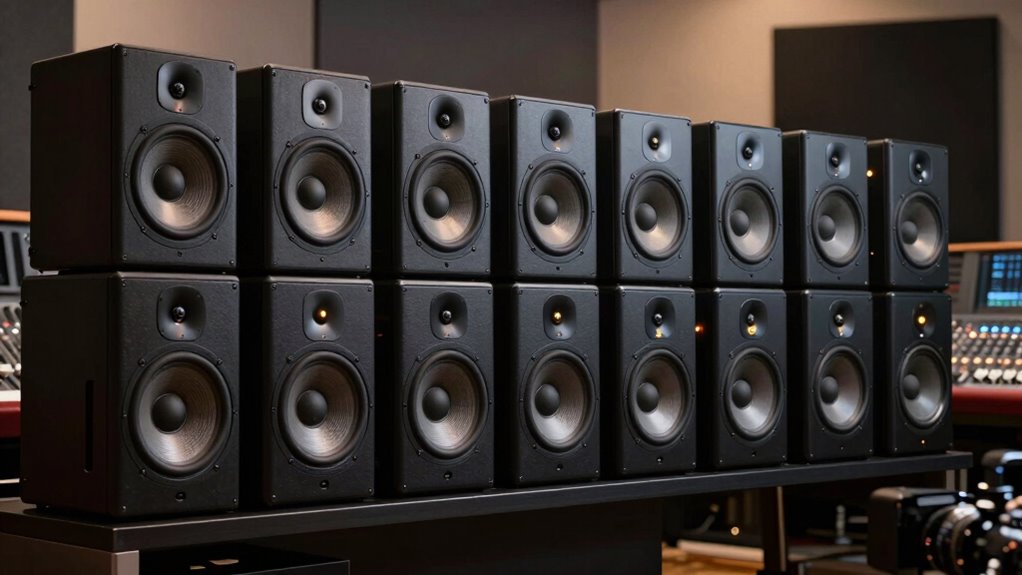

When selecting a studio subwoofer for mixing, the goal is to achieve accurate, tight bass that complements your monitors without overwhelming your mix. The best overall pick is the Mackie CR8SBT for its balanced performance, Bluetooth convenience, and remote control. The PreSonus Eris Sub 8BT stands out as a strong value choice with wireless features, while the Neumann KH 750 appeals to professionals needing high precision and power. Buyers face tradeoffs between size, power, connectivity, and price, making it essential to match your studio’s needs with these factors. Continue reading for a detailed breakdown of each option and help narrowing down your ideal subwoofer.

Get the latest gadgets delivered free with Prime
- Fast, free delivery on millions of items
- Prime Video, Amazon Music and more included
- Member-only deals all year
Complete the kit



Key Takeaways
- The best studio subwoofers balance power and clarity without muddying critical mid-range frequencies.
- Wireless connectivity, like Bluetooth, adds convenience but can sometimes compromise audio purity for mixing purposes.
- Size and power are key tradeoffs—larger subwoofers generally provide deeper bass but take up more space.
- Professional-grade options like Neumann offer high accuracy, but at a higher cost, making them better suited for serious studios.
- Budget-friendly models can still deliver solid performance, especially for smaller or home studios, if you prioritize tight integration and ease of use.
| Mackie CR8SBT 8-inch Studio Subwoofer for CR Monitors with Bluetooth and Remote |  | Best for CR Series Monitor Users | Size: 8 inches | Connectivity: TRS, RCA, Bluetooth | Includes: Remote | VIEW ON AMAZON | See Our Full Breakdown |
| PreSonus Eris Sub 8BT — 8-inch Powered Subwoofer with Bluetooth |  | Best for Versatile Wireless Connectivity | Size: 8 inches | Power: 100 watts | Frequency Response: 30Hz and above | VIEW ON AMAZON | See Our Full Breakdown |
| Yamaha HS8 Studio Subwoofer, Black |  | Best for Precise Bass Management | Size: 8 inches | Frequency Response: 22Hz – 150Hz | Power: 150W | VIEW ON AMAZON | See Our Full Breakdown |
| Neumann KH 750 10-Inch Powered Studio Subwoofer |  | Best for High-Power Professional Monitoring | Power: 256W | Driver Size: 10 inches | VIEW ON AMAZON | See Our Full Breakdown | |
| Audioengine S8 Powered Subwoofer – 250W Wireless-Ready 8-Inch Bass Speaker |  | Best for Powerful, Wireless Home Studio Setup | Power: 250W | Speaker Size: 8 inches | Wireless Compatibility: Yes | VIEW ON AMAZON | See Our Full Breakdown |
| JBL Professional LSR310S – Studio Monitor Subwoofer, 10-Inch, Black |  | Best Overall for Deep, Accurate Bass in Professional Mixing | Driver Size: 10 inches | Frequency Response: Down to 20 Hz | Peak Output: 113 dB | VIEW ON AMAZON | See Our Full Breakdown |
| Yamaha 8″ 100W Powered Subwoofer – Black (NS-SW050BL) |  | Best Budget-Friendly Compact Sub for Home Studios | Power: 100W | Woofer Diameter: 8 inches | Frequency Response: 28 Hz | VIEW ON AMAZON | See Our Full Breakdown |
| Focal Sub One – Dual 8-inch Active Studio Subwoofer, 200W RMS, Slatefiber Drivers, 32Hz–120Hz |  | Best for Precise, Studio-Grade Mixing and Mastering | Driver Size: 8 inches | Power: 200W RMS | Frequency Range: 32Hz–120Hz | VIEW ON AMAZON | See Our Full Breakdown |
| Mackie Mr MRS10 10-Inch Studio Subwoofer |  | Best for Deep, Powerful Bass for Electronic and Hip-Hop Production | Power: 120 Watts | Woofer Size: 10 inches | Amplification: Class A/B | VIEW ON AMAZON | See Our Full Breakdown |
| KALI AUDIO WS-6.2 Dual 6 Inch Studio Subwoofer – 600W, Deep Bass, Compact Design |  | Best for Small Studios Requiring Deep, Precise Monitoring | Power: 600W | Frequency Response: 27Hz | Drivers: Dual 6.5-inch long-excursion | VIEW ON AMAZON | See Our Full Breakdown |
| IK Multimedia iLoud Sub – Compact 25Hz Studio Subwoofer with Automatic Calibration, 6.5″ Driver |  | Best Compact for Small Studios | Frequency Response: 25 Hz | Driver Size: 6.5 inches | Power: 200 W | VIEW ON AMAZON | See Our Full Breakdown |
| Behringer NEKKST K10S Audiophile 10″ Studio Subwoofer with High Excursion Woofer |  | Best for High-Power, Accurate Low End | Power: 300 watts | Woofer Diameter: 10 inches | Enclosure Material: Stainless Steel | VIEW ON AMAZON | See Our Full Breakdown |
| KRK S8.4 Generation 4 8-Inch Powered Studio Subwoofer |  | Best for Precise Studio Monitoring | Woofer Diameter: 8 inches | Power Output: 109 Watts | Frequency Response: Down to 30Hz | VIEW ON AMAZON | See Our Full Breakdown |
| PreSonus Eris Pro Sub 10 — 10-inch Active Studio Subwoofer |  | Best for Precise, Natural Low-End Extension | Speaker Diameter: 10 inches | Power: 170 watt (RMS) | Frequency Response: 20 to 200 Hz | VIEW ON AMAZON | See Our Full Breakdown |
| studio subwoofer for mixing | Power | Frequency Response |
|---|---|---|
| Mackie CR8SBT 8-inch Studio Su | — | — |
| PreSonus Eris Sub 8BT | 100 watts | 30Hz and above |
| Yamaha HS8 Studio Subwoofer | 150W | 22Hz – 150Hz |
| Neumann KH 750 10-Inch Powered | 256W | — |
| Audioengine S8 Powered Subwoof | 250W | — |
| JBL Professional LSR310S | — | Down to 20 Hz |
| Yamaha 8" 100W Powered Subwoof | 100W | 28 Hz |
| Focal Sub One | 200W RMS | — |
| Mackie Mr MRS10 10-Inch Studio | 120 Watts | — |
| KALI AUDIO WS-6.2 Dual 6 Inch | 600W | 27Hz |
| IK Multimedia iLoud Sub | 200 W | 25 Hz |
| Behringer NEKKST K10S Audiophi | 300 watts | — |
| KRK S8.4 Generation 4 8-Inch P | — | Down to 30Hz |
| PreSonus Eris Pro Sub 10 | 170 watt (RMS) | 20 to 200 Hz |
More Details on Our Top Picks
Mackie CR8SBT 8-inch Studio Subwoofer for CR Monitors with Bluetooth and Remote
The Mackie CR8SBT stands out for its seamless integration with CR Series monitors, making it ideal for desktop setups where simplicity and wireless convenience matter. Compared to the Yamaha HS8 Subwoofer, it offers Bluetooth connectivity, adding a modern touch, though it lacks detailed power specs and broad compatibility. Its remote control simplifies adjustments during mixing sessions, but its limited compatibility means it’s not suited for diverse monitor brands or larger studios. The 8-inch driver delivers adequate bass enhancement for compact spaces, yet it relies heavily on the monitors for full sound balance. This pick makes sense for producers who prioritize wireless control and already own CR monitors, but it may fall short in bigger, more demanding environments.
Pros:- Easy integration with CR Series monitors
- Wireless Bluetooth input for convenience
- Remote control for quick adjustments
Cons:- Limited to CR Series monitor compatibility
- No detailed power or weight specifications
- Requires additional monitors for full setup
Best for: Producers using CR Series monitors in desktop or small studio setups who value wireless controls.
Not ideal for: Larger studios or users with non-CR monitors needing more power or broader compatibility.
- Size:8 inches
- Connectivity:TRS, RCA, Bluetooth
- Includes:Remote
- Designed for:CR Series monitors
Our verdict“Best suited for CR monitor owners seeking seamless wireless control in small or desktop environments.”
PreSonus Eris Sub 8BT — 8-inch Powered Subwoofer with Bluetooth
The PreSonus Eris Sub 8BT offers a flexible setup with Bluetooth 5.0, making it an excellent choice for users who want a wireless connection for casual mixing or multimedia. Unlike the Yamaha HS8 Subwoofer, it includes multiple input options and adjustable crossover controls, providing more customization for various room sizes and configurations. Its compact size makes it suitable for desktop use, but its 8-inch driver may not deliver enough bass for larger rooms or demanding genres. The 100W power output is sufficient for moderate volumes but might struggle in high-volume applications. This model is ideal for home studios and multimedia setups where versatility and wireless convenience are priorities, yet it may not satisfy those requiring deep, high-power bass.
Pros:- Wireless Bluetooth connectivity for easy setup
- Multiple input options for versatile connection
- Adjustable crossover and tuning controls
Cons:- Limited to 8-inch size, less suitable for large rooms
- Power output may be insufficient for loud environments
Best for: Home studio owners and multimedia producers seeking easy wireless integration and flexible controls.
Not ideal for: Large professional studios or bass-heavy mixing requiring higher power and deeper bass extension.
- Size:8 inches
- Power:100 watts
- Frequency Response:30Hz and above
- Connectivity:Bluetooth 5.0, TRS, RCA, aux
- Controls:High/low tuning, filters
- Power Saving Mode:Auto
Our verdict“Ideal for casual producers and multimedia users prioritizing wireless flexibility and ease of use.”
Yamaha HS8 Studio Subwoofer, Black
The Yamaha HS8 Subwoofer offers professional-grade bass control with a 150W amplifier, making it suitable for critical mixing environments. Compared to the PreSonus Eris Sub 8BT, it provides a broader frequency response (22Hz – 150Hz) for more accurate low-end reproduction, especially important for projects demanding deep bass. Its adjustable low- and high-cut controls, along with a phase switch, give precise management over the sound, but setting it up requires calibration, which might be daunting for beginners. While it’s compact enough for studio use, it’s designed more for those who need detailed bass tuning rather than wireless convenience. This makes it a strong pick for professional studios that prioritize control and accuracy over ease of use or wireless features.
Pros:- Powerful 150W amplifier for clear bass
- Adjustable low/high cut controls for tailored sound
- Phase switch for phase alignment
Cons:- Requires calibration for optimal performance
- Limited deep bass extension compared to larger subs
Best for: Professional audio engineers and producers needing precise bass management in dedicated studio environments.
Not ideal for: Beginners or casual users seeking wireless connectivity or plug-and-play simplicity.
- Size:8 inches
- Frequency Response:22Hz – 150Hz
- Power:150W
- Features:Low/High cut switches, phase switch
Our verdict“Best for professionals focused on accurate bass tuning in controlled studio settings.”
Neumann KH 750 10-Inch Powered Studio Subwoofer
The Neumann KH 750 stands out for its high power output of 256W and larger 10-inch driver, making it the top choice for demanding professional studios that need deep, impactful bass. Compared with the Yamaha HS8 Subwoofer, it delivers more power and a larger driver, but at a significantly higher price point that may be prohibitive for casual users. Its compact design suits tight studio spaces, yet the setup requires a professional touch to fully optimize its performance. This subwoofer excels in environments where bass accuracy and volume are critical, but it might be overkill for small home setups or users on a budget. It’s best for seasoned professionals who need reliable, high-volume bass in critical listening environments.
Pros:- High power output (256W) for loud, clear bass
- Large 10-inch driver for impactful low-end
- Suitable for professional monitoring needs
Cons:- Expensive for casual or hobbyist use
- Requires professional setup and calibration
Best for: High-end professional studios requiring powerful, accurate bass monitoring.
Not ideal for: Entry-level or home studio users with limited budgets or space constraints.
- Power:256W
- Driver Size:10 inches
Our verdict“Ideal for professional studios demanding high-volume, precise bass performance.”
Audioengine S8 Powered Subwoofer – 250W Wireless-Ready 8-Inch Bass Speaker
The Audioengine S8 offers impressive 250W power in an 8-inch form factor, making it suitable for small studios or home environments where deep bass is desired without sacrificing wireless convenience. Its down-firing design enhances resonance, and wireless compatibility allows flexible placement, unlike the more traditional wired options like the Yamaha HS8 Subwoofer. However, it requires a compatible wireless adapter kit, which adds extra cost and complexity, and its size might be bulky for very tight spaces. Compared to the PreSonus Eris Sub 8BT, it provides more raw power, ideal for users who want deep bass with wireless setup flexibility in a modestly sized room. It’s best for those who want deep bass but are willing to accommodate the size and extra accessories.
Pros:- 250W power for deep, impactful bass
- Wireless-ready for flexible placement
- Down-firing design enhances resonance
Cons:- Requires compatible wireless adapter kit
- May be large for very small spaces
Best for: Home producers and multimedia enthusiasts seeking powerful bass with wireless capabilities.
Not ideal for: Small spaces or users seeking a budget-friendly wired-only setup.
- Power:250W
- Speaker Size:8 inches
- Wireless Compatibility:Yes
- Design:Down firing
Our verdict“Best for home users who prioritize strong bass and wireless flexibility in a compact setup.”
JBL Professional LSR310S – Studio Monitor Subwoofer, 10-Inch, Black
The JBL LSR310S stands out for its ability to produce deep, dynamic bass down to 20 Hz, making it ideal for professional mixing environments where accuracy is paramount. Its XLF tuning and port design enhance low-end extension, surpassing smaller subwoofers like the Yamaha NS-SW050BL, which cannot reach as low or deliver as much volume. However, its size and power requirements mean it’s overkill for casual or home use, and setup may be complex for less experienced users. This subwoofer is perfect for studios needing reliable, full-range bass response with professional connectivity options.
Pros:- Deep bass response down to 20 Hz for accurate mixing
- Professional balanced XLR inputs and outputs
- Enhanced bass with XLF tuning for club-style sound
Cons:- Requires professional setup and placement for optimal performance
- May be excessive for casual or small-scale setups
Best for: Professional audio engineers and serious studio owners needing accurate low-end extension.
Not ideal for: Small bedroom producers or hobbyists who prioritize simplicity over maximum bass extension.
- Driver Size:10 inches
- Frequency Response:Down to 20 Hz
- Peak Output:113 dB
- Inputs:XLR and 1/4″ balanced
- Outputs:XLR
- Sensitivity Switch:-10dBV / +4dBu
Our verdict“A top choice for professionals demanding precise, extended bass in their mixing environment.”
Yamaha 8″ 100W Powered Subwoofer – Black (NS-SW050BL)
The Yamaha NS-SW050BL offers impactful bass in a compact design, making it a solid choice for small home studios or multimedia setups. Its 100W power and advanced bass technologies like the Twisted Flare Port provide punchy sound without overwhelming space. Compared with larger models like the Mackie Mr MRS10, it’s more space-efficient but sacrifices some low-end depth and volume. Its limited connectivity options and modest power make it less suitable for large or professional environments. This model is well-suited for beginners or those with limited room who want reliable bass response without complexity.
Pros:- Powerful impact with 100W output
- Compact size fits small spaces easily
- Advanced bass tech for enhanced sound quality
Cons:- Limited frequency response, only down to 28 Hz
- Not water-resistant or outdoor suitable
- Requires wired connection, lacks wireless features
Best for: Home studio owners or beginners seeking an affordable, space-efficient subwoofer.
Not ideal for: Producers needing deep, extended bass for critical mixing or large-room setups.
- Power:100W
- Woofer Diameter:8 inches
- Frequency Response:28 Hz
- Color:Black
- Connectivity:Wired, Ethernet, Bluetooth
- Warranty:Limited
Our verdict“A smart, budget-conscious pick for small-scale or beginner studio setups with space constraints.”
Focal Sub One – Dual 8-inch Active Studio Subwoofer, 200W RMS, Slatefiber Drivers, 32Hz–120Hz
The Focal Sub One excels in delivering accurate, detailed bass with its dual 8-inch Slatefiber drivers, making it ideal for critical mixing and mastering. Its 200W RMS power ensures ample headroom, outperforming smaller or less powerful subs like the Yamaha NS-SW050BL. Its frequency range from 32Hz to 120Hz strikes a balance between deep bass and clarity in mid-bass frequencies, unlike some larger subs that focus solely on extension. Proper calibration is key, but once set, it offers highly controlled low-end. This subwoofer is best suited for professionals who need precise bass control in a compact, studio-friendly form factor.
Pros:- Accurate low-end with precise bass response
- High power output suitable for professional use
- Customizable settings for optimal mixing
Cons:- Limited deep bass extension below 32Hz
- Requires calibration and setup expertise
Best for: Audio professionals and advanced producers requiring accurate, reliable bass for critical listening.
Not ideal for: Casual users or those needing deep sub-bass below 32Hz for genres like electronic dance music.
- Driver Size:8 inches
- Power:200W RMS
- Frequency Range:32Hz–120Hz
- Drivers:Slatefiber
- Amplification:Class D
- Connectivity:Multiple options for integration
Our verdict“A top-tier choice for professionals focused on detailed, controlled bass in a compact form.”
Mackie Mr MRS10 10-Inch Studio Subwoofer
The Mackie Mr MRS10 delivers robust, deep bass with a 10-inch woofer and 120W Class A/B amplification, making it well-suited for genres that demand punchy low-end like EDM and hip-hop. Its glass aramid composite cone ensures durability and consistent performance, and flexible XLR/TRS inputs allow easy integration. Compared with the JBL LSR310S, it offers a more straightforward setup but less extreme low-frequency extension, making it ideal for users prioritizing power over ultra-deep bass. It’s less suited for small or space-limited studios due to its size and may require careful placement to avoid bass muddiness. Nonetheless, it provides reliable, deep sound for demanding music production.
Pros:- Powerful deep bass suitable for bass-centric genres
- High-quality durable woofer material
- Flexible input options for versatile setup
Cons:- Large footprint may be unsuitable for small spaces
- No wireless or advanced features
Best for: Producers working primarily with bass-heavy genres needing powerful, deep monitoring.
Not ideal for: Small studios or casual users who need a compact, easy-to-place subwoofer.
- Power:120 Watts
- Woofer Size:10 inches
- Amplification:Class A/B
- Woofer Material:Glass aramid composite
- Input Connectivity:Stereo XLR and TRS
Our verdict“An excellent choice for those needing substantial, deep bass for professional music production in larger studios.”
KALI AUDIO WS-6.2 Dual 6 Inch Studio Subwoofer – 600W, Deep Bass, Compact Design
The KALI AUDIO WS-6.2 combines power and compactness, with 600W and dual 6.5-inch drivers delivering deep frequencies down to 27Hz. Its vibration-canceling design and high SPL make it suitable for tight spaces where accurate, punchy bass is needed without overwhelming the room. Compared to larger models like the Mackie Mr MRS10, it offers similar deep bass but in a smaller footprint, perfect for small studios. However, its lower wattage may limit performance in larger or more demanding environments, and it requires an external amp or audio interface. This model shines in small, well-treated spaces where clarity and depth matter most.
Pros:- Deep bass extension down to 27Hz
- Compact, space-saving design
- Vibration-canceling dual drivers for cleaner sound
Cons:- Limited power for large environments
- Requires external amplification
- Designed solely for studio use, not home theater
Best for: Producers and engineers working in small studios needing deep, accurate monitoring without space constraints.
Not ideal for: Large studios or users needing very high SPL for dance or live sound applications.
- Power:600W
- Frequency Response:27Hz
- Drivers:Dual 6.5-inch long-excursion
- Maximum SPL:120dB
- Connectivity:XLR, TRS, RCA
Our verdict“An ideal choice for small studio spaces demanding precise, deep bass without sacrificing room for larger gear.”
IK Multimedia iLoud Sub – Compact 25Hz Studio Subwoofer with Automatic Calibration, 6.5″ Driver
The IK Multimedia iLoud Sub excels in delivering deep bass down to 25 Hz in a remarkably compact form, making it a standout choice for small studios where space is limited. Its automatic ARC X calibration ensures sound balance without complex manual tuning, a feature that surpasses many similarly sized subs like the Yamaha HS8 Studio Subwoofer, which lacks room calibration. The inclusion of multiple connectivity options, including Bluetooth, adds versatility, although it may introduce some signal latency for critical mixing. Compared to larger models like the PreSonus Eris Pro Sub 10, this option sacrifices some power capacity but compensates with ease of setup and space efficiency. The main tradeoff is its design focus on small spaces, which limits its performance in larger or more demanding environments.
Pros:- Deep bass response down to 25 Hz in a compact size
- Automatic room calibration for hassle-free setup
- Flexible connectivity including Bluetooth and USB
- High-quality components for accurate sound
Cons:- Designed primarily for small studio spaces, limiting its use in larger environments
- Setup calibration required for optimal performance
Best for: Small studio owners or producers with limited space who need deep bass without sacrificing clarity.
Not ideal for: Larger studios or those requiring extremely high SPL levels, as it’s optimized for compact setups and may not deliver enough volume for big rooms.
- Frequency Response:25 Hz
- Driver Size:6.5 inches
- Power:200 W
- Connectivity:XLR/RCA, USB, Bluetooth
- Color:Black
- Mounting Type:Wall Mount
Our verdict“Ideal for small studio environments where space is limited but deep, accurate bass remains a priority.”
Behringer NEKKST K10S Audiophile 10″ Studio Subwoofer with High Excursion Woofer
The Behringer NEKKST K10S stands out with its robust 300-watt amplifier and high-excursion 10-inch woofer, making it ideal for users who need precise, deep bass in larger or more demanding setups. Its sturdy stainless steel enclosure ensures durability, and the adjustable crossover allows seamless integration with stereo monitors, similar to the KRK S8.4 but with higher power output. Unlike the PreSonus Eris Pro Sub 10, which emphasizes studio flexibility and filtering, the K10S prioritizes raw power and accurate bass extension, making it well-suited for critical listening and mixing. A tradeoff is its weight—at 38.4 pounds, it’s not easily portable—and it offers limited connectivity details, which could challenge users unfamiliar with high-power subs.
Pros:- High power output of 300 watts for loud, clear bass
- High excursion woofer for deep low-frequency reproduction
- Adjustable crossover for tight monitor integration
- Sturdy, durable stainless steel enclosure
Cons:- Heavy at 38.4 pounds, difficult to move frequently
- Limited connectivity options and details
Best for: Producers and engineers working in larger studios or needing high SPL and accurate low frequencies.
Not ideal for: Casual users or those with limited space, as its weight and size demand dedicated placement and handling.
- Power:300 watts
- Woofer Diameter:10 inches
- Enclosure Material:Stainless Steel
- Color:Black
- Dimensions:20.2″D x 17.4″W x 18.5″H
- Weight:38.4 pounds
Our verdict“Best suited for professionals needing high SPL and accurate low-end response in larger studio spaces.”
KRK S8.4 Generation 4 8-Inch Powered Studio Subwoofer
The KRK S8.4 delivers a well-balanced low end with its 8-inch glass-aramid composite woofer, making it a strong choice for those who prioritize tight, controlled bass in their mixes. Its front-firing bass port allows flexible placement, and the four-position crossover offers precise tuning to match various monitor setups, similar to the Yamaha HS8 Subwoofer. The use of Class D amplification improves transient response, which is critical for accurate monitoring. Compared with the IK Multimedia iLoud Sub, which targets space-saving and ease of setup, the S8.4 appeals to users who want detailed control over their low frequencies. Its main limitation is the absence of a footswitch, meaning additional accessories are required for convenience, and it’s somewhat heavy at 26.5 pounds.
Pros:- Delivers tight, well-defined bass down to 30Hz
- Front-firing bass port allows flexible placement
- High-quality Class D amplification improves transient response
- Adjustable crossover for versatile integration
Cons:- Footswitch control not included, adds extra cost
- Relatively heavy at 26.5 pounds
Best for: Producers and engineers seeking precise low-frequency control in a typical studio environment.
Not ideal for: Casual listeners or those with space constraints, as it’s designed for accurate monitoring rather than portability.
- Woofer Diameter:8 inches
- Power Output:109 Watts
- Frequency Response:Down to 30Hz
- Max SPL:112 dB
- Control Method:Footswitch (not included)
- Weight:26.5 pounds
Our verdict“Perfect for professionals needing accurate, controlled bass in a standard studio setup.”
PreSonus Eris Pro Sub 10 — 10-inch Active Studio Subwoofer
The PreSonus Eris Pro Sub 10 offers a balanced combination of deep, natural low frequencies and versatile controls, making it an excellent choice for professional studios that need tailored sound. Its 170W RMS Class AB amp provides ample power for most mixing environments, and the multiple input options—XLR, TRS, RCA—allow easy integration with various studio gear. Unlike the Behringer NEKKST K10S, which emphasizes raw power, the Eris Pro focuses on detailed sound shaping with adjustable filters, making it more suitable for critical listening. Its main challenge is space; it requires proper placement to achieve optimal bass response and can be cumbersome to transport, given its weight.
Pros:- Deep, natural low-end extension from 20Hz to 200Hz
- Adjustable filters for precise sound shaping
- Multiple input options for flexible connectivity
- Includes a footswitch for bypassing filters easily
Cons:- Requires space for proper placement
- Heavy and less portable
Best for: Professional producers and engineers needing natural low-end for mixing and mastering in a dedicated studio space.
Not ideal for: Casual or portable setups, as it demands careful placement and is relatively heavy.
- Speaker Diameter:10 inches
- Power:170 watt (RMS)
- Frequency Response:20 to 200 Hz
- Input Types:XLR, ¼-inch TRS, RCA
- Additional Features:Variable lowpass filter, switchable highpass, footswitch
- Color:Black
Our verdict“Designed for professional use where accurate, natural low frequencies are essential for mixing and mastering.”

How We Picked
The products in this roundup were selected based on a combination of performance, build quality, usability, and value. I prioritized models that are well-reviewed for accurate bass reproduction, since a studio subwoofer must complement the monitors without introducing coloration. Connectivity options, such as balanced inputs and wireless features, were also considered, as they impact ease of integration into diverse studio setups. Cost was factored in relative to features and performance, ensuring that each pick offers a clear role—whether as a premium solution or a budget-friendly option. The ranking reflects a balance of these factors, aiming to recommend options suited for different levels of professional and home studio use.Factors to Consider When Choosing Studio Subwoofer For Mixing
Choosing the right studio subwoofer involves understanding several key factors that influence how well it will perform in your mixing environment. Beyond raw power, considerations like frequency response, connectivity, size, and build quality determine whether a subwoofer will enhance your workflow or become a distraction. Making an informed decision requires balancing these aspects with your specific studio needs and budget.Performance and Frequency Response
For mixing, accuracy is paramount. Look for a subwoofer with a flat frequency response that reproduces bass without coloring or exaggerating certain ranges. A good sub should extend down to at least 30Hz, ensuring you hear the full bass spectrum. Pay attention to reviews about distortion levels at high volumes, as a subwoofer that distorts can mislead your mix decisions. The best options deliver tight, precise bass that complements your monitors without overwhelming or muddying your sound.
Connectivity and Compatibility
Ease of integration depends heavily on connectivity options. Balanced inputs like XLR or TRS are standard in professional studios for noise-free signals. Wireless features, such as Bluetooth, can offer convenience but may introduce latency or compromise fidelity—something to consider if your priority is accuracy. Check compatibility with your existing monitors and audio interface, and consider if your studio setup benefits from multiple input options or remote control capabilities.
Size, Power, and Space
The physical footprint and power output of a subwoofer directly impact its usefulness in your studio. Larger drivers (10-inch or more) typically produce deeper bass, but they also require more space and power. Smaller, compact models can fit into tight spaces but may sacrifice some low-end depth. Consider your room size: a powerful 10-inch sub might be overkill in a small room, while a smaller sub could struggle in a larger space. The key is matching subwoofer size and power to your room dimensions and mixing needs.
Build Quality and Durability
Studio equipment needs to withstand long-term use. Look for well-constructed cabinets with high-quality drivers and durable finishes. A sturdy build minimizes unwanted vibrations and resonance, which can color your sound. Cheaper models may rattle or distort over time, especially at high volumes, so investing in a robust design pays off in the long run. Also, consider ease of maintenance and whether the design facilitates proper placement and ventilation.
Price and Value
While high-end models deliver unmatched accuracy and power, they come at a premium. Balance your budget with the features you need most—such as wireless connectivity, power, or size. Sometimes, spending a bit more on a trusted brand results in better reliability and performance, especially for professional use. Conversely, entry-level models can be perfectly adequate for small studios or hobbyists, provided they meet your bass reproduction requirements without introducing noise or distortion.
Frequently Asked Questions
Is a subwoofer necessary for mixing in a small home studio?
Whether a subwoofer is necessary depends on your workflow and the frequency range of your monitors. If your monitors lack low-end extension or you need more precise bass control, a sub can significantly improve your mixes. For small rooms with high-quality monitors that already produce accurate bass, a subwoofer might be optional. Consider your specific monitoring setup and whether you frequently work with bass-heavy genres before investing.
How do I know if a subwoofer will match my studio monitors?
Matching a subwoofer with your monitors involves checking compatibility in terms of frequency response and input options. Ideally, the sub should extend the full bass range without conflicting with your monitors’ capabilities. Look for a model with adjustable crossover settings and volume control, so you can blend the bass seamlessly. Reading reviews and manufacturer specs can help ensure the subwoofer will complement your existing gear effectively.
Can I use a consumer-grade subwoofer for professional mixing?
While some high-quality consumer subwoofers can work in a pinch, they often lack the flat response and precise control needed for professional mixing. Professional-grade studio subwoofers are designed with accurate, flat frequency responses and better build quality, which are essential for critical listening. Using a consumer model might lead to inaccurate bass representation, affecting your mix decisions. For the best results, investing in a dedicated studio subwoofer is recommended.
What size subwoofer should I choose for a small versus large studio?
In small studios, an 8-10 inch subwoofer can provide enough bass extension without overpowering the space. For larger studios or rooms with high ceilings, a 10-inch or larger subwoofer may be necessary to fill the space and deliver deep, accurate bass. The key is balancing driver size with room size and monitor placement. Larger subwoofers often require more power and space, so consider your room dimensions before choosing.
Is wireless connectivity a good feature for a studio subwoofer?
Wireless connectivity offers convenience, especially in setups where cable management is a concern. However, for critical mixing tasks, wired connections generally provide more reliable, lower-latency signals. Wireless features can sometimes introduce slight audio delays or interference, which might compromise accuracy. If your studio prioritizes ease of use and flexible placement, a model with wireless options can be beneficial—just ensure it doesn’t sacrifice sound fidelity.
Conclusion
For those seeking the best overall performance, the Mackie CR8SBT offers a balanced mix of clarity, connectivity, and ease of use. If you want the best value, the PreSonus Eris Sub 8BT delivers wireless convenience at a more accessible price point. For professionals requiring top-tier accuracy, the Neumann KH 750 provides unmatched precision and power. Beginners or smaller studios will appreciate the simplicity of models like the IK Multimedia iLoud Sub. Ultimately, your choice depends on your room size, budget, and specific mixing needs—match these factors carefully for optimal results.