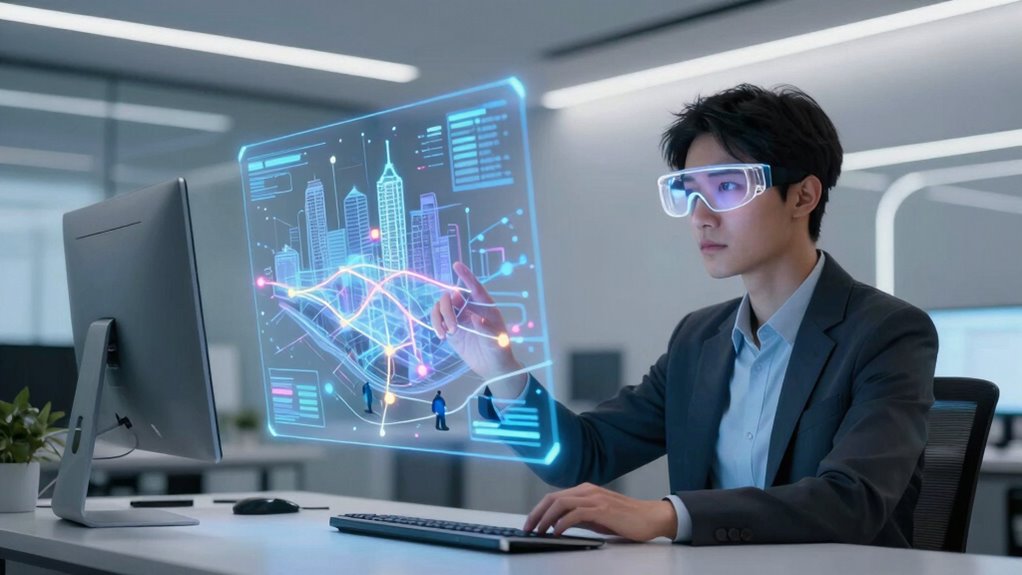

Spatial computing transforms how you interact with digital content by seamlessly blending virtual and physical worlds. It uses tools like augmented reality (AR) and virtual environments to make interactions more intuitive and immersive. This technology changes the way you perform tasks, communicate, and experience information, making everything more integrated into your daily life. If you’re curious about how this evolving technology can reshape your world, you’ll find more exciting insights ahead.

Get the latest gadgets delivered free — and shop member deals
- Fast, free delivery on millions of items
- Access to Prime Big Deal Days deals on October 6–7
- Prime Video, Amazon Music and more included
Key Takeaways
- Spatial computing merges digital and physical environments, enabling seamless interaction with virtual content in real-world settings.
- It utilizes AR and VR technologies to enhance navigation, design, communication, and immersive experiences.
- Spatial computing transforms how we learn, work, and play by making digital interactions more intuitive and contextually relevant.
- It drives innovation in remote collaboration, training, and entertainment through fully digital or augmented environments.
- The technology is essential for future developments in accessibility, digital integration, and immersive environment creation.
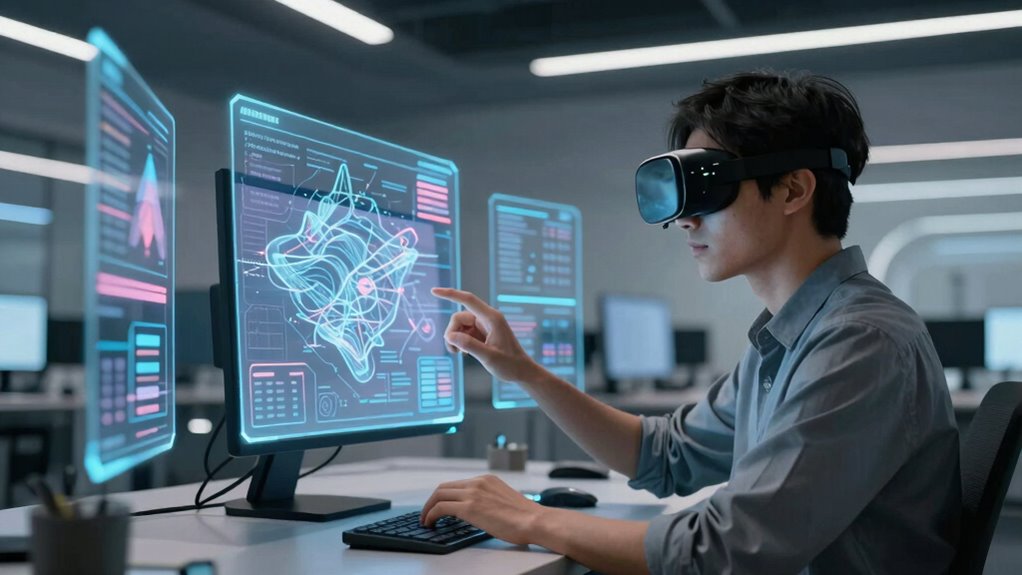
Spatial computing is transforming how we interact with the world around us by seamlessly blending digital and physical environments. This technology allows you to experience and manipulate digital content as if it exists right in your physical space. At its core, spatial computing leverages tools like Augmented Reality (AR) and Virtual Environments to create more immersive, intuitive interactions. Instead of looking at screens or relying solely on traditional interfaces, you’re encouraged to engage with digital information naturally, using gestures, voice commands, or even eye movements. This shift changes not only how you consume information but also how you perform tasks, learn new skills, or communicate.
Spatial computing merges digital and physical worlds, enabling natural, immersive interactions through AR and VR technologies.
Augmented Reality plays a pivotal role in this transformation. It overlays digital elements onto your physical surroundings, so you can see, interact with, and influence virtual objects in real time. Imagine pointing your phone or AR glasses at a room, and instantly, digital furniture appears in your space, allowing you to experiment with interior design without lifting a finger. Or consider how AR can help you navigate complex environments like airports or hospitals by projecting directions directly onto your field of view. This seamless integration makes information more accessible and contextually relevant, ushering in a new way to experience the world.
Virtual Environments, on the other hand, take you into entirely digital worlds that respond to your movements and inputs. When you put on VR headsets, you’re immersed in a space that feels real, despite being entirely virtual. These environments can be designed for entertainment, training, or collaboration, offering a level of engagement that traditional media can’t match. You can explore distant locations, participate in complex simulations, or attend virtual meetings as if you’re physically present. This immersive quality makes Virtual Environments incredibly powerful for education and remote work, breaking down geographical barriers and fostering more natural interactions. Additionally, advances in spatial computing are driving these immersive experiences to become more accessible and integrated into everyday life.
As you embrace spatial computing, you’ll find your relationship with digital content becoming more fluid and intuitive. It’s not just about viewing information anymore; it’s about experiencing it as part of your physical world. Whether it’s through AR enhancing your daily tasks or VR immersing you in new worlds, this technology offers a new paradigm for interaction that’s more immersive, engaging, and efficient. Spatial computing isn’t just a trend — it’s reshaping how you learn, work, and play, making digital experiences more integrated with the physical reality you live in. Exploring augmented reality technology reveals how digital overlays can enhance real-world environments in revolutionary ways.
AR glasses for spatial computing
As an affiliate, we earn on qualifying purchases.
As an affiliate, we earn on qualifying purchases.
Frequently Asked Questions
How Does Spatial Computing Differ From Virtual or Augmented Reality?
Spatial computing differs from virtual or augmented reality by enabling virtual integration directly into your environment, creating seamless interactions. While VR immerses you fully in a digital world and AR overlays digital elements onto your real surroundings, spatial computing enhances sensory immersion by understanding and responding to the physical space around you. It combines these elements, allowing more intuitive, real-time interactions that blend physical and digital worlds effortlessly.
What Industries Are Most Impacted by Spatial Computing Advancements?
You’ll find that industries like healthcare, manufacturing, and architecture are most impacted by spatial computing advancements. It enables better industry integration by leveraging spatial data, which improves accuracy, efficiency, and decision-making. In healthcare, it aids in surgeries and diagnostics. In manufacturing, it streamlines design and assembly processes. Architects use it for immersive visualizations, transforming how projects are planned and executed, ultimately driving innovation and productivity across these sectors.
Are There Privacy Concerns Related to Spatial Data Collection?
Yes, there are privacy concerns related to spatial data collection. You should be aware that data privacy is vital, as spatial computing gathers detailed location and environment information. Companies might collect this data without your explicit consent, risking misuse or breaches. To protect yourself, always review user consent policies and opt out when possible. Staying informed helps guarantee your spatial data remains secure and your privacy is respected.
What Are the Main Technical Challenges in Developing Spatial Computing Devices?
You face several technical challenges when developing spatial computing devices. Ensuring accurate sensor calibration is vital to interpret spatial data correctly, preventing errors in user experience. Additionally, real-time processing demands powerful hardware and optimized algorithms to handle vast data streams swiftly. Overcoming these challenges requires balancing performance, accuracy, and power consumption, making the development process complex but essential for creating effective, immersive spatial computing experiences.
How Accessible Is Spatial Computing Technology for Everyday Consumers?
Spatial computing technology is becoming increasingly accessible, but accessibility barriers and affordability challenges still exist for everyday consumers. You might find high costs and limited device options hold you back from fully experiencing it. However, as technology advances and production scales up, prices are expected to drop, making spatial computing more affordable and widespread. This will gradually bridge the gap, allowing more people like you to enjoy its benefits.
VR headset for immersive environments
As an affiliate, we earn on qualifying purchases.
As an affiliate, we earn on qualifying purchases.
Conclusion
By now, you can see that spatial computing isn’t just a trend—it’s the very fabric shaping our future. Imagine a world where digital and physical blend seamlessly; that’s the power of spatial computing. It’s not just about technology; it’s about transforming your experience, your environment, your reality. So, don’t stay on the sidelines—embrace this revolution before it becomes the story you wish you’d been part of all along.
augmented reality apps for interior design
As an affiliate, we earn on qualifying purchases.
As an affiliate, we earn on qualifying purchases.
virtual reality training systems
As an affiliate, we earn on qualifying purchases.
As an affiliate, we earn on qualifying purchases.
Fall Picks
fall essentials
As an affiliate, we earn on qualifying purchases.