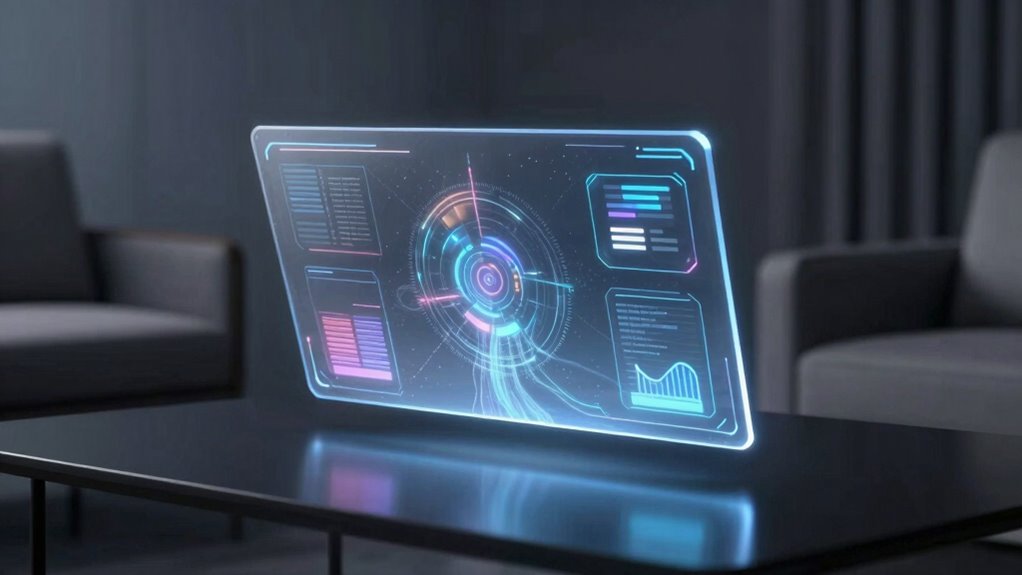

The future of screens involves immersive, seamless experiences that go beyond phones and laptops. You’ll interact with digital content through augmented reality, holography, and gesture or voice controls. Smart glasses and holographic displays will surround you with information and visuals, making tasks more intuitive and immersive. As technology advances, screens will become integrated into your environment, blurring the line between digital and physical worlds. Stay tuned to discover how these innovations will reshape your digital interactions.

Get the latest gadgets delivered free — and shop member deals
- Fast, free delivery on millions of items
- Access to Prime Big Deal Days deals on October 6–7
- Prime Video, Amazon Music and more included
Key Takeaways
- Screens will evolve into immersive, surround environments via augmented reality, holography, and spatial displays.
- Natural gestures and voice commands will replace touch, enabling intuitive interaction with digital content.
- Wearable devices like smart glasses will overlay information directly onto the physical world.
- 3D holographic displays will allow viewing and manipulating digital objects from multiple angles without glasses.
- Digital content will seamlessly integrate with physical surroundings, creating dynamic, context-aware experiences.
Screens are evolving rapidly, transforming how you interact with digital content. No longer confined to flat displays, future screens will blur the lines between reality and technology through innovations like augmented reality and holographic displays. Imagine slipping on a pair of smart glasses and instantly seeing contextual information overlaid onto your surroundings. With augmented reality, your environment becomes a dynamic interface, allowing you to interact with digital objects seamlessly integrated into the real world. This technology will make tasks like navigation, shopping, or even socializing more immersive and intuitive. You won’t need to stare at a screen; instead, digital content will surround you, enriching your experience without distracting from the world around you. As these technologies become more accessible, the way we perceive and utilize digital interfaces will fundamentally change, emphasizing natural interactions. Holographic displays are another breakthrough that promises to make screens more lifelike and engaging. Picture a future where 3D images float in space, visible from multiple angles without the need for glasses or headgear. These displays will enable you to view complex data, artwork, or even 3D models as if they’re physically present, opening new possibilities for education, design, and entertainment. The evolution from flat screens to holograms means you’ll be able to manipulate digital objects in three dimensions just as easily as you would handle physical ones. This shift will dramatically enhance collaboration, allowing multiple people to interact with the same holographic content in real-time, regardless of their physical location. As these technologies become more accessible, your interactions will become more natural and immersive. Instead of tapping a touchscreen or clicking a mouse, you might gesture to manipulate virtual objects or speak commands to control your environment. Wearable devices like augmented reality glasses or contact lenses will project digital information directly onto your field of view, making screens feel like an extension of your perception. The boundary between digital and physical worlds will continue to dissolve, giving you a more fluid, engaging way to access information and entertainment. Additionally, digital interfaces will evolve to become more intuitive, allowing for smoother integration into daily routines. Advances in display technology will further enhance clarity, brightness, and realism, making digital visuals indistinguishable from the physical world. As immersive technology advances, the line between virtual and real environments will increasingly blur, offering more lifelike and interactive experiences. In the future, screens won’t be confined to devices you hold or look at—they’ll surround you, adapt to your needs, and seamlessly integrate into your daily life. Technologies like augmented reality and holographic displays will redefine how you see, interact with, and interpret digital content, making the concept of a screen more intuitive, immersive, and alive.
Frequently Asked Questions
Will Screens Become Fully Invisible or Transparent in the Future?
Yes, screens will likely become fully invisible or transparent in the future. You’ll experience augmented reality through wearable displays that blend seamlessly with your surroundings, making screens feel invisible. These wearable displays will project digital information onto transparent surfaces, allowing you to see through them while still interacting with virtual content. This evolution will make technology more immersive, eliminating bulky devices and integrating digital displays naturally into your everyday environment.
How Will Screens Adapt for Use by Visually Impaired Users?
You’ll see screens adapting for visually impaired users by integrating tactile and auditory features. Haptic feedback will let you feel textures and signals, while auditory interfaces will read content aloud, making information accessible. These innovations work together to create an inclusive experience—allowing you to navigate, interact, and understand digital content through touch and sound. This dual approach enhances independence, ensuring technology serves everyone, regardless of visual ability.
What Are the Environmental Impacts of Emerging Screen Technologies?
You should know that emerging screen technologies can have significant environmental impacts. Manufacturers are increasingly using eco-friendly materials to reduce waste and toxicity. However, these new screens often consume more energy during production and use, leading to higher energy consumption. While innovations aim to minimize ecological footprints, balancing advanced features with sustainability remains a challenge, urging you to support eco-conscious choices when adopting new screen tech.
Will Future Screens Be Safe for Prolonged Eye Exposure?
Future screens are likely to be safer for your eyes, but you should still watch for eye strain and blue light exposure. Advances in screen technology aim to reduce harmful blue light emissions and minimize eye fatigue, making prolonged use more comfortable. However, it’s smart to take regular breaks and use blue light filters to protect your vision and prevent discomfort during extended screen time.
How Will Privacy Be Maintained With Ultra-Immersive Screens?
With ultra-immersive screens, privacy hinges on advanced data encryption and user authentication, ensuring your personal info stays secure. Imagine a world where 75% of users feel confident their data is protected—these measures make it possible. You’ll authenticate with biometrics or passwords, and encryption keeps your conversations and data private, even in highly immersive environments. This way, your experiences remain personal, safe, and under your control.
Conclusion
As you look ahead, screens will become as seamless and invisible as a whisper, blending effortlessly into your daily life. You’ll interact with technology that’s more intuitive and immersive, like stepping into a storybook where the boundaries between digital and real fade away. The future of screens promises a world where information surrounds you like a gentle breeze—constant, unobtrusive, and always at your fingertips. Embrace it, because the next chapter is just around the corner.
Fall Picks
fall essentials
As an affiliate, we earn on qualifying purchases.