
TL;DR
IdeaClyst is a local-first, AI-powered war room for startups. It helps founders validate ideas quickly through structured debate, research, and planning—without leaving their laptop. A War Room for Your Next Idea: Inside IdeaClyst It makes the costly process of choosing what to build much more precise and confident. A War Room for Your Next Idea: Inside IdeaClyst
A war room for your next idea
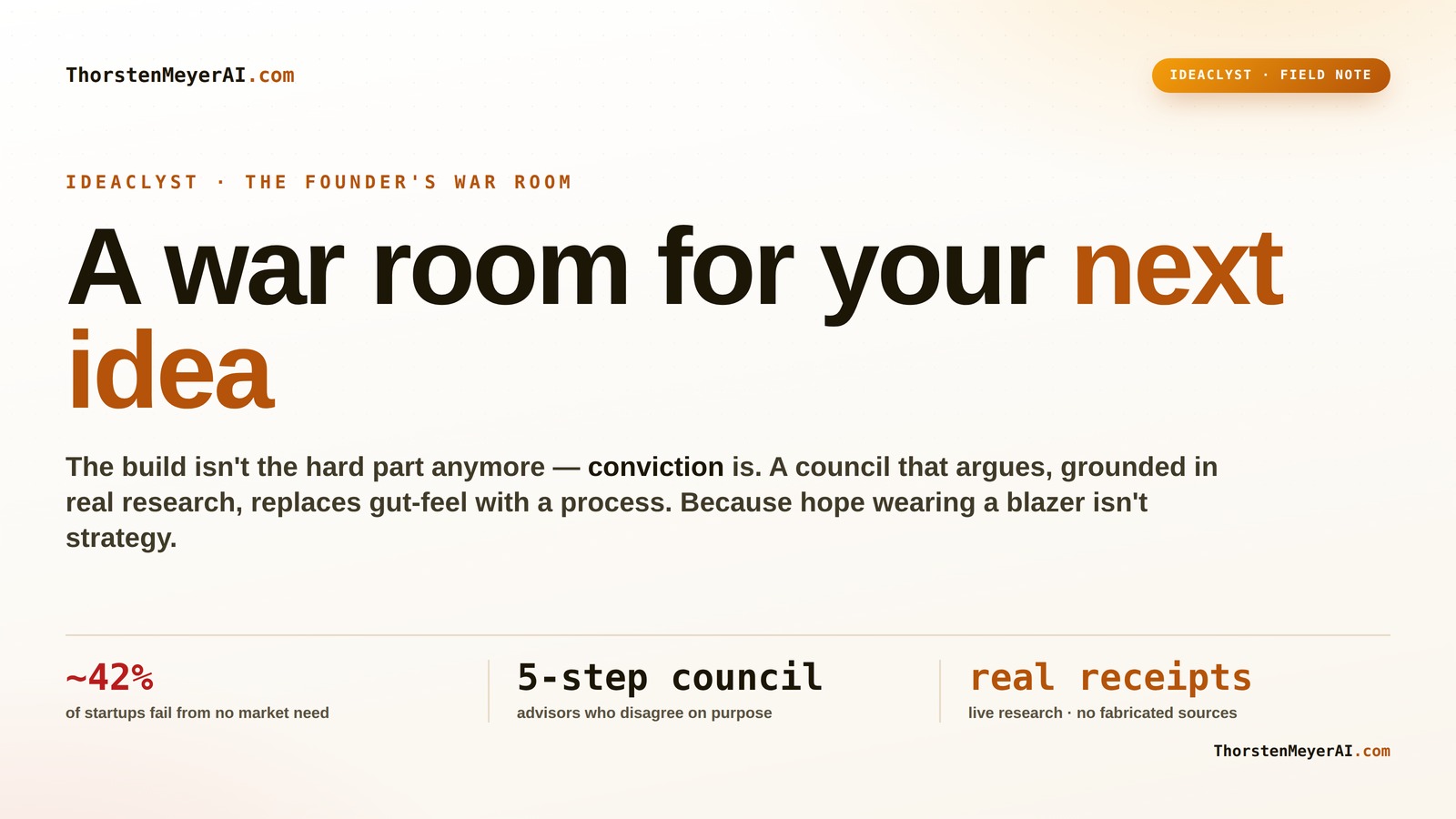
The build isn’t the hard part anymore — conviction is. Knowing which idea deserves the next six months, and being able to defend it. Most founders answer with gut feel and optimistic math. That’s hope wearing a blazer. IdeaClyst replaces it with a process.
The most expensive decision is what to build
The single most valuable thing a tool can do is talk you out of the wrong six months. The numbers make the case better than any pitch.
digital war room software for startups
As an affiliate, we earn on qualifying purchases.
As an affiliate, we earn on qualifying purchases.
Three tools in one — on your own machine
Strip away the framing and IdeaClyst is three things at once, all running locally with nothing leaving your laptop.
An AI council
Pressure-tests an idea you bring it — advisors who argue on purpose.
A discovery engine
Finds ideas you didn’t know to look for by hunting real demand signals.
A founder’s workspace
Carries winners from “interesting” all the way to “ready to build.”
idea validation tools for entrepreneurs
As an affiliate, we earn on qualifying purchases.
As an affiliate, we earn on qualifying purchases.
Advisors who disagree on purpose
Not one confident, agreeable answer — a structured five-step deliberation where models play different roles and turn on their own work. The disagreement is the feature.
The five-step deliberation
A council that leads with the bad news surfaces the objections you’d otherwise find the expensive way, on month five.
Product strategy
Who’s it for, what’s the wedge, why now, what’s the business model.
Technical architecture
What would it actually take to build — and where’s the risk.
Critique pass
The council turns on its own work. Where’s the hand-waving? What kills this?
Second, independent critique
A different voice, a different angle — so blind spots don’t survive.
Final synthesis
Everything into one coherent founder packet: strategy, architecture, validation, plan.
AI-powered research and planning software
As an affiliate, we earn on qualifying purchases.
As an affiliate, we earn on qualifying purchases.
When IdeaClyst cites a source, it actually fetched it
The hard departure from “ask an AI what it thinks of my startup.” It runs in a strict, real-data-only mode — if it can’t gather genuine evidence, it says so plainly rather than inventing a plausible paragraph.
Confidence with receipts
No fabricated statistics, no imaginary competitors, no made-up citations. The packet survives a skeptical co-founder or a sharp investor because the reasoning has receipts.
Market research first
Scouts the landscape before the council reasons about anything.
Competitor read
Real positioning, pricing signals, feature claims — differentiation vs. reality.
Validation with links
Not “talk to customers” — concrete signals & sources you can click.
collaborative startup decision-making tools
As an affiliate, we earn on qualifying purchases.
As an affiliate, we earn on qualifying purchases.
From the blank page to build-ready
Evaluation is half the problem; the blank page is the other half. And a plan is worthless if it dies in a tab you never reopen.
Bring a space, not an idea
“AI for accountants,” “tools for indie game studios” — plus your goal and real capacity. It hunts demand signals across HN, Reddit, Product Hunt, GitHub, pricing pages.
- An honest market read — leads with the bad news when a space is hard
- An opportunity map — high pain, thin competition
- Ranked candidates — wedge, who pays, effort, risk, confidence
- each with KILL CRITERIA — when to walk away
A home and a forward path
Every promising idea gets carried forward, with every artifact in plain files on your disk.
- Validation tooling — sprint board, interview list, evidence browser
- Founder profile — a personal-fit lens; same discovery, different advice
- Build workspaces — funnel, personas, landing draft, version history
- “Build this idea” → a PRD + task queue, ready for a coding agent
Key Takeaways
- A digital war room like IdeaClyst centralizes idea validation, saving startups over $100,000 annually in misguided development costs.
- Structured debates among AI models surface objections early, reducing costly mistakes and increasing decision confidence.
- Grounding critiques in live web research ensures recommendations are relevant and timely, avoiding outdated assumptions.
- Organize your war room with clear summaries, research, critiques, and validation plans—think of it as a living, breathing document.
- Regular maintenance and simplicity keep your digital war room effective and prevent it from becoming a cluttered, unused space.
What is IdeaClyst? Your Digital War Room for Smarter Decisions
IdeaClyst is a local-first, open-source platform that acts as a dedicated space for your startup’s ideas—think of it as a digital war room. It combines AI-driven advice, a discovery engine, and a structured workspace, all on your own machine. No cloud, no subscriptions, just your ideas and the tools to test them.
Imagine having a boardroom, a whiteboard, and a team of advisors all on your laptop. That’s IdeaClyst: a place where your ideas are debated, critiqued, and refined through a structured, multi-model council. It’s designed to mimic a real-world war room—except it lives inside your computer, and your data stays exactly where it belongs: with you. A War Room for Your Next Idea: Inside IdeaClyst
Why a Digital War Room Beats a Whiteboard or Slack Thread
A physical war room is great for visibility and team focus, but a digital one like IdeaClyst takes it further. A War Room for Your Next Idea: Inside IdeaClyst It centralizes all your idea research, debate, and planning into one organized, version-controlled document system. Unlike scattered Slack messages or sticky notes, everything lives on your disk, ready for review or revision.
Why does this matter? Because in fast-paced startup environments, ideas evolve rapidly, and decisions must be revisited and refined continuously. A digital war room allows for this fluidity without losing context. It provides a single source of truth where all relevant data, critiques, and decisions are stored securely and transparently. This setup reduces miscommunication, minimizes lost insights, and accelerates iteration cycles. The tradeoff is that it requires a disciplined approach to organization; otherwise, it can become just another cluttered file system. The benefit, however, is that this structure empowers founders to make smarter, data-backed decisions quickly, rather than relying on memory or scattered notes.
When you bring an idea to IdeaClyst, it doesn’t just give a yes or no. A War Room for Your Next Idea: Inside IdeaClyst Instead, it convenes a structured debate among different AI models—each playing a role like a different advisor. One critiques your product strategy, another examines technical risks, and a third tests assumptions.
This multi-perspective critique is the core advantage. It surfaces objections early, saving you months of misguided work. By engaging multiple AI models with distinct viewpoints, you gain a more comprehensive understanding of your idea’s strengths and weaknesses. This approach not only accelerates validation but also encourages founders to think more critically and holistically about their ideas. The tradeoff is that it requires thoughtful configuration—over-reliance on AI without human judgment can lead to overlooked nuances. Nonetheless, the benefit of catching potential flaws early and gaining diverse insights can significantly reduce costly missteps and increase the likelihood of success.
Final output? A detailed founder packet in Markdown, with sections on strategy, architecture, critique, and validation plans. Everything is versioned, owned, and ready to present—making it easier to communicate your idea’s robustness to stakeholders or investors.
Grounded in Reality: How IdeaClyst Uses Live Web Research to Validate Ideas
Unlike most AI tools that answer based on static data or guesses, IdeaClyst pulls in live web research to ground its critiques. A War Room for Your Next Idea: Inside IdeaClyst It searches current market trends, competition, and user data, making its advice timely and relevant.
This real-time data access is crucial because markets are constantly shifting. Relying on outdated or static information can lead to flawed strategies. By integrating live web research, IdeaClyst ensures that all critiques and recommendations reflect the current environment, helping founders avoid outdated assumptions that could derail their plans. For example, instead of vague claims like “the market is growing,” it can cite recent sales figures, new competitors, or emerging customer needs—providing context that informs smarter decisions. The implication is that founders can act with greater confidence, knowing their strategies are rooted in the latest data, reducing the risk of blind spots and confirmation bias. Ultimately, this approach bridges the gap between analysis and action, making validation more accurate and relevant.