

Edge computing processes data closer to where it’s generated, reducing latency, boosting real-time responses, and enhancing security. Cloud computing, on the other hand, relies on centralized data centers, offering scalability and cost efficiency but with higher delays. The next big shift combines these approaches in hybrid models, optimizing performance and resource management. Understanding these differences helps you make smarter choices about deploying digital infrastructure—stay tuned to find out how this evolution shapes the future.
Key Takeaways
- Edge computing processes data locally near sources, reducing latency and enabling real-time decisions, unlike cloud computing’s centralized approach.
- Cloud computing offers scalable, remote resources ideal for large data storage, whereas edge focuses on immediate processing at the source.
- Combining both creates hybrid models that optimize performance, security, and cost-efficiency across diverse industries.
- Edge reduces data transmission costs and enhances privacy, while cloud provides easier management and elastic scalability.
- The future of computing integrates edge and cloud solutions for faster, smarter, and more secure digital ecosystems.

NETGEAR Nighthawk Cable Modem and WiFi 5 Router Combo (C7000) - Compatible with Major Cable Providers incl. Xfinity & Cox - Cable Plans up to 800Mbps - AC1900 (Up to 1.9Gbps) - DOCSIS 3.0
- Two-in-One Modem Router: Combines modem and router in one device
- WiFi 5 Speed: Up to 1.9Gbps for streaming and gaming
- Wide Coverage with Beamforming+: Boosts range and reduces dead spots
As an affiliate, we earn on qualifying purchases.
Fundamental Differences in Location and Architecture

The fundamental difference between edge computing and cloud computing lies in their location and architecture. With edge computing, you process data close to its source—like IoT devices or sensors—reducing travel distance and latency. This setup is decentralized, distributing resources near users or devices for rapid responses. In contrast, cloud computing relies on centralized data centers located remotely, often across the globe. Its architecture is highly scalable and virtualized, offering vast resources from a few large facilities. Edge architecture emphasizes local or regional nodes to handle real-time data, while cloud infrastructure provides extensive, on-demand capacity for large-scale processing. Sometimes, hybrid models combine both, leveraging the immediacy of edge with the power of cloud to optimize workflows and performance. Additionally, high refresh rates in projectors can significantly enhance real-time data visualization, which is especially beneficial in edge computing scenarios where quick data processing is critical. Furthermore, understanding the distribution of resources between edge and cloud environments can help optimize overall system efficiency and reliability. Incorporating resource allocation strategies can further refine system performance by dynamically adjusting workloads based on demand and capacity. Recognizing the energy efficiency of each approach can also contribute to more sustainable and cost-effective solutions. Moreover, considering scalability options ensures that the system can adapt to future growth and changing demands.

NETGEAR Nighthawk WiFi 6Cable Modem Router CAX30-100NAR Compatible with Xfinity, Spectrum, and Cox, AX2700 (Up to 2.7Gbps) DOCSIS 3.1 (Renewed)
- Compatibility: Works with major cable providers up to 2Gbps
- Coverage: Up to 2,500 sq. ft. with WiFi 6
- Device Capacity: Supports 25 devices simultaneously
As an affiliate, we earn on qualifying purchases.
Impact on Data Latency and Processing Speed
You’ll notice that edge computing drastically reduces transmission delays by processing data near its source, enabling real-time responses. In contrast, cloud computing can introduce higher latency because data must travel farther to centralized servers. This difference directly impacts processing speeds, especially in time-sensitive applications where milliseconds matter. Additionally, local automation plays a key role in optimizing response times within smart homes by handling data processing on‑site. As the digital infrastructure continues to evolve, understanding these technological differences becomes crucial for making informed investment decisions in digital infrastructure. Furthermore, data center locations influence latency levels, as strategically placed centers can mitigate delays associated with cloud computing. Recognizing the importance of distributed data processing can help optimize overall system performance and reliability.
Real-Time Data Handling
Real-time data handling plays a crucial role in determining how quickly systems can respond to events, directly impacting data latency and processing speed. When you prioritize immediate responses, edge computing shines by processing data near sources like sensors and devices, reducing delays. This approach supports home safety & accessibility by enabling faster detection of hazards or emergencies, enhancing safety at home. This enables your system to react instantly, essential for applications like autonomous vehicles or industrial automation. Additionally, edge computing’s decentralized architecture helps distribute workloads, further speeding up responses and reducing bottlenecks.
Consider these key points:
- You get near-instant feedback, boosting operational efficiency.
- Your system minimizes delays, supporting critical decision-making.
- You reduce dependency on centralized servers, ensuring faster responses.
- Your workflows become more resilient, even during internet disruptions.
Transmission Delay Reduction
How much does transmission delay impact data latency and processing speed? It can markedly slow down your system’s response time, especially in time-sensitive applications. When data travels to a centralized cloud, the delay caused by physical distance and network congestion increases latency. This makes real-time processing challenging. With edge computing, data is processed closer to the source, drastically reducing transmission delays. This proximity allows for faster decision-making and immediate responses. As a result, tasks like autonomous driving or industrial automation become more reliable and efficient. By minimizing the need to send every piece of data over long distances, you experience quicker processing speeds and lower latency. Overall, reducing transmission delay enhances your system’s responsiveness, especially in scenarios where every millisecond counts. Additionally, understanding network infrastructure can help optimize data flow and further improve performance. Incorporating network topology insights can also help identify bottlenecks and optimize data routing for even better results.
Processing Speed Variations
Processing speed variations directly influence data latency and overall system performance, especially when handling time-sensitive tasks. When processing speeds fluctuate, your system’s responsiveness can suffer, leading to delays or missed opportunities. Faster processing ensures real-time reactions, essential for applications like autonomous vehicles or industrial automation. Conversely, slower speeds create bottlenecks and frustration. Consider these impacts:
- Critical delays that can jeopardize safety or efficiency.
- Reduced user experience due to sluggish responses.
- Increased operational costs from processing inefficiencies.
- Potential data loss or outdated insights affecting decision-making.

Arris (G18) - Cable Modem Router Combo - Fast DOCSIS 3.1 Multi-Gigabit WiFi 6 (AX1800), Approved for Comcast Xfinity, Cox, Spectrum & More
- High-Speed Internet: Fast, reliable connection for streaming and gaming
- Advanced Modem Technology: Uses DOCSIS 3.1 for enhanced speed and security
- Wi-Fi 6 Coverage: Dual-band Wi-Fi 6 for wider, faster wireless coverage
As an affiliate, we earn on qualifying purchases.
Scalability Challenges and Resource Management Strategies
Scalability remains one of the primary challenges in deploying edge computing solutions, as expanding local nodes and maintaining consistent performance can quickly become complex and costly. Unlike cloud systems, where resources can be scaled elastically, edge setups require deploying additional physical devices or nodes, which involves higher costs and logistical hurdles. Managing these resources demands careful planning to ensure reliability and performance. You must consider network connectivity, hardware limitations, and maintenance efforts. To visualize, here’s a quick comparison:
| Aspect | Cloud | Edge |
|---|---|---|
| Scalability Approach | Virtual, elastic resources | Physical, limited by hardware |
| Cost & Deployment | Lower, rapid scaling | Higher, complex expansion |
| Management Complexity | Centralized | Decentralized, challenging |
| Resource Flexibility | Virtually unlimited | Constrained by device limits |
| Performance Stability | Consistent across regions | Variability due to hardware |
Additionally, implementing effective resource management strategies is crucial for optimizing performance and controlling costs in both paradigms. Proper planning and monitoring systems are essential to adapt to changing demands and prevent resource bottlenecks. Leveraging advanced analytics can further enhance resource allocation and operational efficiency in these environments. Moreover, adopting automated management tools can streamline maintenance and reduce manual oversight, which is especially important in decentralized edge deployments. Furthermore, understanding the unique hardware limitations associated with edge devices helps in designing more resilient and scalable solutions.

NETGEAR Nighthawk Modem Router Combo (CAX30) DOCSIS 3.1 Cable Modem and WiFi 6 Router - AX2700 2.7 Gbps - Compatible with Xfinity, Spectrum, Cox, and More - Gigabit Wireless Internet
- Compatibility: Works with major cable providers
- Coverage and Speed: Up to 2,000 sq. ft., 25 devices, WiFi 6
- Ports and Connectivity: 4 Gig Ethernet ports, USB 3.0
As an affiliate, we earn on qualifying purchases.
Bandwidth Optimization and Cost Implications
By processing data locally, edge computing minimizes the amount of information sent over the network, reducing bandwidth costs. In contrast, cloud computing often requires transmitting large volumes of raw data, increasing expenses. Understanding these differences helps you choose the most cost-effective approach for your data needs. Additionally, integrating connected equipment into your setup can further optimize data flow and operational efficiency. Properly managing user consent and cookie preferences also plays a role in maintaining privacy and compliance while leveraging these technologies. Implementing navigation and mapping strategies can enhance system accuracy and reliability, especially in complex environments. Incorporating power backup tips can ensure your systems remain reliable during outages, preventing data loss or downtime. Leveraging edge analytics can also provide real-time insights and faster decision-making, boosting overall system performance.
Local Processing Reduces Data Transfer
Local processing in edge computing considerably reduces the amount of data transmitted to central servers, which helps optimize bandwidth usage. By filtering and analyzing data at or near the source, you send only essential information, preventing network congestion. This not only speeds up response times but also cuts costs associated with data transfer and storage. Imagine the impact of:
- Faster decision-making with real-time insights.
- Lower operational expenses due to decreased bandwidth needs.
- Enhanced network reliability by reducing data load.
- Greater data privacy since sensitive info stays closer to its source.
Additionally, data management strategies play a crucial role in maximizing the benefits of local processing and ensuring efficient system operation.
This approach ensures you’re using your network resources efficiently, making your systems more responsive, cost-effective, and secure. Local processing empowers you to handle data smarter, not harder, in today’s connected world.
Cost Savings in Bandwidth
Implementing bandwidth optimization in edge computing can lead to significant cost savings by reducing the amount of data transmitted to the cloud. By processing data locally, you send only essential or summarized information, lowering transmission fees and decreasing network congestion. This approach is especially beneficial for IoT environments, where large data volumes can quickly inflate costs. To illustrate, consider this comparison:
| Aspect | Cloud Computing | Edge Computing | Cost Implication |
|---|---|---|---|
| Data Transmitted | Raw, unfiltered data | Filtered or aggregated data | Lower in edge, reducing costs |
| Bandwidth Usage | High | Moderate to low | Significant savings for large data flows |
| Cost Efficiency | Higher transmission costs | Cost-effective data handling | Saves money on bandwidth expenses |
| Data Processing Location | Centralized | Near data sources | Less data sent over networks |
| Impact on Network | Congestion risk | Reduced network load | Less network strain, lower costs |
Security Concerns and Data Privacy Considerations
Security concerns and data privacy considerations are central when choosing between edge and cloud computing, as each approach presents distinct vulnerabilities and protections. With edge computing, data stays close to its source, reducing exposure during transmission, but the distributed nature increases the attack surface. Cloud environments offer robust security protocols and centralized management, simplifying compliance but risking data breaches across borders. Your biggest challenge is balancing control with vulnerability. Consider these points:
- Edge’s local data privacy minimizes transmission risks but demands strong device security.
- Distributed architecture increases physical attack points, raising vulnerability fears.
- Cloud’s encryption and disaster recovery bolster protection but face jurisdictional compliance hurdles.
- Choosing the right approach hinges on your industry’s regulatory needs and your capacity to secure data effectively.
Key Use Cases Driving Adoption in Various Industries
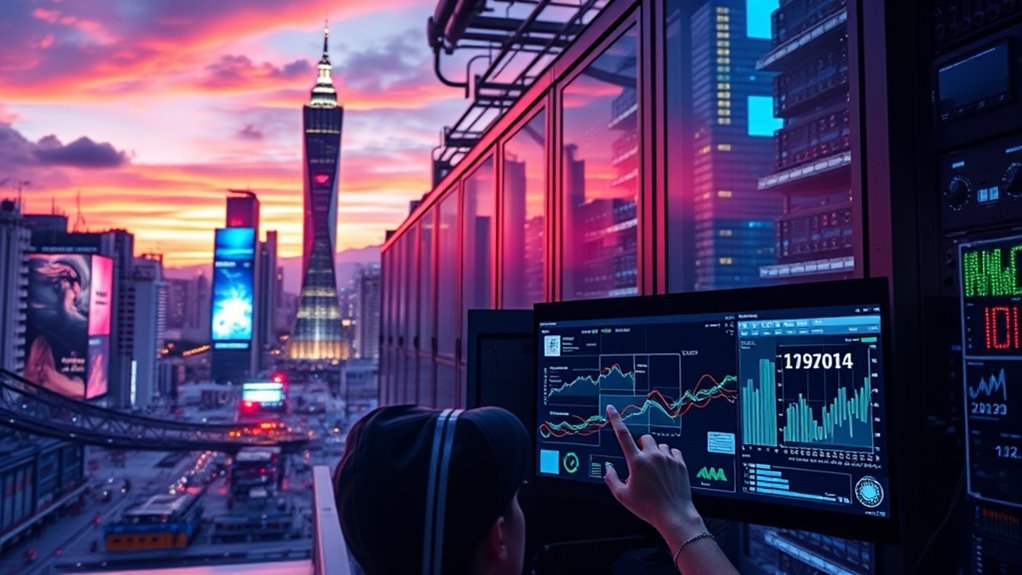
Autonomous vehicles, robotics, and smart factories are transforming industries through real-time data processing. You’ll see edge computing play a pivotal role in enabling instant decision-making and automation at the source. These use cases showcase how local processing drives efficiency, safety, and innovation across sectors.
Autonomous Vehicles and Robotics
Autonomous vehicles and robotics are a driving force behind the rapid adoption of edge computing because they demand real-time data processing and ultra-low latency responses. You need immediate decisions to guarantee safety and efficiency. Without quick responses, accidents or failures could happen. Edge computing processes data locally, enabling vehicles to react instantly to changing conditions. Here are four key impacts:
- Enhanced Safety: Instant data analysis prevents accidents by responding to hazards faster than cloud-based systems.
- Operational Reliability: Robots operate smoothly even with intermittent internet, maintaining productivity.
- Reduced Latency: Near-instant processing ensures seamless navigation and obstacle avoidance.
- Data Privacy: Sensitive information stays close to the source, reducing exposure risks.
This localized processing is essential for autonomous systems to perform at its best and safely.
Smart Factories and Automation
Smart factories and automation are transforming manufacturing by enabling real-time monitoring, control, and optimization of industrial processes. With edge computing, you can process data locally from sensors and machines instantly, reducing latency and enabling immediate responses to issues. This means faster defect detection, predictive maintenance, and adaptive production lines that respond dynamically to changing conditions. Cloud computing supports long-term data storage, analytics, and system orchestration, but it often falls short for time-critical tasks. Hybrid models combine both, allowing you to handle urgent tasks locally while leveraging the cloud for large-scale analysis. By adopting these technologies, you improve efficiency, reduce downtime, and enhance product quality, making your factory smarter and more responsive in a competitive landscape.
Hybrid Models: Combining Edge and Cloud for Optimal Performance

Hybrid models that combine edge and cloud computing are transforming how organizations handle data processing and management. These models let you leverage the strengths of both, creating seamless workflows that boost performance. Imagine:
- Faster decision-making by processing critical data locally at the edge, reducing delays.
- Cost savings through minimized data transfer, lowering bandwidth expenses.
- Enhanced security by keeping sensitive info close to the source, reducing exposure.
- Scalability with flexible deployment, letting you expand local nodes or cloud resources as needed.
Technological Infrastructure and Deployment Flexibility
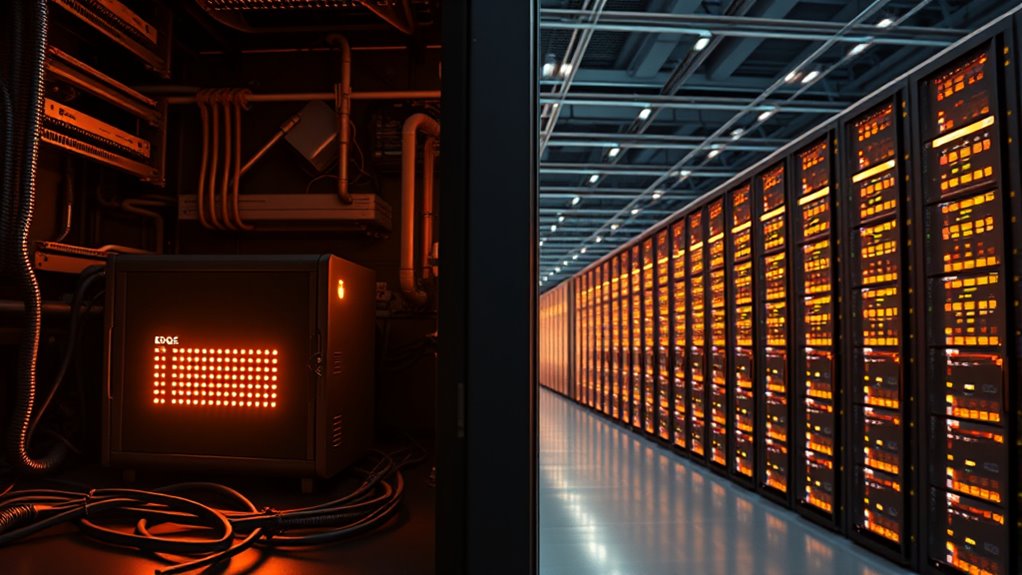
Have you ever wondered how organizations adapt their technological infrastructure to meet diverse operational needs? With edge computing, you deploy localized hardware like sensors, gateways, and regional nodes close to data sources, offering flexibility for real-time processing. You can add or move these devices to target specific areas without overhauling the entire system. Conversely, cloud infrastructure relies on centralized data centers that provide scalable, virtualized resources accessible globally. This setup allows you to quickly expand capacity or update software remotely, simplifying deployment across multiple locations. Hybrid models combine both approaches, giving you the ability to process critical data locally while leveraging cloud resources for heavy analytics and storage. This flexibility enables tailored solutions, balancing performance, cost, and compliance based on your operational demands.
Future Trends and Predictions for Edge and Cloud Integration
As organizations continue to expand their technological infrastructure, the integration of edge and cloud computing is expected to become increasingly seamless and sophisticated. You’ll see more hybrid solutions that combine real-time edge processing with powerful cloud analytics, creating smarter, more responsive systems. Here are some future trends to watch:
- Deeper AI Integration – Expect AI to be embedded at the edge, enabling instant decision-making without cloud reliance.
- Automated Orchestration – Increased use of containerization and orchestration tools will simplify managing hybrid environments.
- Enhanced Security Measures – Advanced encryption and decentralized security frameworks will protect data across both spheres.
- Industry-Specific Solutions – Tailored edge-cloud architectures will emerge for healthcare, manufacturing, and other sectors, optimizing performance and compliance.
Selecting the Right Approach for Business Needs

Choosing the right computing approach depends on your specific business needs and operational priorities. If real-time processing is critical—like in autonomous vehicles or industrial automation—edge computing is your best fit because it offers ultra-low latency and local data handling. For large-scale data storage, analytics, or machine learning tasks, cloud computing provides scalable, centralized resources that can grow with your business. Hybrid models combine both, enabling immediate local responses while leveraging cloud’s extensive processing power for long-term insights. Consider your bandwidth, security, and compliance requirements too. If data privacy and regulatory compliance are paramount, edge may be preferable. Ultimately, evaluate your application’s responsiveness, scalability, cost constraints, and security needs to determine whether edge, cloud, or a hybrid approach aligns with your business goals.
Frequently Asked Questions
How Do Edge and Cloud Computing Impact Data Governance and Compliance?
You should consider how edge and cloud computing impact data governance and compliance. Edge keeps sensitive data local, enhancing privacy and making it easier to meet regulations. However, it broadens the attack surface and complicates security. Cloud centralizes data, simplifying compliance management with strong security protocols. Balancing both allows you to leverage local control and centralized oversight, ensuring data policies are enforced while maintaining security and regulatory requirements.
What Are the Cost Differences Between Scaling Edge Devices and Expanding Cloud Resources?
Scaling edge devices generally costs more because you need to deploy and maintain multiple localized nodes, which can be expensive and complex. Expanding cloud resources, on the other hand, is often more cost-effective thanks to elastic virtual resources and subscription models that allow you to increase capacity without physical hardware investments. While edge scaling offers low latency benefits, cloud expansion provides easier, faster scalability for large workloads and global access.
How Does Network Reliability Influence Edge and Cloud Deployment Choices?
Network reliability greatly impacts your deployment choices. If your internet connection is unstable, edge computing becomes more attractive because it can operate locally without constant connectivity, ensuring real-time data processing. Conversely, cloud computing relies heavily on consistent, high-quality internet for data transfer and access to centralized resources. Poor network reliability can cause delays or disruptions in cloud-based tasks, making edge solutions preferable for critical, latency-sensitive applications.
What Security Measures Are Most Effective for Protecting Edge Devices?
You need strong security measures for your edge devices because they’re vulnerable to physical tampering and cyberattacks. Use encryption to protect data in transit and at rest, along with strong access controls to prevent unauthorized use. Regular firmware updates and network monitoring help spot threats early. Combining physical security with these digital defenses keeps your devices safer, ensuring your data stays private and your operations remain reliable.
How Will Emerging Technologies Like 5G Affect Edge and Cloud Computing Strategies?
Emerging 5G technology will dramatically enhance your edge and cloud strategies. With ultra-fast, low-latency connections, 5G enables real-time processing at the edge, supporting applications like autonomous vehicles and smart factories. It also boosts cloud capabilities by facilitating faster data transfer and seamless integration between devices and centralized servers. You’ll find more reliable, scalable, and efficient solutions, making both edge and cloud computing more responsive and better suited for data-intensive, latency-sensitive tasks.
Conclusion
As you navigate the world of edge and cloud computing, remember that choosing the right approach is like picking a trusty steed for your quest—each has its strengths and quirks. Whether you prioritize speed, security, or scalability, understanding these shifts helps you stay ahead of the curve. Don’t get caught in the stone age; embrace the future of tech, and make your business as innovative as a flying car in 2023.