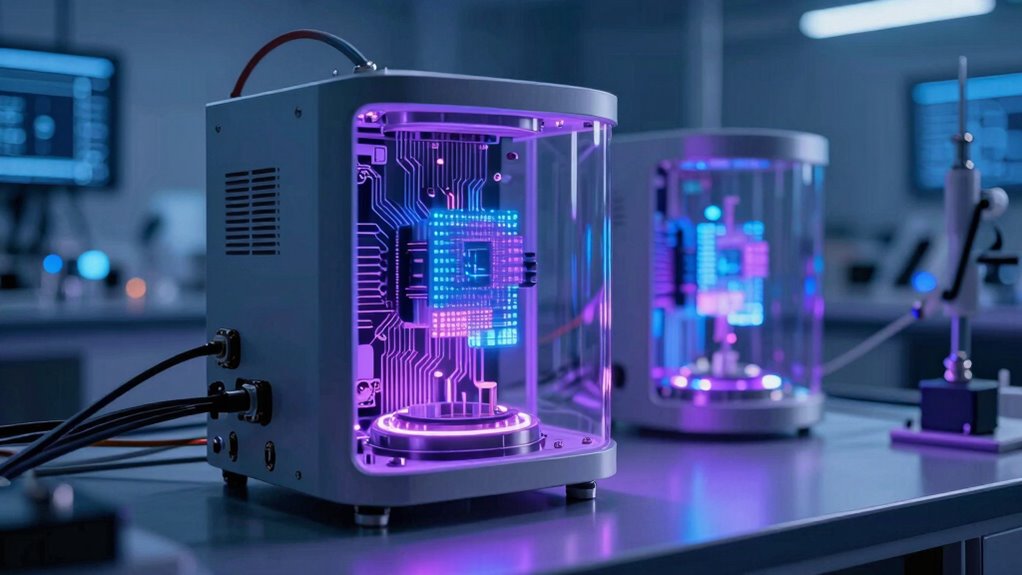

Quantum computing is likely to first change fields that demand complex calculations, like cryptography, materials science, and optimization. You’ll see it improve encryption security, develop new materials faster, and solve problems beyond the reach of classical computers. As hardware advances, these impacts will grow more dramatic. If you want to understand how this technology will reshape your world and reveal new possibilities, keep exploring what’s coming next.

Get the latest gadgets delivered free — and shop member deals
- Fast, free delivery on millions of items
- Access to Prime Big Deal Days deals on October 6–7
- Prime Video, Amazon Music and more included
Key Takeaways
- Cryptography will be the first major area impacted, with quantum algorithms threatening current encryption methods.
- Optimization problems in logistics and finance will see rapid improvements through quantum-enhanced algorithms.
- Material science and drug discovery processes will accelerate as quantum simulations model molecules more accurately.
- Industry-specific applications, like supply chain management, will adopt quantum solutions to increase efficiency.
- Early hardware advancements will enable practical demonstrations of quantum advantages in real-world tasks.

Quantum computing is revolutionizing technology faster than many expected, fundamentally changing how we approach complex problems. Its potential to solve issues that stump classical computers is opening doors to innovations across multiple fields. At the heart of this transformation are quantum algorithms, which leverage the unique properties of qubits to perform calculations exponentially faster for certain problems. These algorithms are designed to exploit quantum superposition and entanglement, enabling breakthroughs in areas like cryptography, optimization, and simulation. As researchers develop more sophisticated quantum algorithms, you’ll see these capabilities first making waves in sectors where classical methods struggle.
Alongside these algorithms, hardware advancements are accelerating the practical deployment of quantum computers. Early quantum devices faced significant limitations, such as qubit stability and error rates, which hindered their real-world usefulness. But recent progress in hardware design—like better qubit coherence, improved error correction, and more reliable quantum gates—means quantum machines are becoming more stable and scalable. This progress is crucial because, without reliable hardware, even the most clever algorithms can’t be effectively executed. As hardware continues to improve, you’ll notice quantum computers starting to handle more complex tasks than ever before, bringing their theoretical advantages closer to practical application. Moreover, advancements in qubit coherence are essential for reducing error rates and increasing computational reliability. Additionally, innovations in quantum error correction are vital for maintaining data accuracy during computations. Furthermore, ongoing research in scalable quantum hardware aims to facilitate the transition from experimental devices to commercially viable quantum systems. A deeper understanding of quantum hardware architecture will also play a significant role in achieving this goal. Continued research into quantum hardware design is expected to unlock new possibilities for scalable and reliable quantum systems.
The first major area that will change with these advancements is cryptography. Quantum algorithms, such as Shor’s algorithm, threaten to crack encryption methods that currently secure our digital communications. This shift will force industries and governments to adopt quantum-resistant encryption, fundamentally altering cybersecurity protocols. You might also see a transformation in material science and pharmaceuticals, where quantum simulations can model molecules at an atomic level much more accurately than classical computers. This could lead to faster drug discovery and the development of new materials, revolutionizing healthcare and manufacturing.
Optimization problems, from supply chain logistics to financial modeling, stand to benefit as well. Quantum algorithms can sift through vast solution spaces more efficiently, leading to more optimal decisions in a fraction of the time. As hardware advances make quantum computers more accessible, businesses will start integrating these solutions into their operations, increasing efficiency and reducing costs. Overall, the initial waves of change driven by quantum algorithms and hardware advancements will reshape industries that rely on complex computations, changing the way problems are solved on a fundamental level.
You’re likely to witness a cascade of innovations as quantum computing matures, with these early shifts laying the groundwork for more profound transformations in the future. The combination of powerful quantum algorithms and ever-improving hardware will push the boundaries of what’s possible, changing technology and society in ways we’re only beginning to understand.
As an affiliate, we earn on qualifying purchases.
Frequently Asked Questions
How Soon Will Quantum Computers Be Commercially Available?
You can expect quantum computers to become commercially available within the next 10 to 15 years. As they emerge, you’ll need to focus on quantum ethics to understand potential risks and benefits, ensuring responsible use. Quantum education will also become essential, helping you grasp complex concepts and adapt to this revolutionary technology. Staying informed now prepares you for the rapid changes quantum computing will bring to industries and society.
What Industries Will Benefit Most Immediately From Quantum Computing?
Imagine opening a treasure chest of quantum breakthroughs—immediately, finance and pharmaceuticals leap forward like sprinters in a race. You’ll see industry transformations unfold rapidly as quantum computers crack complex problems, optimize logistics, and discover new materials faster than ever. These sectors will benefit most first, using quantum power to revolutionize drug discovery, financial modeling, and cybersecurity, turning today’s limitations into tomorrow’s possibilities.
Are There Current Quantum Computing Use Cases in Development?
Yes, you’re seeing quantum computing use cases develop now. Companies focus on quantum encryption to enhance data security, making communication nearly unbreakable. They’re also working on algorithm optimization, which improves processing speeds for complex problems. These early applications help test quantum tech’s potential and prepare industries for broader adoption. As development continues, expect more practical solutions that leverage quantum capabilities, transforming how you secure information and solve computational challenges.
How Will Quantum Computing Impact Cybersecurity?
Imagine a fortress under siege—quantum computing could be the battering ram that breaks through current cybersecurity defenses. You’ll see quantum encryption improve, making data more secure, but it also exposes data vulnerabilities as traditional cryptography becomes easier to crack. You must stay ahead by adopting quantum-resistant encryption methods now, or risk your sensitive information falling into the wrong hands. The battle for digital security is evolving rapidly.
What Are the Biggest Technical Hurdles Remaining?
You face significant hurdles in advancing quantum computing, mainly in developing reliable hardware stability and efficient quantum algorithms. Hardware stability remains challenging because qubits are highly sensitive to environmental disturbances, causing errors. Additionally, creating practical quantum algorithms that outperform classical ones is complex. Overcoming these issues requires innovative hardware designs and algorithm development, but doing so will release the full potential of quantum computing, transforming fields like cryptography and optimization.
quantum encryption security device
As an affiliate, we earn on qualifying purchases.
As an affiliate, we earn on qualifying purchases.
Conclusion
As quantum computing begins to unfold its potential, you’ll find it opening doors faster than you can imagine, transforming industries like cryptography and material science. It’s like a lightning bolt illuminating the dark corners of technology, promising breakthroughs that once seemed out of reach. While the journey is just starting, staying ahead means embracing this wave now, because once it hits full stride, there’ll be no turning back—only riding the lightning into a new era.
As an affiliate, we earn on qualifying purchases.
quantum error correction hardware
As an affiliate, we earn on qualifying purchases.
As an affiliate, we earn on qualifying purchases.
Fall Picks
fall essentials
As an affiliate, we earn on qualifying purchases.