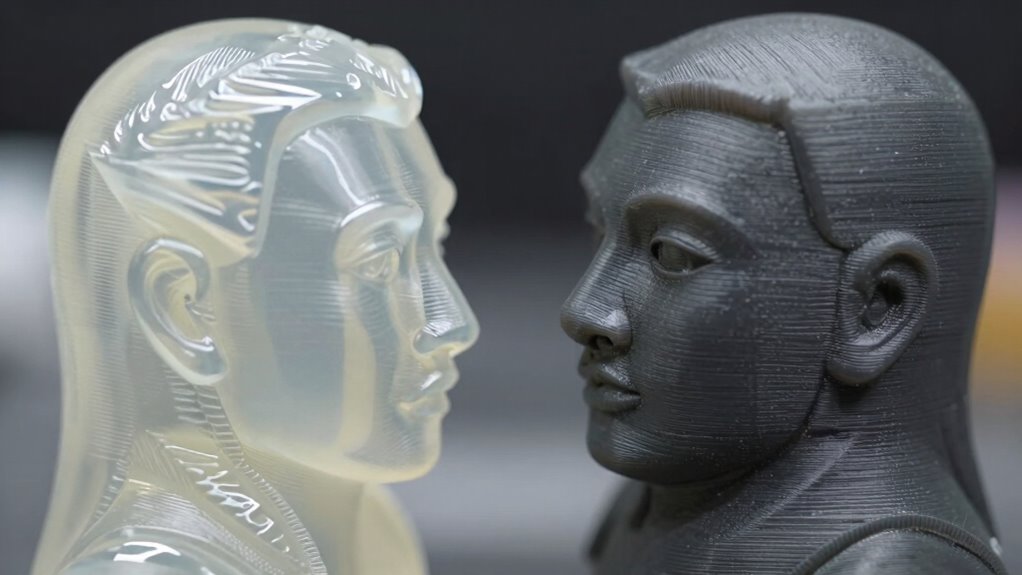

Resin printing uses liquid resin that’s cured layer by layer with UV light, resulting in highly detailed and smooth models perfect for intricate designs. In contrast, filament printing melts thermoplastic filaments through a heated nozzle to build parts, typically with less surface detail but better durability. Resin parts require careful post-processing like cleaning and curing, while filament parts need minimal finishing. If you want to understand more about how each method suits different needs, keep exploring the differences.

Get the latest gadgets delivered free with Prime
- Fast, free delivery on millions of items
- Prime Video, Amazon Music and more included
- Member-only deals all year
Key Takeaways
- Resin printing offers higher resolution and smoother surfaces due to fine layer details, suitable for intricate designs.
- Post-processing for resin models involves cleaning and UV curing, making it more time-consuming than filament printing.
- Resin parts tend to become brittle and degrade over time if not properly cured, unlike more durable filament materials.
- Resin printing is more sensitive to environmental factors, limiting long-term durability compared to filament options.
- Resin excels in detailed, decorative models, while filament is preferred for functional, durable parts.
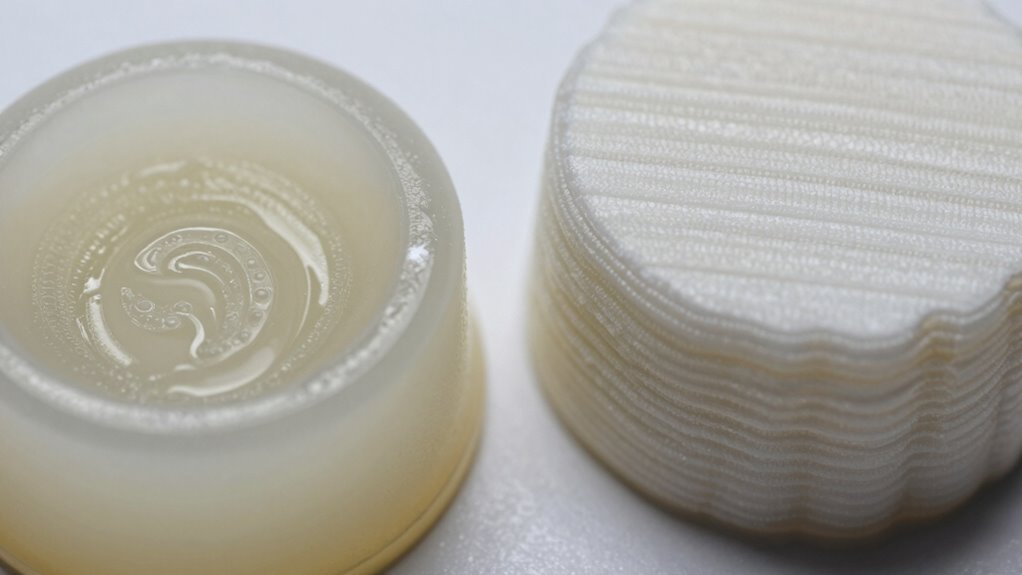
Resin printing generally produces highly detailed and smooth models because of its fine layer resolution. However, this precision comes with specific post-processing requirements. After printing, you’ll need to carefully clean your parts with isopropyl alcohol, removing excess resin, and then cure them under UV light to achieve full strength. This additional post-processing can be time-consuming but is essential to improve the final surface finish and mechanical properties. In contrast, filament prints often require minimal finishing—just some sanding or painting—making them more straightforward to prepare for use or display. Additionally, the layer resolution of resin printing allows for intricate designs that are difficult to achieve with filament methods.
Material longevity also varies markedly between the two methods. Resin parts tend to be more brittle over time, especially if not properly cured or if exposed to UV light and environmental stressors. Over extended periods, resin models can degrade or crack, limiting their durability for long-term use. Conversely, filament materials like PLA, ABS, or PETG exhibit better material longevity, especially when stored correctly. These plastics resist environmental factors better and tend to withstand wear and tear longer, making filament prints more suitable for functional parts or items that require durability. Additionally, the availability of different material options allows for tailored properties depending on the specific application. The material composition also influences their resistance to environmental stressors and overall lifespan.
As an affiliate, we earn on qualifying purchases.
Frequently Asked Questions
Which Printing Method Offers Better Detail Resolution?
Resin printing offers better detail resolution than filament printing, making it ideal for highly detailed models. You’ll notice sharper lines, finer textures, and intricate features. It also excels in color accuracy, capturing subtle shades better. Additionally, resin printing provides greater material versatility, allowing you to work with various resins for different finishes. Overall, if precision and detail are your priorities, resin printing is the superior choice.
How Do Post-Processing Requirements Differ Between the Two?
You’ll find post-processing for resin printing involves cleaning with alcohol, removing the resin smell, and curing under UV light, which can be messier and smellier than filament printing. For filament, you mainly need to remove the filament spool and smooth the surface with sanding or heat. Resin prints require careful handling of chemicals and more steps, while filament printing is generally simpler and less odorous.
Which Printer Type Has Higher Ongoing Maintenance Costs?
You’ll find resin printers generally have higher ongoing maintenance costs than filament printers. While the cost comparison can be a bit nuanced, resin printers often require more frequent cleaning of delicate parts and replacement of resin tanks, which can add up. Filament printers tend to be more straightforward, but resin printers shine with material versatility and finer detail. Keep in mind, the smoother operation might mean a slightly higher investment over time.
Are There Safety Concerns Specific to Resin or Filament Printers?
You should be aware that resin printers pose specific safety concerns, mainly due to chemical hazards from uncured resin and vapors. Proper ventilation is essential to prevent inhaling harmful fumes. Resin chemicals can cause skin and eye irritation, so wearing gloves and safety glasses is recommended. Filament printers generally have fewer safety risks, but always guarantee good airflow and handle materials carefully to prevent any accidents.
Which Printing Process Is Faster for Large-Scale Projects?
When tackling large-scale projects, filament printing often wins the race with its faster speeds. Imagine a continuous flow of molten material weaving through the layers like a steady river, completing big jobs swiftly. Resin printing, with its detailed precision, takes more time. Filament printers also consume less energy during longer runs, making them more efficient for large projects. If speed and energy efficiency matter, filament printing is your go-to choice.
As an affiliate, we earn on qualifying purchases.
Conclusion
So, whether you prefer the precise, polished perfection of resin printing or the straightforward, sturdy strength of filament printing, each offers its own unique allure. With resin’s radiant realism and filament’s formidable functionality, your creative journey is truly customizable. Immerse yourself in the details, discover your desire, and don’t delay—delve into the delightful world of 3D printing, where your dreams shape into stunning, tangible sculptures. Let your imagination ignite and your projects perfectly take shape!
isopropyl alcohol for 3D printing
As an affiliate, we earn on qualifying purchases.
As an affiliate, we earn on qualifying purchases.
As an affiliate, we earn on qualifying purchases.
Fall Picks
fall essentials
As an affiliate, we earn on qualifying purchases.