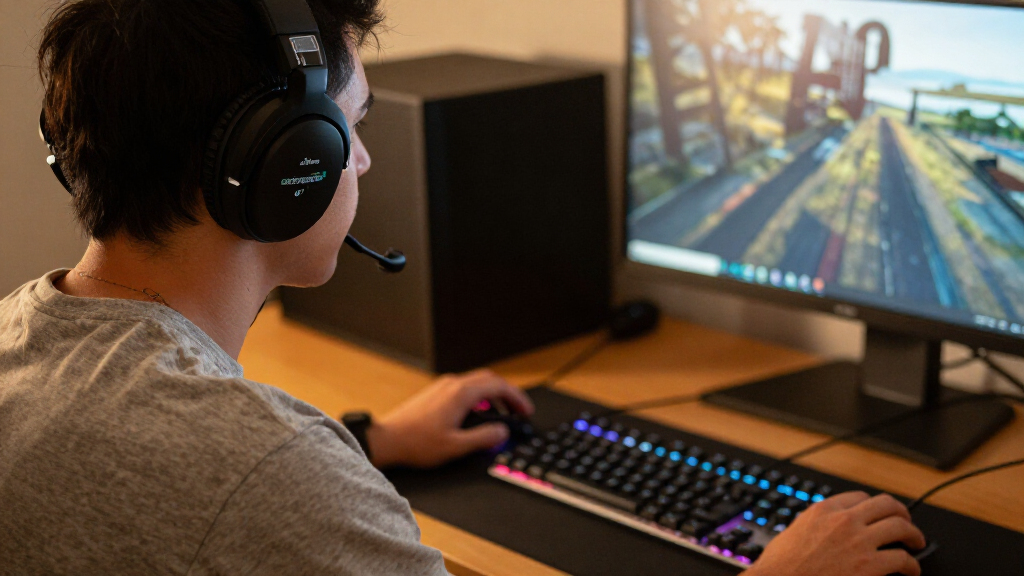

Choosing a wireless gaming headset is less about cutting a cable than deciding how you want audio to connect. A 2.4 GHz headset uses a dedicated USB dongle or receiver, while a Bluetooth headset connects directly to compatible devices. Many models support both, but their gaming performance, device support, battery behavior, and prices still differ.

Get the latest gadgets delivered free with Prime
- Fast, free delivery on millions of items
- Prime Video, Amazon Music and more included
- Member-only deals all year

Turtle Beach Stealth 600 Wireless Gaming Headset
- ✔ Compatibility: Xbox Series X|S and Xbox One, PS5 and PS4, Windows PC, Steam Deck, mobile
- ✔ Wireless: 2.4 GHz wireless and Bluetooth
- ✔ Bluetooth: Version 5.2 listed, with inconsistent source details

Turtle Beach Stealth 600 Gen 3 Wireless Multiplatform Gaming Headset
- ✔ Compatibility: PS5, PS4, PC, Steam Deck, mobile
- ✔ Connectivity: 2.4 GHz wireless and Bluetooth 5.2
- ✔ Battery: Up to 80 hours; quick charge

Logitech G733 Lightspeed Wireless Gaming Headset – Black
- ✔ Compatibility: PC, PS5, PS4, Nintendo Switch
- ✔ Wireless: Lightspeed 2.4 GHz
- ✔ Weight: 278 g
For most players who game on a PC or console, 2.4 GHz is the safer choice: its lower latency helps sound stay in step with play, and its microphone connection is often better suited to voice chat. Bluetooth makes more sense if you move between a phone, laptop, and console, or want one headset for music and calls as well as games. The best choice depends on which connection you will actually use and which devices it supports.
At a Glance
| Criteria | 2.4 GHz wireless gaming headsets | Bluetooth wireless gaming headsets | Winner |
|---|---|---|---|
| Gaming audio latency | Typically lower latency through a dedicated USB receiver | Latency can be more noticeable in games, depending on headset and device | A |
| Device compatibility | Works with devices that support its receiver, subject to ports and platform support | Connects to many Bluetooth-enabled phones, tablets, and computers | B |
| Microphone and voice chat | Often better suited to gaming chat; quality varies by model | Call quality and mic behavior vary; some devices limit audio quality during calls | A |
| Battery and wireless use | Varies by model; dedicated connection uses the headset’s battery | Varies by model; Bluetooth can serve music and calls away from the gaming setup | Depends |
| Setup and convenience | Receiver needs a free compatible port; usually simple after pairing | No gaming dongle needed on supported devices; can require reconnecting between devices | Depends |
| Price and value | Broad range; strong value if gaming performance is the priority | Can be good value for mixed everyday use; not automatically cheaper | Depends |
Turtle Beach Stealth 600 Wireless Gaming Headset
The Stealth 600 earns our top spot because its feature set covers the widest range of listed gaming situations: Xbox, PlayStation, PC, Steam Deck, and mobile, with both 2.4 GHz wireless and Bluetooth. That combination makes it a natural fit for someone moving between a console or computer and a phone, without choosing a headset tied to just one platform. The QuickSwitch button is meant to make changing connection modes more convenient, and the flip-to-mute microphone keeps muting straightforward during play.Its 80-hour stated battery life is a major advantage over the G733’s 29 hours, especially for people who would rather charge less often. Glasses relief, memory foam cushions, and a lay-flat design also give it useful comfort and storage touches. The 50 mm Nanoclear drivers and adjustable EQ broaden its appeal, although some of those audio and microphone adjustments depend on the Swarm II app. The supplied details list Bluetooth 5.2 in one place but describe the version inconsistently elsewhere, so we would not make that version number a deciding factor. Compared with the Gen 3, the original Stealth 600 lists Xbox support; compared with the G733, it offers more battery life and Bluetooth, but no listed RGB lighting or Blue VO!CE filters.There are limits: the app requirement adds a setup step for advanced tuning, and the inconsistent Bluetooth specification leaves a small information gap. Buyers focused on a clearly specified multiplatform setup should compare it with the Gen 3, while those who value lighting and Logitech’s voice filters may prefer the G733.
Pros:
- Lists compatibility with Xbox, PlayStation, PC, Steam Deck, and mobile devices.
- Combines 2.4 GHz wireless with Bluetooth and a QuickSwitch button.
- Up to 80 hours of battery life, with quick charge listed.
- Memory foam cushions include glasses relief, and the design lays flat.
Cons:
- Advanced EQ and microphone adjustments require the Swarm II app.
- Bluetooth version details are inconsistent in the supplied listing.
- No RGB lighting feature is listed.
Best for: Gamers who switch between Xbox, PlayStation, PC, handheld, and mobile devices and want both 2.4 GHz wireless and Bluetooth.
Not ideal for: Buyers who want advanced tuning without an app, need a consistently documented Bluetooth version, or prioritize RGB lighting and Blue VO!CE filters.
Bottom line: Choose the Stealth 600 for the broadest stated platform support and long battery life, provided its app-based tuning and Bluetooth detail gap suit your needs.
“Choose the Stealth 600 for the broadest stated platform support and long battery life, provided its app-based tuning and Bluetooth detail gap suit your needs.”
Turtle Beach Stealth 600 Gen 3 Wireless Multiplatform Gaming Headset
The Stealth 600 Gen 3 is a strong choice for a PlayStation and PC setup that also includes handheld or mobile listening. It pairs low-latency 2.4 GHz wireless with Bluetooth 5.2, and the QuickSwitch button supports moving between those connection types. Like the other Stealth 600, it lists an 80-hour battery, 50 mm Nanoclear drivers, an AI-noise-reducing flip-to-mute microphone, and memory foam cushions with glasses relief. The shared core means the choice between the two Turtle Beach models turns largely on platform list and the clarity of their supplied specifications.Here, the Gen 3’s stated compatibility includes PS5, PS4, PC, Steam Deck, and mobile, but not Xbox. That makes it a sensible fit for buyers whose devices align with that list, while the other Stealth 600 is the more suitable option for Xbox owners. Bluetooth 5.2 is clearly specified in the Gen 3 details, unlike the inconsistent version information attached to its sibling. The Swarm II desktop and mobile app adds deeper audio customization, but it also means buyers who want to adjust EQ or microphone behavior should expect to use companion software.The tradeoffs matter for particular buyers: its microphone is not detachable, and no wired connection is mentioned for people seeking a wired fallback. Compared with the G733, the Gen 3 has far longer stated battery life and Bluetooth; the G733 instead offers listed RGB lighting and Blue VO!CE filters. Choose the Gen 3 for its clear PlayStation and PC orientation, not for an Xbox setup or a detachable mic.
Pros:
- Lists 2.4 GHz wireless and Bluetooth 5.2 with QuickSwitch.
- Up to 80 hours of battery life and quick charge capability.
- Memory foam cushions include glasses relief.
- Swarm II desktop and mobile app supports audio customization.
Cons:
- Xbox compatibility is not included in the supplied list.
- Microphone is not detachable.
- Advanced audio customization requires the Swarm II app; no wired option is mentioned.
Best for: PlayStation and PC gamers who also use a Steam Deck or mobile device and want a long-lasting headset with Bluetooth 5.2 specified.
Not ideal for: Xbox owners, buyers who need a detachable microphone, or anyone requiring a stated wired connection option.
Bottom line: Pick the Gen 3 for a PlayStation and PC focused setup with clearly specified Bluetooth, but check the compatibility list if Xbox is part of your rotation.
“Pick the Gen 3 for a PlayStation and PC focused setup with clearly specified Bluetooth, but check the compatibility list if Xbox is part of your rotation.”
Logitech G733 Lightspeed Wireless Gaming Headset – Black
The G733 takes a different route from the Turtle Beach headsets: it focuses on a lightweight 278 g design, customizable dual-zone RGB lighting, and Blue VO!CE microphone filters. For PC gamers who want their headset to match a themed setup and care about voice customization, that combination makes it the most distinctive option in this group. Its reversible suspension headband and memory-foam earcups are designed for extended sessions, while the 40 mm PRO-G drivers are described as delivering clear, low-distortion sound.The clearest compromise is endurance. Its stated battery life reaches 29 hours, well below the 80 hours listed for both Stealth 600 models, so frequent charging is more likely to be part of ownership. It also relies on Lightspeed 2.4 GHz wireless, with no Bluetooth connection listed; that makes it less convenient for switching to a phone than either Turtle Beach option. Its compatibility list covers PC, PS5, PS4, and Nintendo Switch, but does not list Xbox. In return, buyers get lighting and voice tools the Turtle Beach models do not list.At 278 g, Logitech calls the design lightweight, though some users may still find it noticeable over very long sessions. There is no active noise cancellation, so it will not block out surrounding sounds. Compared with the Stealth 600 Gen 3, the G733 is better suited to shoppers who prioritize lighting, microphone filters, and its suspension headband; the Gen 3 is the stronger match for long battery life and Bluetooth use.
Pros:
- Dual-zone Lightsync RGB lighting supports extensive color customization.
- Up to 29 hours of battery life and Lightspeed 2.4 GHz wireless.
- Reversible suspension headband and memory-foam earcups.
- Blue VO!CE microphone filters and 40 mm PRO-G drivers.
Cons:
- Battery life is shorter than the 80 hours listed for either Turtle Beach headset.
- No Bluetooth connection or active noise cancellation is listed.
- At 278 g, it may feel heavy to some users during very long sessions.
Best for: PC and PlayStation gamers who value customizable RGB lighting, Blue VO!CE microphone filters, and a suspension headband.
Not ideal for: Xbox users, frequent mobile listeners who want Bluetooth, or gamers who prioritize the longest battery life or active noise cancellation.
Bottom line: Choose the G733 when lighting, voice filters, and a suspension headband matter more than Bluetooth versatility and the Turtle Beach models’ longer stated battery life.
“Choose the G733 when lighting, voice filters, and a suspension headband matter more than Bluetooth versatility and the Turtle Beach models’ longer stated battery life.”
As an Amazon Associate we earn from qualifying purchases.
Key Differences
The main difference is the link between headset and game. A dedicated 2.4 GHz receiver is designed to carry audio with low delay, which helps effects, dialogue, and movement cues line up with what is happening on screen. Bluetooth is convenient and broadly supported, but delay depends on the headset, the source device, and the Bluetooth codecs they share. For casual games, that may be unimportant; for competitive play or rhythm games, a delay can be distracting. Check whether the headset offers a gaming mode or a separate low-latency connection before relying on Bluetooth.
Compatibility is more complicated than choosing a connection label. A USB receiver may work well on a PC but fail to provide full features on a console, and some consoles do not support ordinary Bluetooth audio headsets at all. Bluetooth, by contrast, is common on phones and many computers, but it is not a universal route into console gaming. A headset with both Bluetooth and 2.4 GHz can cover more situations, though simultaneous connections and console chat support differ by model.
Comfort, microphone quality, battery life, and controls depend heavily on the headset itself, not just its wireless technology. Treat connection type as the first filter, then compare the models you can actually use. A multi-device headset is worth paying extra for when it replaces separate gear or makes switching easier. If you only play on one compatible gaming system, the extra flexibility may add cost without improving your regular setup.
Detailed Comparison
Gaming audio latency (2.4 GHz wireless gaming headsets wins — moderate)
2.4 GHz wins by a moderate margin for gaming. A dedicated receiver is generally built to keep audio delay low, which makes it a reliable choice for fast action, competitive matches, and rhythm games. Bluetooth performance varies with the headset and source device; some combinations feel responsive enough for casual play, while others make sound cues lag behind the screen. If timing matters to you, choose a model that explicitly supports a low-latency gaming mode, and confirm that the console or computer can use it.
Device compatibility (Bluetooth wireless gaming headsets wins — major)
Bluetooth wins for everyday device breadth, with a major practical advantage for multi-device users. Phones, tablets, and many laptops can connect without a receiver. A 2.4 GHz headset depends on a compatible USB port, receiver, and platform support, so the same model may behave differently across devices. However, Bluetooth does not automatically solve console compatibility: many consoles have limits on direct Bluetooth audio. Check the specific console and headset compatibility before buying either type.
Microphone and voice chat (2.4 GHz wireless gaming headsets wins — moderate)
2.4 GHz usually has the edge for gaming chat, though model quality matters more than the label alone. Its dedicated link is commonly designed around simultaneous game audio and microphone use. Bluetooth headsets can sound good for music but may switch into a lower-quality call mode when the mic is active, depending on the device and connection. This is a moderate difference for regular team chat. Look for clear microphone samples and platform-specific chat support, rather than assuming a headset’s marketing claims apply everywhere.
Battery and wireless use (minor difference)
This is a tie because the connection type alone does not predict runtime. Battery life changes with headset design, volume, lighting, active noise features, and whether the headset supports more than one connection at once. Bluetooth can be convenient for listening to music or taking calls away from a gaming setup, but those activities still consume power. Compare the stated runtime and charging options of the individual models, and check whether advertised figures assume features you plan to leave on.
Setup and convenience (minor difference)
Neither connection wins for everyone. Bluetooth avoids a receiver and is straightforward on devices with built-in support, but moving between multiple paired devices can take extra steps. A 2.4 GHz receiver is usually quick to use once plugged in, but it occupies a port and can be inconvenient if your device has few available connections. This is a minor difference for a fixed desk setup and a more noticeable one if you regularly switch between a laptop, phone, and console.
Price and value (moderate difference)
There is no dependable winner without comparing specific models. Both types span budget and premium prices. Paying extra for dual connectivity makes sense if you will use the headset with both a gaming system and everyday Bluetooth devices. If your priority is gaming on one compatible system, spend first on comfort, dependable chat, and a receiver that works with your platform. A lower price is poor value if the headset cannot connect to your device or feels uncomfortable during long sessions.
2.4 GHz wireless gaming headsets: Pros and Cons
Pros:
- Typically low-latency game audio through a dedicated receiver
- Often a strong fit for PC and supported console gaming
- Gaming-focused models commonly support voice chat over the same connection
Cons:
- Requires a compatible receiver and available port
- Platform support and features can vary by console
- Less convenient for phones and other devices without a compatible receiver
Bluetooth wireless gaming headsets: Pros and Cons
Pros:
- Pairs directly with many phones, tablets, and computers
- Useful for music and calls away from a gaming setup
- Avoids carrying or plugging in a gaming receiver on supported devices
Cons:
- Audio delay may be noticeable in timing-sensitive games
- Console Bluetooth audio support is limited or model-dependent
- Microphone use can reduce audio quality on some device and headset combinations
Who Should Choose What
Choose 2.4 GHz wireless gaming headsets if:
- You mainly play on a PC or console that supports the headset’s USB receiver.
- You play competitive, fast-action, or rhythm games where audio timing matters.
- You regularly use voice chat and want a connection designed for gaming.
Choose Bluetooth wireless gaming headsets if:
- You want one headset for a Bluetooth phone, tablet, and laptop as well as casual gaming.
- You value taking calls or listening to music away from your gaming setup.
- Your games are not timing-sensitive and your device supports the headset’s Bluetooth features.
Skip both if: Skip both connection types until you confirm platform compatibility. If your console does not support the headset’s connection, choose a model explicitly certified for it or use a compatible wired headset.
Value for Money
Pay more for dual 2.4 GHz and Bluetooth only if you will use both connections. It can replace separate headsets and reduce friction when switching from gaming to calls or music, making the extra cost worthwhile for frequent multi-device users. For a single-device gaming setup, that flexibility may sit unused; prioritize fit, microphone performance, reliable platform support, and battery life instead. Bluetooth is not automatically the budget option, and 2.4 GHz is not automatically premium. Compare the actual models and the features you will use.
Final Verdict
For most people buying a headset primarily for PC or supported console gaming, choose a 2.4 GHz model. Its dedicated receiver usually gives more dependable low-delay audio and a better fit for gaming chat. Choose Bluetooth if using the same headset across phones, tablets, and computers matters more than perfect timing, and verify that it works with your gaming device before paying.
The biggest deciding factor is platform compatibility: a connection is useful only if your system supports it. Pay extra for dual connectivity when you will regularly use both modes; otherwise, spend that money on comfort and a microphone you can live with for long sessions.
Frequently Asked Questions
Are Bluetooth headsets good for gaming?
They can work well for casual games, especially on phones and computers that support the headset’s features. Audio delay varies, so for competitive or timing-sensitive games, a low-latency 2.4 GHz model is usually the safer pick.
Do wireless gaming headsets work with every console?
No. Console support depends on the headset, its receiver, and the console’s audio rules. Check the manufacturer’s compatibility list for the exact console and features you need, including microphone chat.
Is a dual wireless headset worth paying more for?
It is worth the premium if you switch between gaming over 2.4 GHz and everyday Bluetooth devices often. If you only use one gaming system, the extra connection may have little value.
Does 2.4 GHz mean better sound quality?
Not by itself. The connection can help with latency, but driver design, tuning, fit, and source quality shape sound. Compare listening impressions and microphone samples for the specific headsets.