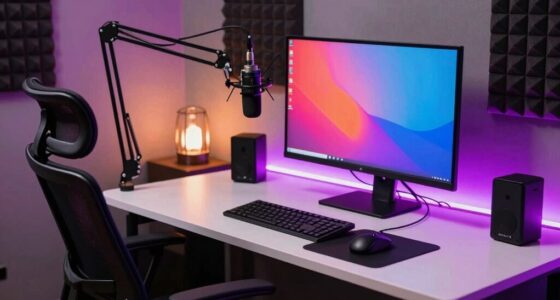
Playing video games regularly can boost your cognitive skills, like faster reaction times, improved attention, and better spatial reasoning. It also increases activity in brain regions responsible for decision-making and problem-solving while making visual processing more efficient. However, excessive gaming may lead to health issues or addiction risks. If you keep exploring, you’ll discover how gaming can truly sharpen your mind and what limits to watch out for.
Key Takeaways
- Regular gaming enhances cognitive functions like attention, working memory, processing speed, and spatial reasoning through increased brain activity.
- Action games improve visual processing, perception, and spatial skills, making gamers more alert and visually responsive.
- Brain scans show increased activity in regions tied to decision-making and problem-solving, indicating neuroplasticity benefits.
- Gaming can strengthen executive functions such as planning and response inhibition, boosting overall mental flexibility.
- Excessive gaming poses risks like reduced physical activity, sleep disturbances, and potential behavioral issues, highlighting moderation’s importance.

Samsung 27" Odyssey G5 (G51F) Series QHD (1440P) Gaming Monitor
- Resolution: QHD (2560 x 1440) for detailed images
- HDR Support: HDR10 for vivid, realistic scenes
- Refresh Rate: 180Hz for smooth gameplay
As an affiliate, we earn on qualifying purchases.
As an affiliate, we earn on qualifying purchases.
Cognitive Skill Enhancements Linked to Gaming

Playing video games can considerably boost your cognitive skills, especially when you engage regularly. When you play for three or more hours daily, you may notice faster and more accurate responses on tasks involving impulse control and working memory. Action games, in particular, improve perception, attention, and spatial skills, making you more alert and better at visual processing. Adults who play over five hours weekly often perform cognitively like someone 13.7 years younger, highlighting significant benefits. Regular gaming also enhances processing speed, mental flexibility, and spatial reasoning. These improvements are linked to increased activity in brain regions responsible for attention and memory. By consistently engaging with video games, you strengthen your brain’s capacity to process information quickly and efficiently. Incorporating high refresh rate displays can further boost reaction times and visual clarity during gameplay. Additionally, ongoing research suggests that such gaming benefits are optimized when combined with sustainable technology, emphasizing the importance of environmentally conscious gaming equipment. Moreover, engaging in environmentally friendly gaming practices can reduce the ecological footprint of gaming activities, supporting green gaming initiatives. Recognizing the role of innovative gaming hardware, like electric-powered gaming setups, can also contribute to a more eco-friendly gaming environment.

Gamer Gift for Men Teenage Boy Wood Controller Organizer with Headphone Holder & Game Controller Stand – Unique Gift Idea for Husband, Boyfriend, Gamers, Game Lover, Gaming Accessory (Spider)
- Multi-Functional Gaming Organizer: Holds controllers, headphones, and accessories
- Eco-Friendly Natural Wood: Made from durable, polished solid wood
- Universal Compatibility: Fits most gaming consoles and PCs
As an affiliate, we earn on qualifying purchases.
As an affiliate, we earn on qualifying purchases.
Brain Activity Changes Among Gamers

Research shows that frequent gamers experience notable changes in brain activity, especially in regions linked to cognitive functions. When you play regularly, your brain shows increased activity in the frontal areas responsible for attention, decision-making, and problem-solving. Functional MRI scans reveal that gamers have heightened activity in these demanding regions, supporting improved cognitive skills. At the same time, visual processing areas often display lower activity, indicating greater efficiency due to repeated gaming practice. This suggests your brain adapts by optimizing neural responses, making certain tasks easier over time. These changes are associated with enhanced mental flexibility, quicker response times, and better spatial reasoning. Overall, your brain becomes more efficient and responsive, reflecting the cognitive advantages gained through consistent gaming. Additionally, these neural adaptations may contribute to brain plasticity, allowing for ongoing learning and skill development.

Logitech G502 Hero Wired Gaming Mouse – Black
- HERO Sensor: 25600 DPI precision tracking
- Programmable Buttons: 11 customizable buttons for gameplay
- Hyper-Fast Scroll Wheel: Dual mode for quick scrolling
As an affiliate, we earn on qualifying purchases.
As an affiliate, we earn on qualifying purchases.
Impact on Executive Function and Memory

Engaging regularly with video games can substantially enhance your executive functions and working memory. When you play strategic or action games, your brain improves in areas like planning, mental flexibility, and response inhibition. These games challenge you to adapt quickly, make decisions, and remember complex information, which strengthens your working memory. Gamers often perform better on attention and problem-solving tasks, thanks to heightened cognitive control. Additionally, frequent gaming can boost your ability to switch between tasks smoothly and hold information in mind longer. Research indicates that these benefits are most notable in players who engage in gaming sessions that require strategic thinking and multitasking. As a result, gaming can sharpen your overall mental agility and support improved executive functioning. Moreover, understanding brain plasticity can help you appreciate how these mental skills can be developed and enhanced over time through consistent gaming practice. Recognizing the role of neuroplasticity underscores how adaptable and trainable the brain truly is, especially when engaged in mentally stimulating activities like gaming. In fact, brain adaptability allows for continuous improvement of cognitive skills with regular practice, and this capacity is supported by recent advances in AI-powered cognitive training tools.

Professor Rubik's Brain Fitness (Nintendo Switch)
- Brain-Boosting Puzzle Game: Test and improve your brain functions
- Family-Friendly Gameplay: Colorful and accessible for all ages
- New Rubik Challenge: Experience a fresh, challenging twist
As an affiliate, we earn on qualifying purchases.
As an affiliate, we earn on qualifying purchases.
Visual and Spatial Processing Improvements

Building on the improvements in executive function and memory, video game play also considerably enhances visual and spatial processing skills. When you play regularly, your ability to interpret and respond to visual information sharpens, leading to faster and more accurate perception. Action games, in particular, boost spatial cognition by challenging you to navigate complex environments and track multiple moving objects simultaneously. This repeated practice increases your visual working memory and top-down attention, making you more adept at filtering relevant from irrelevant stimuli. Over time, your brain becomes more efficient, requiring less activity in visual areas to process information. As a result, you develop quicker reflexes, better spatial awareness, and heightened visual responsiveness—benefits that extend beyond gaming into everyday tasks.
Potential Risks and Limitations of Gaming

While playing video games offers cognitive and perceptual benefits, it also carries potential risks that shouldn’t be overlooked. Excessive gaming can lead to reduced physical activity, which impacts overall health. Some individuals may develop addictive behaviors, causing neglect of responsibilities and social interactions. Prolonged gaming sessions can cause eye strain, headaches, and sleep disturbances. Not all game genres provide the same benefits; violent or highly stimulating games might increase aggression or stress in some players. Additionally, the research is mostly correlational, so it’s unclear whether gaming directly causes these issues or is simply associated with them. Long-term effects and ideal play durations remain uncertain, emphasizing the need for moderation and mindful gaming habits.
Frequently Asked Questions
Do Different Game Genres Produce Different Cognitive Benefits?
Different game genres do produce different cognitive benefits. Action games boost spatial reasoning, perception, and top-down attention, while strategy games enhance working memory, planning, and mental flexibility. Puzzle games improve problem-solving skills, and simulation games can increase creativity. You’ll notice that playing a variety of genres can target multiple cognitive areas, but the specific benefits depend on the game’s demands. So, mixing genres can maximize your brain’s growth.
How Long Does It Take to See Cognitive Improvements From Gaming?
You can start noticing cognitive improvements after just a few weeks of regular gaming. For example, children playing three or more hours daily show faster and more accurate impulse control and working memory tasks. Adults gaming five or more hours weekly often perform cognitively like someone 13.7 years younger. With consistent play, you’ll likely see gains in processing speed, spatial reasoning, and mental flexibility within a few weeks.
Are There Specific Age Groups That Benefit Most From Gaming?
You’ll find children and young adults benefit most from gaming, especially in developing impulse control, working memory, and spatial skills. Kids playing regularly show faster, more accurate responses, while adults who game five or more hours weekly perform cognitively like people 13.7 years younger. However, benefits vary based on game type and individual differences, so keep in mind that not everyone experiences the same level of improvement.
Can Gaming Negatively Affect Mental Health or Attention Span?
Gaming can negatively affect your mental health and attention span if you play excessively or choose violent or highly stimulating games. You might experience increased anxiety, stress, or difficulty focusing outside gaming sessions. Overplaying can lead to sleep problems, social withdrawal, and reduced impulse control. To stay healthy, balance your gaming with other activities, set time limits, and prioritize games that promote positive cognitive and emotional effects.
What Types of Games Are Best for Enhancing Creativity?
Puzzle, platform, and role-playing games are best for boosting your creativity. These genres challenge you to think critically, craft clever strategies, and imagine incredible worlds. As you solve puzzles or build stories, your mental flexibility and problem-solving skills sharpen. Playing diverse, creative games encourages adaptive thinking and sparks innovation. So, immerse yourself in games that inspire your imagination, and watch your creative capabilities comfortably, consistently, and consciously grow.
Conclusion
Playing video games can boost your cognitive skills, like problem-solving and memory, with studies showing gamers often outperform non-gamers on spatial tasks. However, be aware of potential risks, such as increased eye strain or addiction. Interestingly, research indicates that gamers can experience up to a 20% improvement in visual processing speed. So, while gaming offers real brain benefits, it’s essential to balance play with other healthy activities for the best overall mental health.