
5G and Wi-Fi 6 are both game-changers for your mobile devices, offering faster speeds, lower latency, and more reliable connections. 5G shines outdoors with wide coverage and ultra-fast outdoor data, perfect for streaming on the go. Wi-Fi 6 boosts your indoor network, reducing congestion and improving efficiency. Understanding how these technologies differ can help you get the most out of your devices—stick around to explore these differences in detail.
Key Takeaways
- 5G provides broader coverage and higher speeds for mobile devices over large areas, while Wi-Fi 6 optimizes local network performance indoors.
- 5G supports ultra-low latency and real-time responses across wide regions, ideal for mobility and outdoor use; Wi-Fi 6 enhances responsiveness within home or office environments.
- 5G requires compatible smartphones and infrastructure investments, whereas Wi-Fi 6 mainly needs upgraded routers and supported devices.
- 5G offers higher peak speeds and better outdoor connectivity, while Wi-Fi 6 improves energy efficiency and handles multiple devices efficiently indoors.
- Both standards are evolving to improve security and ecosystem support, with 5G focusing on wide-area coverage and Wi-Fi 6 on local network optimization.
Overview of 5G Technology
While 5G technology is still relatively new, it has already begun transforming how you connect and communicate. It offers markedly faster speeds, lower latency, and greater capacity compared to previous networks. This means smoother streaming, quicker downloads, and more reliable connections, especially in crowded areas. 5G uses higher frequency bands, which allows it to transmit larger amounts of data more efficiently. It also supports a massive number of connected devices, enabling smarter cities, autonomous vehicles, and advanced IoT applications. As a mobile user, you’ll notice improved responsiveness and less lag while browsing, gaming, or working remotely. Although widespread adoption is still unfolding, 5G promises a more seamless, responsive mobile experience that will shape how you stay connected in everyday life. Additionally, European cloud innovation plays a crucial role in supporting the infrastructure needed for these advanced networks and services.
Understanding Wi-Fi 6 and Its Features
Wi-Fi 6 delivers faster data rates, so you can stream, download, and game more smoothly. It also boosts network efficiency, reducing congestion even when multiple devices are connected. Understanding these features helps you see how Wi-Fi 6 improves your everyday internet experience. Additionally, high refresh rates in routers can further enhance performance for gaming and streaming applications. Moreover, power management techniques in Wi-Fi 6 help extend device battery life by optimizing data transmission. These advancements are inspired by innovations in wireless technology, such as improved antenna designs, which contribute to better connectivity and range. Furthermore, the integration of beamforming technology enhances signal strength and reliability across your home network. Innovations like multi-user MIMO allow multiple devices to communicate simultaneously, further improving overall network performance.
Faster Data Rates
Thanks to its advanced technology, Wi-Fi 6 delivers markedly faster data rates than previous standards, allowing you to download files, stream videos, and play online games with less lag. This improvement comes from innovations like 1024-QAM, which increases data encoding efficiency, and wider channels that boost throughput. MU-MIMO technology enables multiple devices to transmit simultaneously, reducing congestion and ensuring smoother performance. OFDMA divides channels into smaller sub-channels, allowing more devices to share bandwidth efficiently. As a result, your devices experience quicker response times, even in crowded environments. These enhancements make Wi-Fi 6 ideal for high-bandwidth activities and multiple device use, ensuring you get faster, more reliable connections for everyday tasks and demanding applications alike.
Improved Network Efficiency
By incorporating advanced features like OFDMA and MU-MIMO, Wi-Fi 6 substantially enhances network efficiency, allowing multiple devices to communicate simultaneously without congestion. OFDMA divides channels into smaller sub-channels, increasing capacity and reducing latency when many devices connect. MU-MIMO enables routers to handle multiple data streams at once, improving throughput for all devices. As a result, your network becomes more reliable, especially in crowded environments like cafes or homes with numerous gadgets. Wi-Fi 6 also introduces Target Wake Time (TWT), which reduces power consumption by scheduling data transmissions, extending battery life on your devices. Overall, these technologies work together to deliver a smoother, faster, and more consistent internet experience, even as the number of connected devices continues to grow.
Coverage and Range Capabilities

While both 5G and Wi-Fi 6 aim to provide high-speed connectivity, they differ markedly in their coverage and range capabilities. 5G networks utilize a mix of high and low-band frequencies, enabling broader coverage and better building penetration. Low-band 5G can reach miles, ideal for rural areas and widespread coverage, but may sacrifice some speed. Mid-band offers a balance of range and performance, covering several hundred meters to a few kilometers. High-band, or mmWave, provides ultra-fast speeds over short distances, perfect for dense urban zones but with limited range. Wi-Fi 6, on the other hand, generally covers a smaller area, like a home or office, with a range up to a few hundred feet. Its signal strength diminishes more quickly through walls and obstacles, and signal stability can vary significantly between the two, affecting overall connectivity quality. Moreover, understanding the technological infrastructure is crucial for deployment and optimal performance of each network type. As Wi-Fi 6 continues to evolve, it also incorporates features that improve its performance in crowded environments, making it more reliable in dense settings. Additionally, advancements in adaptive technologies help Wi-Fi 6 better manage interference and maintain stable connections in complex environments.
Speed and Performance Comparison
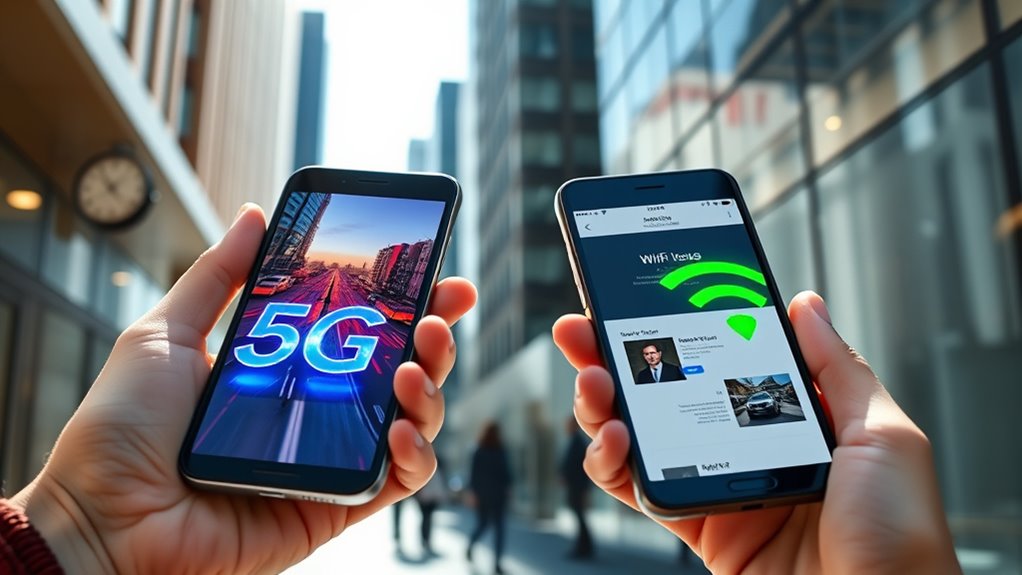
When comparing speed and performance, 5G generally offers faster data transfer rates than Wi-Fi 6, especially in ideal conditions. 5G networks can reach peak download speeds of up to several gigabits per second, making them perfect for high-bandwidth activities like streaming 4K videos or online gaming. Wi-Fi 6 also improves speeds over previous Wi-Fi standards but typically maxes out around a gigabit per second under optimal conditions. To visualize, consider this comparison:
| Feature | 5G | Wi-Fi 6 |
|---|---|---|
| Max Speed | Up to several Gbps | Up to 1-2 Gbps |
| Use Cases | Mobile streaming, gaming | Local high-speed internet |
| Performance Range | Wide coverage with strong signal | Fast within a smaller area |
| Ideal Conditions | Clear signal, close proximity | Stable home/office network |
Additionally, network coverage plays a vital role in the overall performance of each technology.
Latency and Response Times
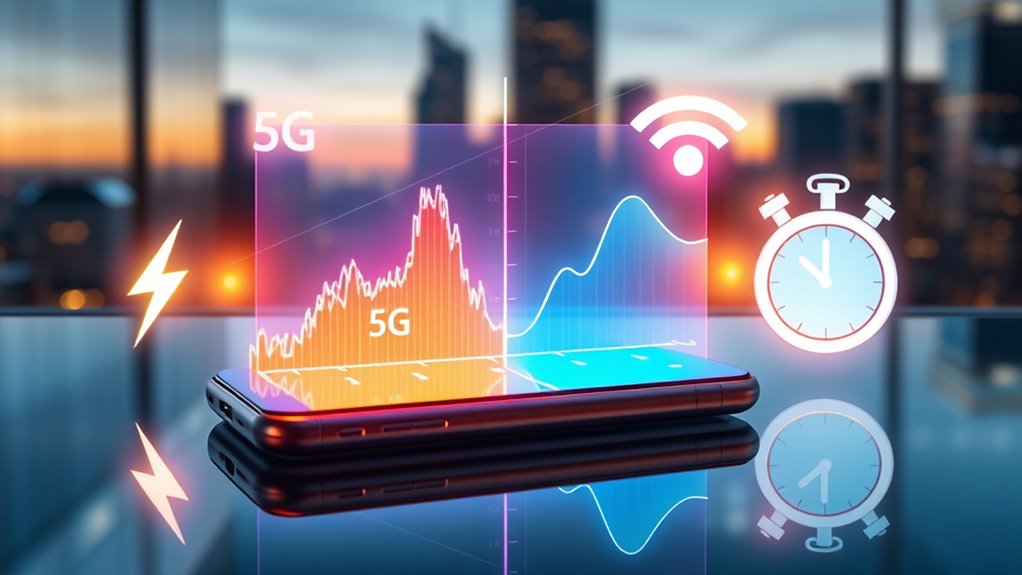
Latency and response times directly impact how quickly your devices communicate and react in real time. With lower latency, your actions are reflected instantly, making interactions smoother. Understanding how 5G and Wi-Fi 6 compare in this area helps you choose the best connection for your needs. As with automotive repair, preventive maintenance in network setup can help avoid issues before they impact performance. Trusted businesses and services near you can help optimize your network setup for better performance. Additionally, network efficiency plays a crucial role in maintaining low latency across different technologies. Improving signal quality can further reduce response times and enhance overall connectivity, especially when deploying advanced wireless standards designed for high-speed, low-latency communication.
Speed of Communication
Both 5G and Wi-Fi 6 aim to deliver fast, responsive communication, but they achieve this through different mechanisms that impact latency and response times. 5G networks typically offer lower latency thanks to their advanced infrastructure, extensive coverage, and optimized spectrum use. This allows your devices to transmit data quickly, reducing delays during real-time activities like live streaming or video calls. Wi-Fi 6 also improves communication speed by increasing bandwidth and using technologies like OFDMA and MU-MIMO, which enable multiple devices to communicate simultaneously without slowdown. While both technologies boost data transfer rates, 5G’s broader coverage and network design often mean faster response times, especially over longer distances or in congested areas. This makes 5G and Wi-Fi 6 suitable for high-speed, low-latency tasks, but their effectiveness depends on your environment. Additionally, network architecture plays a significant role in how efficiently these technologies deliver low-latency performance in various settings.
Real-Time Responsiveness
5G and Wi-Fi 6 are designed to deliver quick responses, but they differ markedly in how they handle real-time interactions. 5G typically provides lower latency, enabling your devices to communicate faster over longer distances and in crowded areas. This advantage makes it particularly suitable for remote control work and other latency-sensitive applications. This means actions like gaming, video calls, or remote control work feel more immediate and seamless with 5G. Wi-Fi 6 also reduces response times compared to previous Wi-Fi standards, but its latency can be affected by your router’s congestion and your environment. Generally, Wi-Fi 6 offers fast responses within a localized area, while 5G excels at delivering low-latency connections across wider regions. Your choice depends on whether you prioritize immediate responsiveness in a fixed location or need quick reactions on the go. Additionally, network congestion can influence the effectiveness of both technologies, impacting their real-time responsiveness. Factors like device compatibility and environmental interference also play roles in how well each technology performs in delivering low latency. Moreover, environmental interference can sometimes cause fluctuations in response times, especially in densely populated or obstructed areas. To optimize performance, understanding the environmental factors that impact each network type can be crucial for users.
Security Features and Privacy Concerns

While 5G and Wi-Fi 6 both aim to enhance connectivity, their security features and privacy concerns differ markedly. 5G networks use advanced encryption and stronger authentication methods to safeguard your data, making intercepting or tampering more difficult. However, the increased complexity of 5G infrastructure can create new vulnerabilities if not properly maintained, potentially exposing sensitive information. Wi-Fi 6 also offers improved security through WPA3 encryption, which strengthens protection over previous Wi-Fi standards. But, since Wi-Fi networks often rely on shared connections, they can be more susceptible to local attacks or unauthorized access if security settings aren’t carefully configured. Both technologies prioritize security, but the way they handle privacy risks varies, requiring you to stay vigilant with updates and network practices. Additionally, vetted security protocols are essential to maintaining privacy and preventing breaches across both networks.
Device Compatibility and Ecosystem Support
Device compatibility and ecosystem support are essential factors when choosing between 5G and Wi-Fi 6. With 5G, you’ll need a compatible smartphone or device that supports 5G networks, as older devices might only connect via 4G LTE. Major device manufacturers are increasingly releasing 5G-enabled models, but adoption still varies. Wi-Fi 6, on the other hand, requires devices with Wi-Fi 6 support, which is common in newer laptops, smartphones, and smart home gadgets. Your existing devices may need updates or replacements to take full advantage of the latest standards. Ecosystem support also matters—if your devices, routers, and accessories are optimized for one technology, you’ll experience better performance and easier integration. Compatibility and ecosystem support influence how smoothly your devices operate within the chosen network.
Cost and Implementation Considerations
Implementing 5G and Wi-Fi 6 involves different costs and logistical considerations that can impact your decision. For 5G, you’ll face higher expenses due to infrastructure upgrades, spectrum licensing, and device costs, especially since not every area has full coverage yet. Upfront investments can be significant, but ongoing service fees may apply. Wi-Fi 6, on the other hand, typically requires less investment, mainly involving new routers and compatible devices. Installation is straightforward, often as simple as upgrading your existing Wi-Fi setup. However, if you need extensive coverage or enterprise-level networking, costs can increase. While Wi-Fi 6 presents a more budget-friendly and easier implementation route for home or small business use, 5G offers broader coverage but demands more substantial initial spending and planning.
Practical Use Cases for 5G and Wi-Fi 6
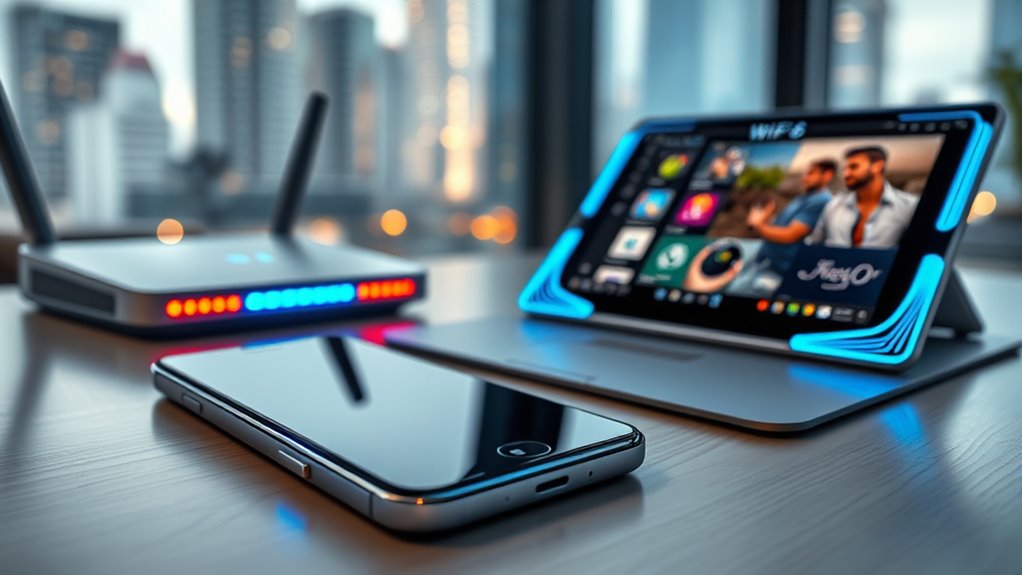
Both 5G and Wi-Fi 6 excel in different scenarios, making them suitable for a variety of practical use cases. If you’re streaming high-definition videos on the go, 5G offers fast, reliable connectivity even in crowded areas. Wi-Fi 6 shines in home or office environments, supporting multiple devices simultaneously without lag. For large-scale events or public spaces, 5G provides widespread coverage and mobility, while Wi-Fi 6 handles dense device clusters efficiently. Use the table below to see where each technology is most effective:
| Use Case | Best Technology | Key Benefit |
|---|---|---|
| Streaming on the go | 5G | High speed and mobility |
| Home Wi-Fi | Wi-Fi 6 | Multiple devices, low latency |
| Large events | 5G | Wide coverage, seamless connectivity |
| Office work | Wi-Fi 6 | Fast data transfer, reliability |
| Smart homes | Wi-Fi 6 | Device management, security |
Future Outlook and Technological Trends
As technology advances, you’ll see emerging 5G innovations that enhance speed and connectivity. Meanwhile, Wi-Fi 6 continues to evolve, offering better performance for more devices. Together, these trends are shaping the future of seamless, high-capacity wireless networks.
Emerging 5G Innovations
Emerging 5G innovations are set to revolutionize connectivity by enabling faster speeds, lower latency, and more reliable networks. You can expect advancements like network slicing, which allows tailored services for different applications, enhancing efficiency. Edge computing will become more integrated, bringing data processing closer to your device for instant responses. Massive MIMO technology will increase network capacity, supporting more devices simultaneously without slowdown. Additionally, new antenna designs and beamforming techniques will improve coverage and signal quality, especially in crowded areas. These innovations will support future applications such as autonomous vehicles, smart cities, and immersive augmented reality experiences. As these technologies mature, you’ll notice more seamless, responsive connections, transforming how you work, play, and communicate in an increasingly connected world.
Wi-Fi 6 Evolution
Wi-Fi 6 continues to evolve rapidly, driven by advancements that boost speed, capacity, and efficiency. New standards are integrating AI and machine learning to optimize network performance dynamically. Expect improvements in beamforming, multi-user MIMO, and power management, making connections more reliable and energy-efficient. These innovations will support the growing number of connected devices in homes and workplaces. As Wi-Fi 6 advances, it’ll better handle high-bandwidth applications like streaming and virtual reality, ensuring smoother experiences. Here’s a quick overview of some key trends:
| Trend | Impact |
|---|---|
| AI-driven optimization | Smarter, self-adjusting networks |
| Enhanced security | Better protection against threats |
| Increased range | Wider coverage with fewer dead zones |
| Lower latency | Faster response times for devices |
Future Connectivity Trends
Looking ahead, technological innovations are set to reshape how devices connect and communicate. Expect faster speeds, lower latency, and more reliable connections as 5G and Wi-Fi 6 continue to evolve. Emerging trends include the integration of edge computing, which brings data processing closer to your devices for quicker responses. You’ll also see increased use of AI to optimize network performance dynamically. The rise of the Internet of Things (IoT) will lead to smarter homes, cities, and industries, all connected seamlessly. As these technologies mature, expect more widespread adoption of augmented reality (AR) and virtual reality (VR) applications, transforming how you work, play, and interact. The future of connectivity promises a more connected, responsive, and intelligent digital environment tailored to your needs.
Frequently Asked Questions
How Does 5G Impact Battery Life on Mobile Devices?
You might notice that 5G can drain your device’s battery faster because it requires more power to maintain high-speed connections and handle increased data traffic. However, modern smartphones optimize power consumption through smarter hardware and software. To extend your battery life, you can switch to 4G or Wi-Fi when possible, disable 5G when not needed, and keep your device updated for better energy efficiency.
Can Wi-Fi 6 Work Seamlessly With Existing Wi-Fi Networks?
Can Wi-Fi 6 work seamlessly with your existing networks? Absolutely. Imagine upgrading your home Wi-Fi without replacing your current router; Wi-Fi 6 is designed to be backward compatible. It works smoothly alongside older devices, enhancing speed and efficiency. You won’t need to overhaul your entire setup—just guarantee your devices support Wi-Fi 6, and you’ll enjoy improved performance without disrupting your current network.
What Are the Environmental Impacts of Deploying 5G Infrastructure?
You should know that deploying 5G infrastructure has environmental impacts, like increased energy consumption from new cell towers and network equipment. Manufacturing and installing these components also generate waste and emissions. While 5G promises faster speeds, it’s important to contemplate its carbon footprint. To minimize environmental harm, industry efforts focus on developing energy-efficient technology and recycling old infrastructure, helping balance technological progress with ecological responsibility.
How Do 5G and Wi-Fi 6 Compare in Urban vs. Rural Areas?
Imagine zooming through city streets with lightning-fast 5G signals, or enjoying stable Wi-Fi 6 connections in quiet rural areas. In urban settings, 5G offers ultra-high speeds and low latency, perfect for busy environments. In rural areas, Wi-Fi 6 provides reliable connectivity where cell signals might be weaker. You’ll find both technologies tailored to your environment, ensuring smooth, efficient connections wherever you are.
Will Future Devices Automatically Switch Between 5G and Wi-Fi 6?
Future devices will likely switch automatically between 5G and Wi-Fi 6, thanks to smart technology. Your device’s software continuously monitors signal strength and connection quality, then seamlessly switches to the best network available. This guarantees you experience the fastest, most reliable internet without needing to manually change settings. Advanced features like network aggregation and smart handoff make your connectivity smoother, so you stay connected whether you’re indoors or outdoors.
Conclusion
Ultimately, choosing between 5G and Wi-Fi 6 is like selecting the right key to unseal your digital world. Each offers a different path—one reaching outward into new horizons, the other strengthening your fortress at home. By understanding their unique symbols of connection and speed, you can forge a future where your devices dance seamlessly. Embrace these technologies as the guiding stars that illuminate your connected journey, shaping your digital destiny with purpose and clarity.