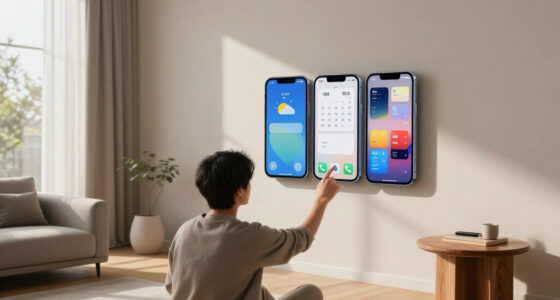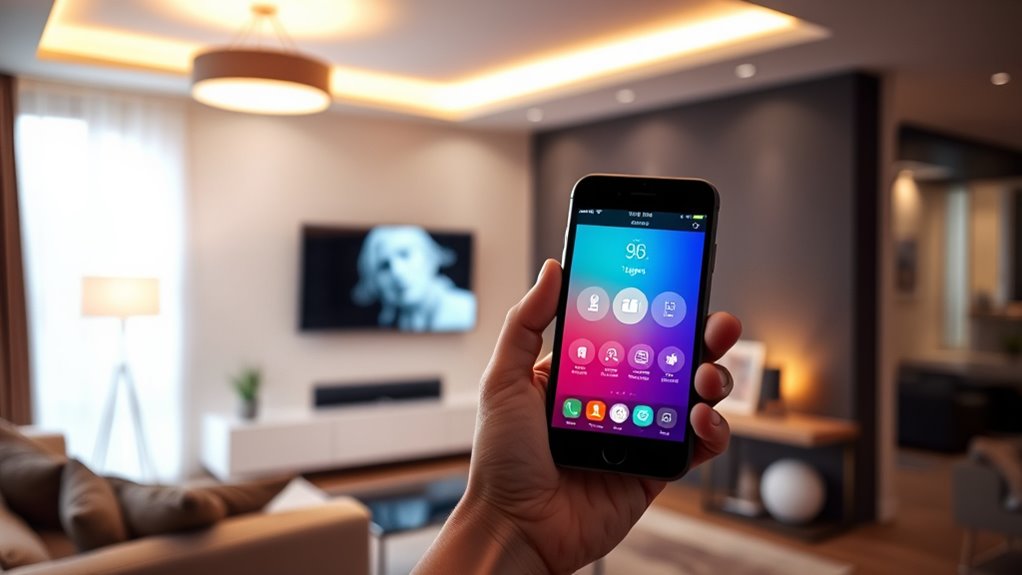

To use your smartphone as a universal remote, first guarantee your device supports IR, Wi-Fi, or Bluetooth. Download a compatible remote app and follow setup prompts to connect to your smart home devices by selecting their brands and models. You can control them via simplified buttons, create macros, or integrate voice commands for hands-free use. For more tips on optimizing your setup and fixing issues, continue exploring how to enhance your smart home control.

Get the latest gadgets delivered free — and shop member deals
- Fast, free delivery on millions of items
- Access to Prime Big Deal Days deals on October 6–7
- Prime Video, Amazon Music and more included
Key Takeaways
- Download a compatible universal remote app that supports your smart home devices and connection methods (IR, Wi-Fi, Bluetooth).
- Set up the app by selecting your device types and brands, then pairing via Wi-Fi, Bluetooth, or IR as required.
- Ensure your smartphone is connected to the same Wi-Fi network as your smart home devices for seamless control.
- Customize controls, create macros, or routines within the app for quick access to multiple functions.
- Link the remote app to voice assistants like Alexa or Google Home for hands-free smart home management.
universal remote app for smartphones
As an affiliate, we earn on qualifying purchases.
As an affiliate, we earn on qualifying purchases.
Understanding Compatibility Requirements for Smart Home Devices

To effectively use your smartphone as a universal remote for smart home devices, you need to understand their compatibility requirements. First, check if your device runs Android 5.0 or higher or an equivalent iOS version, as most remote apps need this. Your smartphone must have an IR blaster, Wi-Fi, or Bluetooth capability to control devices directly. For smart TVs, streaming boxes, or home automation gear, they should be connected to the same Wi-Fi network as your phone. Keep in mind, some apps support only specific brands like Samsung, LG, or Roku, so verify if your devices are compatible. Older TVs without smart features may require an external IR blaster or adapter to function properly. Matching device type, brand, and connection method guarantees seamless control. Additionally, understanding device compatibility can help prevent frustration and ensure your setup works smoothly. Recognizing the role of home automation protocols can further assist in integrating various devices for more efficient control. Ensuring your devices support interoperability standards can also enhance your smart home experience by allowing different brands and systems to work together seamlessly. Becoming familiar with universal remote standards can simplify managing multiple devices with a single app.
As an affiliate, we earn on qualifying purchases.
Selecting the Right Universal Remote App for Your Needs

When choosing a universal remote app, you need to ensure if it’s compatible with your devices and connection types. You’ll also want to weigh the app’s features against your budget and how easy it is to use. Making the right choice ensures seamless control without unnecessary hassle. Additionally, considering device compatibility and the support for various connection options can significantly enhance your smart home experience. Checking for integration capabilities can help ensure your app works smoothly with all your smart appliances. For example, some apps are better suited for integrating smart home ecosystems like Alexa or Google Home, which can be crucial for a fully connected experience. Being aware of software updates and ongoing support can also ensure your remote remains functional and secure over time. Understanding network infrastructure requirements can further improve connectivity and reliability within your smart home setup.
Device Compatibility Considerations
Choosing the right universal remote app depends on your device types and compatibility needs. First, check if your devices support IR, Wi-Fi, or Bluetooth, as many apps require specific hardware. If your phone lacks an IR blaster, you’ll need a compatible external adapter, like a Broadlink or Harmony Hub. Consider the brands you own—some apps only support major brands like Samsung, LG, or Sony. Make sure the app is compatible with your device’s operating system version. If you have smart TVs, streaming devices, or other smart home gadgets, verify they can connect over your network. Compatibility issues are common, so double-check app specifications and supported devices before downloading. This ensures seamless control and avoids frustration later.
Connectivity and Features
Selecting the right universal remote app depends on your device’s connectivity options and the features you want. If your phone has an IR blaster, choose an app that supports IR control for direct line-of-sight device operation. For Wi-Fi-enabled devices like smart TVs and streaming boxes, confirm the app offers reliable Wi-Fi control and supports your device brands. Bluetooth is useful for pairing with select smart home gadgets, so pick an app that integrates Bluetooth control if needed. Hybrid apps combine IR, Wi-Fi, and Bluetooth, providing broader compatibility. Consider the advanced features you desire, such as macro commands, scene setup, or voice assistant integration. Make sure the app supports the specific devices you own and offers flexible control options suitable for your smart home setup.
Cost and User Experience
Cost and user experience play significant roles in finding the right universal remote app for your needs. While some apps are free, others charge a one-time fee or subscription for extra features. Consider your budget and whether the app offers good value. User experience varies; look for apps with intuitive interfaces, straightforward setup, and reliable controls. Paid apps often provide advanced functions like macros and customization, but free versions might suffice for basic control. Reading reviews can help gauge how easy and pleasant the app is to use. Also, check if the app supports your device brands and types to avoid frustration. Ultimately, balancing cost with ease of use ensures you find an app that enhances your smart home experience without breaking the bank.
- Free options with basic features for simple control
- Paid apps offering advanced customization and automation
- User-friendly interfaces reduce setup time
- Compatibility with your devices prevents hassles
As an affiliate, we earn on qualifying purchases.
Installing and Setting Up Your Chosen Remote App

To get started with your universal remote app, you need to download it from the Google Play Store or Apple App Store. Once installed, open the app and grant the necessary permissions—like microphone, network access, or Bluetooth—to guarantee full functionality. Next, select the device type you want to control, such as a TV or streaming box. Use the app’s database to pick your brand and model, then follow on-screen prompts to complete pairing via Wi-Fi, Bluetooth, or IR. Here’s a quick overview:
| Step | Action | Details |
|---|---|---|
| 1 | Download | Find your app in store and install |
| 2 | Permissions | Allow required access permissions |
| 3 | Device Setup | Select device type and brand |
Additionally, understanding the device compatibility can help ensure your remote functions correctly with your smart home setup.
Bluetooth universal remote for smart devices
As an affiliate, we earn on qualifying purchases.
As an affiliate, we earn on qualifying purchases.
Connecting Your Smartphone to Your Smart Home Devices

Connecting your smartphone to your smart home devices is straightforward when you guarantee they’re on the same Wi-Fi network. This assures smooth communication between your phone and devices, allowing seamless control. First, verify your phone and devices are connected to the same Wi-Fi network. Then, open your remote app and follow these steps:
- Select your device type and brand during setup
- Enable device discovery or auto-scan features in the app
- Ensure your device’s Wi-Fi settings are properly configured
- Confirm your smartphone has the latest app update for compatibility
- Free Floating technology helps keep your smart home devices synchronized and responsive.
- Additionally, network stability is crucial for uninterrupted smart home operation and quick response times.
- To maintain optimal performance, regularly update your firmware to ensure compatibility and security.
- Proper network configuration ensures reliable communication and minimizes connectivity issues.
- Ensuring a strong and consistent Wi-Fi signal across your home can significantly improve device responsiveness and overall smart home experience.
Configuring Control Methods: IR, Wi-Fi, and Bluetooth

To set up your smartphone as a universal remote, you’ll need to configure control methods like IR, Wi-Fi, or Bluetooth. Depending on your device, this may involve installing the right app and pairing it with your gadgets through direct IR signals or wireless connections. Once you understand these options, you’ll be ready to control a wide range of devices seamlessly. Additionally, understanding home safety & accessibility features can help ensure that your smart home setup also promotes safety and independence. Recognizing the compatibility of your smartphone with various smart home devices can further simplify the integration process and enhance your control options, especially when considering wiring basics and proper installation to prevent issues. Ensuring your setup adheres to installation best practices can help avoid common connectivity problems and enhance overall reliability. Being aware of device compatibility can also prevent frustration and streamline the setup process.
IR Blaster Setup
Setting up your smartphone as a remote involves configuring different control methods, including IR, Wi-Fi, and Bluetooth. When using the IR blaster, verify your phone has this feature and that it’s unobstructed. To set it up:
- Open your chosen universal remote app and select the IR control option.
- Align your phone’s IR blaster with the device’s IR sensor, keeping a clear line of sight.
- Follow the app prompts to scan or select your device brand and model.
- Test the remote functions, like power and volume, to confirm proper setup.
Wi-Fi and Bluetooth Pairing
Wi-Fi and Bluetooth pairing offer flexible options for controlling your devices without the need for line-of-sight. With Wi-Fi, your smartphone communicates directly over your home network, allowing seamless control of smart TVs, streaming devices, and other compatible gadgets. Make sure your device is on the same Wi-Fi network as your phone for smooth pairing. Bluetooth pairing is ideal for select smart home devices that don’t support Wi-Fi, like some speakers or smart locks. To pair, enable Bluetooth on your phone, put the device in pairing mode, and select it from the list. Follow app prompts to complete setup. Both methods require compatible hardware and proper configuration, but they eliminate the constraints of IR remotes, offering more convenience and control flexibility.
Customizing Buttons and Creating Macro Commands

Customizing buttons and creating macro commands can considerably enhance your remote control experience by allowing you to tailor functions to your preferences and automate complex tasks. You can assign frequently used commands to dedicated buttons, making controls faster and more Intuitive controls, which helps reduce frustration and improve overall usability. Macro commands let you combine multiple actions into a single tap, like turning on the TV, adjusting the volume, and switching to a specific input all at once. This saves time and simplifies your smart home interactions. Incorporating connected equipment into your macros can further streamline your routines, making your smart home more efficient and responsive. Additionally, understanding passive voice detection can help you write clearer, more direct instructions for your smart home setup.
Integrating Voice Assistants for Hands-Free Control

Once you’ve configured your remote buttons and created macros to streamline your entertainment setup, adding voice assistants can make controlling your devices even more effortless. By linking your smartphone to voice assistants like Google Assistant, Alexa, or Siri, you can control your smart home hands-free. Most apps support voice commands, allowing you to change channels, adjust volume, or turn devices on and off with just your voice. Here’s a quick overview:
| Voice Assistant | Compatible Devices |
|---|---|
| Google Assistant | Smart TVs, smart lights, thermostats |
| Alexa | Streaming devices, speakers, lights |
| Siri | Apple TV, HomeKit-compatible devices |
| Bixby | Samsung smart devices |
| Custom Commands | Macros, scene activation |
This integration makes your smart home more intuitive and responsive.
Troubleshooting Common Connectivity and Compatibility Issues

Connectivity and compatibility issues are common obstacles when using your smartphone as a universal remote, but many can be resolved with some troubleshooting. First, verify your device meets the app’s requirements, like Android 5.0+ or having Wi-Fi, Bluetooth, or IR capabilities. Check that your smart devices are on the same network as your phone, especially for Wi-Fi-controlled gadgets. If your remote isn’t working, try restarting the app, reconnecting Bluetooth, or resetting your Wi-Fi connection. Make sure you’ve selected the correct brand and model in the app’s database. If your device isn’t supported, consider using external adapters like Harmony Hub or Broadlink. Finally, update your app and device firmware regularly to fix bugs and improve compatibility.
Connectivity issues often arise; ensure devices are on the same network and your app and firmware are up to date.
- Confirm device compatibility before setup
- Keep all devices on the same network
- Reinstall or update the remote app
- Use external adapters for unsupported devices
Enhancing Your Smart Home Experience With External Accessories

External accessories like smart hubs and universal remote adapters can considerably expand your smartphone’s control over your entire smart home setup. They bridge gaps between devices, ensuring seamless operation. For example, a smart hub connects multiple protocols—Wi-Fi, Zigbee, Z-Wave—so you can manage lights, locks, and sensors from one app. Universal remote adapters like Logitech Harmony extend IR and Bluetooth control to devices without native smart features.
| Accessory Type | Compatibility | Control Method |
|---|---|---|
| Smart Hub | Zigbee, Z-Wave, Wi-Fi-enabled devices | App, voice commands |
| Universal Remote Adapter | IR, Bluetooth devices | Smartphone app |
| External IR Blaster | Non-smart TVs, older devices | Line-of-sight control |
These tools make your smart home more integrated, responsive, and easier to manage.
Frequently Asked Questions
Can I Control Multiple Smart Home Devices With One App?
Yes, you can control multiple smart home devices with one app. Many apps support a variety of device types, brands, and protocols like Wi-Fi, Bluetooth, and IR. You just need to set up each device within the app, often by selecting its type and brand. Once configured, you can manage your entire smart home from a single interface, making it easy to control lights, TVs, thermostats, and more seamlessly.
Are There Universal Remote Apps Compatible With Both Android and Ios?
Yes, there are universal remote apps that work across both Android and iOS, acting as bridges in your smart home orchestra. Apps like AnyMote and Peel support multiple platforms, letting you control TVs, streaming devices, and more from either device. Just make certain your gadgets are compatible and connected to the same network. With these apps, you’re the conductor, seamlessly managing your devices no matter what phone you carry.
Do I Need Special Hardware for Non-Smart TVS Without IR Blasters?
If your non-smart TV lacks an IR blaster, you’ll need special hardware like an external IR blaster or a universal remote hub, such as Logitech Harmony or Broadlink. These devices connect to your Wi-Fi network and act as a bridge, allowing your smartphone to control your TV. Without this hardware, controlling non-smart, IR-only TVs through your phone isn’t possible directly. Investing in these accessories makes remote control feasible.
How Do I Update Remote Apps to Support New Device Models?
Think of your remote app as a garden that needs tending; to support new device models, you simply update the seeds. Check for app updates in the app store, and download the latest version. Developers often add new device support through these updates, so staying current guarantees your app blooms with compatibility. Sometimes, you may need to manually add device details or wait for the app to recognize new models.
Is There a Way to Secure My Smart Home Remote Controls From Hacking?
You can secure your smart home remote controls by updating your apps regularly, which patches security vulnerabilities. Use strong, unique passwords for your accounts and enable two-factor authentication where possible. Keep your device’s software up to date, and connect your devices to a secure Wi-Fi network with WPA3 encryption. Avoid using public Wi-Fi for remote control access, and disable remote features when not in use to reduce hacking risks.
Conclusion
Now that you know the essentials, your smartphone can become the ultimate smart home hub. But imagine the possibilities waiting just beyond your current setup—hidden features, seamless automation, and even smarter control. Are you ready to access these secrets? Dive deeper, experiment, and discover what your device can really do. Your smart home adventure is just beginning—what will you access next? The future of effortless living is closer than you think.
Fall Picks
fall essentials
As an affiliate, we earn on qualifying purchases.