Among these robotic window cleaning vacuums, I name the ECOVACS WINBOT W2S PRO the best overall for its balance of cleaning capability and practical controls. The ECOVACS WINBOT W3 OMNI stands out for buyers who want a self-cleaning station, while the compact ECOVACS WINBOT MINI is a better fit for smaller panes and tight spaces. The main tradeoffs are between convenience and upkeep, compact reach and larger-window coverage, and feature-rich systems versus simpler operation. Suction figures alone do not tell you how well a robot handles edges, corners, or spray distribution. Read on for my comparison of all 15 picks and advice on matching one to your windows.

Get the latest gadgets delivered free with Prime
- Fast, free delivery on millions of items
- Prime Video, Amazon Music and more included
- Member-only deals all year
Complete the kit



Key Takeaways
- The W2S PRO is my best overall pick because it balances useful cleaning features and day-to-day practicality without making a station the center of the setup.
- The WINBOT W3 OMNI and W2 PRO Omni prioritize reduced hands-on maintenance with multifunction or self-cleaning stations, but their added equipment makes them less appealing for buyers who want a simple, compact robot.
- The WINBOT MINI models are the clearest compact choices for smaller panes or limited storage; they are less suited to buyers whose main task is cleaning broad expanses of glass.
- Spray and pad design create meaningful differences: four-nozzle models such as the Tosima WA9C Pro emphasize coverage, while the HUTT 10 options distinguish themselves with round-square pads.
- Many non-premium listings emphasize suction numbers and remote controls, but buyers should compare those claims with safety provisions, navigation, window compatibility, and the support available for the specific model.
| ECOVACS WINBOT MINI Window Cleaning Robot |  | Best for Small Homes | Brand: ECOVACS | Model: WINBOT MINI | Recommended surface: Glass | VIEW LATEST PRICE | See Our Full Breakdown |
| ECOVACS WINBOT W2S PRO Window Cleaning Robot |  | Best for Wet-Cleaning Features | Brand: ECOVACS | Model: WINBOT W2S PRO | Surface: Glass | VIEW LATEST PRICE | See Our Full Breakdown |
| ECOVACS WINBOT W3 OMNI Robot Window Cleaner with Self-Cleaning Station |  | Best for Pad-Cleaning Convenience | Brand: ECOVACS | Model: WINBOT W3 OMNI | Recommended surface: Glass | VIEW LATEST PRICE | See Our Full Breakdown |
| ECOVACS WINBOT MINI 2 Compact Window Cleaning Robot |  | Best for Tight Glass Areas | Dimensions: 8.46 × 8.46 × 2.17 in | Minimum window size: 8.66 × 9.84 in | Suction: 8000 Pa | VIEW LATEST PRICE | See Our Full Breakdown |
| Robot Window Cleaner with Dual Ultrasonic Spray, 6400Pa Suction, Intelligent Navigation and Remote Control |  | Best for Multi-Surface Flexibility | Suction power: Up to 6400 Pa | Water tank capacity: 85 ml | Cleaning modes: Fast, Thorough, Spot | VIEW LATEST PRICE | See Our Full Breakdown |
| HUTT 10 Premium Window Cleaning Robot with Dual Round-Square Pads |  | Best for Two-Stage Cleaning | Suction: Up to 6500 Pa | Cleaning system: Round wet-cleaning pad and square dry-polishing pad | Spray system: Dual-direction ultrasonic spray | VIEW LATEST PRICE | See Our Full Breakdown |
| BOJUK Window Cleaning Robot with 6500Pa Suction |  | Best for Straightforward Routine Cleaning | Model: C260-M | Suction power: 6500 Pa | Cleaning paths: Top-Down, Left-Down, and Right-Down | VIEW LATEST PRICE | See Our Full Breakdown |
| Tosima X1 Window Cleaning Robot | 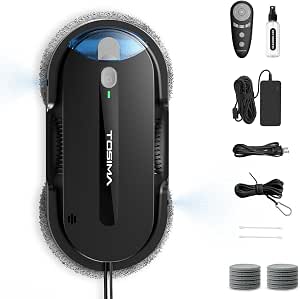 | Best for Larger Refill Intervals | Model: X1 | Surface recommendation: Glass | Water tank: 85 ml | VIEW LATEST PRICE | See Our Full Breakdown |
| TOSIMA WA9C Pro Window Cleaning Robot with 4 Nozzles and Remote |  | Best for Flexible Spray and Route Control | Suction force: 2600–3200 Pa | Cleaning modes: N-shape, Z-shape, and manual | Spray nozzles: 4 | VIEW LATEST PRICE | See Our Full Breakdown |
| ECOVACS WINBOT W2 PRO Omni Window Cleaning Robot with Multifunction Station |  | Best Premium Cordless-Capable Pick | Model: WINBOT W2 | Operating modes: Battery or plugged-in operation | Battery cleaning time: Up to 110 minutes | VIEW LATEST PRICE | See Our Full Breakdown |
| HUTT 10 Premium Round-Square Window Cleaning Robot |  | Best for Wet Cleaning Plus Polishing | Maximum suction: Up to 6500 Pa | Cleaning pressure: 55 N | Water tank: 80 ml | VIEW LATEST PRICE | See Our Full Breakdown |
| X6 Window Cleaning Robot with 6400 Pa Suction |  | Best for Straightforward, Fast Coverage | Suction: 6400 Pa variable | Shape: Round | Cleaning path width: 8 inches | VIEW LATEST PRICE | See Our Full Breakdown |
| KADSKAN HCR-10 Automatic Window Cleaning Robot with Water Spray |  | Best for Manual Spray Control | Model: HCR-10 | Suction power: 5600 Pa | Cleaning modes: 3 automatic modes plus manual directional control | VIEW LATEST PRICE | See Our Full Breakdown |
| ECOVACS WINBOT Mini Window Cleaning Robot |  | Best for Small Windows and Light Touch-Ups | Surface recommendation: Glass | Control: App control | Power source: Corded electric | VIEW LATEST PRICE | See Our Full Breakdown |
| Tosima W5 Window Cleaning Robot |  | Best for Adaptive Suction and Safety Features | Model: W5 | Maximum suction: 6400 Pa | Cleaning path width: 6 inches | VIEW LATEST PRICE | See Our Full Breakdown |
More Details on Our Top Picks
ECOVACS WINBOT MINI Window Cleaning Robot
The WINBOT MINI is the compact, straightforward choice for routine glass upkeep: its 8.46-inch footprint suits smaller windows and apartments where a larger cleaner may be awkward to position. App control, intelligent path planning, and three cleaning modes keep operation simple, while the nine-stage protection system adds reassurance during cleaning. Dual ultrasonic spray is aimed at everyday dust and light smudges, not a long-neglected pane. Compared with the WINBOT W2S PRO, this model gives up the listed triple-spray system and more detailed mode selection in favor of a smaller format. That makes it a sensible pick for frequent light cleaning, but buyers dealing with water spots or stuck-on grime should expect extra passes and may prefer a more feature-rich option.
Pros:- Compact 8.46-inch footprint is easier to position on smaller glass areas
- App control and intelligent path planning simplify routine operation
- Dual ultrasonic spray supports everyday dust and light-smudge cleaning
- Nine-stage protection system adds a layer of safety support
Cons:- Heavy dirt may need refreshed pads or multiple cleaning cycles
- The supplied product details do not specify suction strength or battery runtime
- Fewer documented spray and cleaning-mode details than the WINBOT W2S PRO
Best for: Apartment residents and owners of smaller windows who want a compact robot for regular dust and light-smudge removal.
Not ideal for: People cleaning large panes or heavy buildup who want detailed cleaning specifications and a stronger wet-wiping setup.
- Brand:ECOVACS
- Model:WINBOT MINI
- Recommended surface:Glass
- Control:App control
- Dimensions:8.46 × 8.46 × 2.17 in
- Spray system:Dual ultrasonic spray nozzles
- Cleaning modes:3
- Safety:9-stage protection system
Our verdict“Choose the WINBOT MINI for compact, routine glass care, but pick the WINBOT W2S PRO if heavier wet cleaning is your priority.”
ECOVACS WINBOT W2S PRO Window Cleaning Robot
The WINBOT W2S PRO makes the strongest case here for buyers who want a more active wet wipe rather than a basic pass over dusty glass. Its triple-spray mist, microfiber pad, and 4.1-fluid-ounce water capacity are suited to everyday smudges and water spots, while edge brushes and felt bristles help it work closer to frames. Six named modes—including Heavy-Duty and Deep—give more task-specific choices than the WINBOT MINI. Route planning and a 10-stage safety system add useful structure to cleaning. The tradeoff is a more involved setup: it is corded, limited to glass, and requires the safety tether to be attached and used according to the manual. Choose it over the MINI for broader wet-cleaning options, not for a compact or especially simple setup.
Pros:- Triple-spray mist and microfiber pad target everyday smudges and water spots
- Edge brushes and felt bristles are designed to clean close to frames and corners
- Six named cleaning modes offer more task choices than the WINBOT MINI
- 10-stage safety system and boundary-aware route planning support controlled cleaning
Cons:- Designed for glass surfaces rather than a range of smooth materials
- Corded operation limits placement and requires access to power
- Safety tether setup and manual instructions add steps before cleaning
Best for: Homeowners with framed glass windows who want multiple wet-cleaning modes and edge-focused wiping for routine dirt and water spots.
Not ideal for: Buyers who want a cordless setup, plan to clean non-glass surfaces, or prefer the smallest and simplest machine in the lineup.
- Brand:ECOVACS
- Model:WINBOT W2S PRO
- Surface:Glass
- Suction:10,000 Pa
- Power source:Corded electric
- Water capacity:4.1 fluid ounces
- Cleaning modes:Fast, Thorough, Edge, Heavy-Duty, Deep, Zone
- Battery life:30 minutes
- Control:App control
Our verdict“Pick the WINBOT W2S PRO if wet wiping and mode variety matter more than compact size or a minimal setup.”
ECOVACS WINBOT W3 OMNI Robot Window Cleaner with Self-Cleaning Station
The WINBOT W3 OMNI is the lineup’s convenience-focused option: its station automatically washes the mop pads, reducing the manual cleanup that follows a window-cleaning session. The robot combines a triple-nozzle spray system with an edge-cleaning scrubber, while WIN-SLAM 5.0 navigation and multiple modes are aimed at varied window layouts. That makes it more appealing for frequent or larger jobs than the compact WINBOT MINI, which is geared toward lighter routine cleaning and does not include an automatic pad-washing station. The convenience comes with a substantial footprint and a listed weight of 12.22 kg, so storage and moving the system may take more effort. It is also intended for indoor glass, limiting its usefulness for buyers who want one robot for mirrors, tiles, and other surfaces.
Pros:- Automatic station washing cuts down on manual pad-cleaning after use
- Triple-nozzle spray and wet wiping support routine dirt removal
- Edge-cleaning scrubber is designed to reach corners
- WIN-SLAM 5.0 navigation and multiple modes suit varied window layouts
Cons:- Listed weight of 12.22 kg makes the system less convenient to move and store
- Recommended for indoor glass rather than a broad range of smooth surfaces
- Warranty details require contacting customer service
Best for: People who clean multiple or large indoor glass surfaces regularly and want the station to handle mop-pad washing.
Not ideal for: Small-home buyers with limited storage, anyone needing a lightweight cleaner, or those who want to clean surfaces beyond indoor glass.
- Brand:ECOVACS
- Model:WINBOT W3 OMNI
- Recommended surface:Glass
- Navigation:WIN-SLAM 5.0
- Spray system:Triple-nozzle
- Battery life:130 minutes
- Capacity:1.1 liters
- Dimensions:10.63 × 2.99 × 10.63 in
- Weight:12.22 kg
Our verdict“Choose the W3 OMNI if automatic pad washing is worth the larger, heavier system for your regular indoor glass-cleaning routine.”
ECOVACS WINBOT MINI 2 Compact Window Cleaning Robot
The WINBOT MINI 2 pairs a compact body with unusually specific edge and safety details, making it a stronger fit than the original WINBOT MINI when narrow panes, mirrors, or frameless glass are part of the job. Its edge brushes and side wings are designed to clean within 1 mm of the frame, and WIN-SLAM 4.0 offers five modes, including Spot and Edge Clean. Bluetooth directional control gives the user another way to guide it beyond app control. Backup attachment protection is listed for over 30 minutes during a power interruption, with a safety rope included. The small format does impose a minimum window size, and heavily soiled glass can still need repeat cycles. A tether also needs to be anchored before use, so this is compact—not setup-free.
Pros:- Edge brushes and side wings are designed to clean within 1 mm of frames
- Compact size suits narrow and hard-to-reach glass areas
- Five modes plus app and Bluetooth directional control provide flexible operation
- Backup attachment protection and included safety rope add fall-protection measures
Cons:- Minimum window size is 8.66 × 9.84 inches
- Heavily soiled glass may need multiple passes
- Safety rope must be anchored before operation
Best for: Buyers cleaning smaller framed or frameless windows, mirrors, and glass doors who value close edge coverage and directional control.
Not ideal for: People with panes smaller than 8.66 × 9.84 inches, heavy grime, or a preference for using a window robot without tether setup.
- Dimensions:8.46 × 8.46 × 2.17 in
- Minimum window size:8.66 × 9.84 in
- Suction:8000 Pa
- Cleaning modes:Fast, Thorough, Deep, Spot, Edge Clean
- Navigation:WIN-SLAM 4.0
- Cleaning pressure:14 N
- Backup attachment protection:Over 30 minutes
- Noise level:65 dB
- Control:App control and Bluetooth directional control
Our verdict“Choose the MINI 2 for small glass areas where close edge cleaning and directional control matter more than avoiding setup.”
Robot Window Cleaner with Dual Ultrasonic Spray, 6400Pa Suction, Intelligent Navigation and Remote Control
This unnamed robot stands apart from the ECOVACS models by listing compatibility with glass, tiles, marble, shower doors, and mirrors. That wider surface range is its main reason to make the roundup: buyers can use one machine across several smooth areas, rather than choosing a glass-only option such as the WINBOT W2S PRO. Dual ultrasonic spray, up to 6400Pa suction, and Fast, Thorough, and Spot modes cover the basics, while a remote and reusable cloths add practical flexibility. The tradeoff is that it must be plugged in to start, and setup includes the water tank and tether. Its power-off adhesion is rated for up to 20 minutes, shorter than the MINI 2’s listed backup attachment protection of over 30 minutes. Treat it as a versatile generalist, not the strongest safety or mode-rich pick.
Pros:- Listed compatibility includes glass, tiles, marble, shower doors, and mirrors
- Dual ultrasonic spray and up to 6400Pa suction support its cleaning routine
- Remote control and Fast, Thorough, and Spot modes offer straightforward operation
- Includes 10 reusable cloths and two replacement nozzles
Cons:- Must be plugged in to start, limiting use where power access is inconvenient
- Water tank and safety tether require setup before cleaning
- Power-off adhesion is listed for up to 20 minutes, shorter than the MINI 2’s backup protection
Best for: Households that want one window robot for glass, mirrors, shower doors, and other compatible smooth surfaces.
Not ideal for: Buyers seeking cordless operation, a longer listed backup-attachment period, or a broad set of specialized cleaning modes.
- Suction power:Up to 6400 Pa
- Water tank capacity:85 ml
- Cleaning modes:Fast, Thorough, Spot
- Spray system:Dual ultrasonic
- Compatible surfaces:Glass, tiles, marble, shower doors, mirrors, glass curtain walls
- Power-off adhesion:Up to 20 minutes
- Safety tether:5 m
- Included cleaning cloths:10 reusable cloths
- Compatible glass thickness:6–19 mm
Our verdict“Choose this model if multi-surface compatibility matters most, and skip it if you want cordless use or a longer specified backup hold.”
HUTT 10 Premium Window Cleaning Robot with Dual Round-Square Pads
The HUTT 10 separates wet cleaning from dry polishing with a round wet pad and square dry pad, a useful distinction for buyers who want a finishing pass rather than a single wipe. Its 6500 Pa suction, NAVI 7.0 mapping, and 14 sensors support route planning and edge detection; compared with the simpler path options on the BOJUK C260-M, this one puts more emphasis on mapped movement and pad roles. A 30-minute backup battery and safety rope add protection if power drops, though the robot still relies on a cord during normal use. The 80 ml tank is rated for up to 60 m² per refill, but traction can suffer if drive tracks are dusty or pads are too wet. I’d skip it if you want a truly hands-off setup with no pad care.
Pros:- Separate round wet-cleaning and square dry-polishing pads
- NAVI 7.0 mapping and 14 sensors support route planning and edge detection
- 30-minute backup battery plus a safety rope
- 80 ml tank is specified for coverage up to 60 m² per refill
Cons:- Dusty tracks or overly wet pads can reduce traction
- Cleaning liquid is not included, and purified water is recommended
- Corded power is required during normal operation
Best for: Glass-cleaning buyers who want separate wet and dry pad stages, mapped routes, and added backup protection for larger windows.
Not ideal for: People who want minimal setup or do not want to monitor pad moisture and keep the drive tracks clean.
- Suction:Up to 6500 Pa
- Cleaning system:Round wet-cleaning pad and square dry-polishing pad
- Spray system:Dual-direction ultrasonic spray
- Water tank:80 ml; up to 60 m² coverage per refill
- Navigation and sensors:NAVI 7.0 smart mapping; 14 sensors
- Backup battery:Up to 30 minutes
- Weight and noise:1.3 kg; 65 dB
- Minimum glass surface:30 × 30 cm
- Included accessories:Remote control, safety rope, spray bottle, 6 nozzles, and 3 pairs of cleaning pads
Our verdict“Choose the HUTT 10 if a wet-cleaning pass followed by dry polishing matters more than the simpler routine-cleaning approach of the BOJUK C260-M.”
BOJUK Window Cleaning Robot with 6500Pa Suction
The BOJUK C260-M is a practical pick for routine window upkeep, pairing 6500 Pa suction with edge detection and three directional cleaning paths: top-down, left-down, and right-down. Those selectable routes make it more adaptable than the Tosima X1’s stated automatic S-shaped path, while keeping operation centered on a remote rather than a more involved mapping system like the HUTT 10. Dual spray nozzles and a 60 ml tank support regular maintenance, but the description cautions that stubborn buildup may need pre-cleaning or extra cycles. Its 25-minute UPS backup and 5-meter safety rope add protection, and the 10 included pads give owners replacements for ongoing upkeep. The tradeoff is a smaller tank than the Tosima X1’s 85 ml reservoir, plus pads that need washing after each cycle.
Pros:- Three directional cleaning paths for different window layouts
- 6500 Pa suction with edge detection
- Dual spray nozzles and remote control included
- 25-minute UPS backup and 5-meter safety rope
Cons:- Heavy buildup may require pre-cleaning or extra cycles
- 60 ml tank is smaller than the Tosima X1’s 85 ml tank
- Cleaning pads require washing after each cycle
Best for: People maintaining moderately soiled windows, glass doors, or tile who want selectable routes and a remote control.
Not ideal for: Buyers facing dried-on grime or seeking less pad maintenance; tough stains may need manual preparation and pads need washing after use.
- Model:C260-M
- Suction power:6500 Pa
- Cleaning paths:Top-Down, Left-Down, and Right-Down
- Water tank:60 ml
- Safety rope:5 meters
- UPS backup:25 minutes
- Cleaning path width:8 inches
- Control:Remote control
- Included pads:10 cleaning pads
Our verdict“Pick the BOJUK C260-M for routine upkeep with route choices, but favor the larger-tank Tosima X1 if fewer refills matter more.”
Tosima X1 Window Cleaning Robot
The Tosima X1’s main practical advantage is its 85 ml visible tank, which holds more than the BOJUK C260-M’s 60 ml reservoir and may mean fewer pauses during a longer cleaning session. It follows an automatic S-shaped path and uses dual ultrasonic spray nozzles, with a remote available for manual direction adjustments. A roughly 25-minute backup battery and safety tether help if power fails, while the minimum window size of 30 × 30 cm suits many small panes as well as larger glass. This is a corded robot in normal use, so a power outlet and cable management remain part of the job. The tank’s capacity is still finite, and the listing does not provide a suction figure or multiple selectable paths like the BOJUK.
Pros:- 85 ml visible tank holds more water than the BOJUK C260-M’s 60 ml tank
- Automatic S-shaped cleaning path
- Dual spray nozzles and remote control
- Safety tether and about 25 minutes of backup attachment time
Cons:- Requires corded power during normal cleaning
- Tank may still need refilling during extended cleaning
- Product data does not specify suction power
Best for: Buyers cleaning several glass panes who value a larger visible reservoir and automatic route coverage with remote adjustments.
Not ideal for: People without a convenient outlet or shoppers who want a stated high suction rating and several selectable cleaning paths.
- Model:X1
- Surface recommendation:Glass
- Water tank:85 ml
- Cleaning path:Automatic S-shaped path
- Cleaning path width:8 inches
- Backup battery:About 25 minutes during a power outage
- Minimum window size:30 × 30 cm
- Noise level:65 dB
- Warranty:2 years
Our verdict“Choose the Tosima X1 when a larger tank and automatic S-shaped route outweigh the BOJUK C260-M’s selectable paths and stated suction rating.”
TOSIMA WA9C Pro Window Cleaning Robot with 4 Nozzles and Remote
The WA9C Pro gives buyers four spray nozzles and a choice of N-shape, Z-shape, or manual movement, making it the most route-flexible option here for someone who wants to adjust how the robot crosses the glass. That contrasts with the Tosima X1’s automatic S-shaped path and dual-nozzle spray, though the WA9C Pro lists a lower 2600–3200 Pa suction force than the 6500 Pa HUTT 10 and BOJUK. Its anti-fall sensor, power-failure protection, backup battery, and safety rope provide multiple safeguards, but the rope still needs a secure anchor for overhead work. Despite the battery-powered wording in the specs, the product description says it requires an AC cable during operation, so buyers should plan around a cord rather than expect cordless cleaning.
Pros:- Four spray nozzles provide broad spray coverage
- N-shape, Z-shape, and manual cleaning modes
- Remote control and automatic navigation
- Anti-fall sensor, power-failure protection, backup battery, and safety rope
Cons:- Listed suction force of 2600–3200 Pa is below the HUTT 10 and BOJUK ratings
- Requires an AC power cable during operation
- Safety rope must be anchored for overhead use
Best for: People who want several automatic path choices, manual remote control, and broad spray coverage for glass windows.
Not ideal for: Buyers seeking higher listed suction or a cordless operating setup; the robot needs an AC cable and its suction rating is lower than the HUTT 10’s.
- Suction force:2600–3200 Pa
- Cleaning modes:N-shape, Z-shape, and manual
- Spray nozzles:4
- Cleaning path width:8 inches
- Backup battery:Up to 25 minutes
- Control:Remote control
- Safety features:Anti-fall sensor, power-failure protection, and safety rope
- Power:AC power cable required for operation
- Included accessories:Four cleaning mops, replacement nozzles, and safety rope
Our verdict“Pick the WA9C Pro if route choice and four-nozzle coverage matter more than the higher suction ratings offered by the HUTT 10 and BOJUK.”
ECOVACS WINBOT W2 PRO Omni Window Cleaning Robot with Multifunction Station
The WINBOT W2 PRO Omni stands apart from the other four with battery or plugged-in operation and up to 110 minutes of cleaning in battery mode. That makes it a better fit for windows where a nearby outlet is inconvenient than the cord-dependent HUTT 10, BOJUK C260-M, Tosima X1, and WA9C Pro. Its three-nozzle spray system, WIN-SLAM 4.0 path planning, multifunction station, and 12-stage protection target a more complete setup, including frameless and tilting windows. The compromise is that battery mode has a defined runtime and coverage limit—up to 55 m² per full charge—and the robot is intended for glass. Compared with the HUTT 10’s 30-minute backup battery, this is designed to clean on battery power, not only remain attached through an outage.
Pros:- Battery and plugged-in operating modes
- Up to 110 minutes of cleaning and 55 m² coverage per full charge in battery mode
- Three-nozzle spray and WIN-SLAM 4.0 path planning
- Multifunction station and 12-stage protection system
Cons:- Battery mode is limited to the stated runtime and coverage
- Designed for glass surfaces only
- More elaborate station-based setup than the simpler corded picks
Best for: Buyers with large or awkwardly placed glass windows who want battery-powered cleaning, a station, and route planning for varied window types.
Not ideal for: People cleaning non-glass surfaces or needing uninterrupted battery operation beyond the stated 110-minute runtime and 55 m² coverage.
- Model:WINBOT W2
- Operating modes:Battery or plugged-in operation
- Battery cleaning time:Up to 110 minutes
- Battery-mode coverage:Up to 55 m² per full charge
- Spray system:Three-nozzle spray system
- Navigation:WIN-SLAM 4.0 path planning
- Protection:12-stage protection, anti-fall, and edge cleaning
- Control:App control
- Surface recommendation:Glass; includes frameless and tilting windows
Our verdict“Choose the WINBOT W2 PRO Omni if battery-powered cleaning and a station-based setup justify its runtime limits, rather than the simpler corded operation of the other picks.”
HUTT 10 Premium Round-Square Window Cleaning Robot
The HUTT 10 is the most differentiated pick here for buyers who want more than a single-pass wipe: its round wet-cleaning pad and square dry-polishing pad split loosening grime from finishing the glass. That two-stage approach can be useful on mirrors and sliding doors as well as windows, while smart mapping and 14 sensors help it plan around edges. Its 30-minute backup adhesion and safety rope add reassurance for elevated glass. Compared with the X6, which prioritizes a broader 8-inch cleaning path and simple controls, the HUTT 10 offers a more involved pad system and higher stated suction, but requires more care: cleaning fluid is not included, and dirty or damp pads and tracks can affect traction. Choose it for finish flexibility, not minimum upkeep.
Pros:- Separate wet and dry pads support cleaning followed by polishing
- Smart mapping and 14 sensors help plan routes and detect edges
- Backup battery and safety rope add protection during elevated cleaning
- Supports windows, mirrors, shower doors, sliding doors, and small glass areas
Cons:- Cleaning liquid is not included
- Pads and tracks need careful cleaning and drying to maintain traction
- Spray performance may depend on using purified water
Best for: Glass-cleaning buyers who want separate wet-cleaning and dry-polishing stages for windows, mirrors, or shower doors.
Not ideal for: People who want a ready-to-run kit with little maintenance; cleaning liquid is not included, and pads and tracks need proper cleaning and drying.
- Maximum suction:Up to 6500 Pa
- Cleaning pressure:55 N
- Water tank:80 ml
- Coverage per refill:Up to 60 m² (646 sq ft)
- Backup adhesion:Up to 30 minutes
- Noise level:65 dB
- Weight:1.3 kg
- Minimum glass surface:30 × 30 cm
Our verdict“Pick the HUTT 10 if you value a wet-cleaning-and-polishing routine more than a simpler, lower-maintenance robot.”
X6 Window Cleaning Robot with 6400 Pa Suction
The X6 suits buyers who want a relatively direct route from setup to cleaning: a one-touch start, remote control, and automatic path planning reduce the amount of manual steering. Its 8-inch cleaning path and stated ability to clean a 3.3 m² window in about seven minutes make it a stronger fit for larger panes than the narrower-path KADSKAN HCR-10. Variable suction, dual spray nozzles, edge detection, a safety cable, and a 30-minute UPS backup broaden its use across glass, mirrors, and tile walls. The tradeoff is that speed does not remove the need for upkeep: heavily soiled glass may need another pass, and dirty pads or excess water can affect results. I would choose it for routine coverage, not for neglected windows that need intensive scrubbing.
Pros:- 8-inch cleaning path supports coverage of larger panes
- Remote control and one-touch start keep operation simple
- Edge detection, safety cable, and UPS backup provide multiple safety measures
- Works on glass, mirrors, and tile walls
Cons:- Heavily soiled windows may need more than one pass
- Cleaning results depend on suitable water use and clean pads
Best for: Homeowners with several large glass panes who want remote or one-touch operation and automatic route planning.
Not ideal for: People expecting a single pass to restore heavily soiled glass or who do not want to manage pad cleanliness and water application.
- Suction:6400 Pa variable
- Shape:Round
- Cleaning path width:8 inches
- Water capacity:85 ml
- Noise level:63 dB
- UPS backup:Up to 30 minutes
- Warranty:1 year
Our verdict“Choose the X6 for quick, mostly hands-off maintenance on larger panes, provided you are willing to repeat passes on stubborn dirt.”
KADSKAN HCR-10 Automatic Window Cleaning Robot with Water Spray
The HCR-10 gives buyers more direct control over water application than the X6 or Tosima W5: it offers automatic and manual spraying, plus three automatic modes and directional remote control. That flexibility can help when a particular patch needs extra moisture, while frame and obstacle detection guide its cleaning heads around the glass. Its 300 lb-rated safety rope and included 10 cleaning pads make the package appealing for people who expect regular pad changes. The compromise is scale: the 30 ml water container is much smaller than the X6’s 85 ml tank, so it is less suited to long sessions without refilling. Its 5.7-inch path is also narrower than the X6’s, and the listed battery life is 30 minutes. This is a control-focused option, not the best pick for broad, uninterrupted coverage.
Pros:- Offers both automatic and manual water spraying
- Three cleaning modes and directional remote control provide operating flexibility
- Detects window frames and obstacles
- Includes 10 cleaning pads and a safety rope rated for 300 lb
Cons:- 30 ml water capacity is limited for extended cleaning
- 5.7-inch cleaning path covers less width than the X6
- Listed battery life is 30 minutes
Best for: Buyers who want to adjust spray manually for different glass areas and value a generous supply of replacement pads.
Not ideal for: People cleaning many large windows in one session; the 30 ml container and narrower path call for more frequent attention.
- Model:HCR-10
- Suction power:5600 Pa
- Cleaning modes:3 automatic modes plus manual directional control
- Water spray:Automatic and manual
- Cleaning path width:5.7 inches
- Water capacity:30 ml
- Battery life:30 minutes
- Safety rope load capacity:300 lb
Our verdict“Pick the HCR-10 if hands-on spray control matters more than tank capacity or wide-area coverage.”
ECOVACS WINBOT Mini Window Cleaning Robot
The WINBOT Mini is the most compact, light-duty choice in this group. Its 8.46-inch square footprint, app control, and three cleaning modes suit indoor glass where dust, fingerprints, or light marks are the main problem. That makes it a more natural match for small panes and quick maintenance than the X6, whose wider cleaning path is better suited to larger windows. The Mini also uses ultrasonic spray and suction with safety protections, but its brief specifies light cleaning rather than heavy grime; badly soiled glass may need multiple cycles or a fresh pad. It is corded electric, so the cleaning area depends on access to power, and the listed package includes only the robot. I would choose it for manageable indoor touch-ups, not demanding exterior jobs or deep cleaning.
Pros:- Compact footprint suits small panes and tight glass areas
- App control and three cleaning modes offer convenient operation
- Ultrasonic spray and suction support routine glass cleaning
- Washable filter supports repeated maintenance
Cons:- Heavy dirt may require multiple cycles or a cleaned pad
- Corded power limits placement and reach
- Designed for indoor use and light cleaning
Best for: Apartment dwellers and homeowners maintaining small indoor windows, mirrors, or glass doors with light dust and fingerprints.
Not ideal for: People tackling heavily soiled glass, large exterior windows, or areas without convenient access to a power outlet.
- Surface recommendation:Glass
- Control:App control
- Power source:Corded electric
- Voltage:110 V
- Capacity:200 ml
- Cleaning modes:3
- Dimensions:8.46 × 8.46 × 2.17 in
- Usage:Indoor
Our verdict“Choose the WINBOT Mini for compact indoor touch-ups, but pick the X6 or HUTT 10 for broader or more demanding cleaning needs.”
Tosima W5 Window Cleaning Robot
The Tosima W5 is a strong match for buyers who want an automatic glass-cleaning route paired with several layers of fall protection. Its adaptive suction up to 6400 Pa, edge sensor, safety rope, and backup power address the practical concern of keeping a corded robot attached while it works. Dual spray and dual-spiral pads handle routine dust and stains, while button and remote controls let users start or direct cleaning. Compared with the KADSKAN HCR-10, the W5 has a higher stated maximum suction and a much longer-rated safety rope load, but it lacks the HCR-10’s manual spray option and included 10-pad supply. The W5 also needs a power connection during normal use and is intended for smooth glass, so it is less versatile across surfaces than the X6.
Pros:- Adaptive suction reaches up to 6400 Pa
- Automatic navigation and dual spray help manage routine cleaning
- Edge sensing, safety rope, and backup power add protection
- Button and remote controls provide two operating options
Cons:- Requires a power connection during normal operation
- Specified for smooth glass windows rather than multiple surface types
- Up to 25 minutes of battery life is less than the 30-minute backup listed for the HCR-10
Best for: Glass-window owners who prioritize adaptive suction, remote operation, and backup safety features for elevated cleaning.
Not ideal for: People who need a cordless robot or want one appliance for glass, mirrors, and tile; the W5 requires normal-use power and is specified for smooth glass.
- Model:W5
- Maximum suction:6400 Pa
- Cleaning path width:6 inches
- Battery life:Up to 25 minutes
- Battery voltage:14.8 V
- Controls:Button control and remote control
- Safety rope capacity:Up to 220 kg
- Manufacturer warranty:1 year
Our verdict“Choose the W5 for safety-focused, automatic cleaning of smooth glass, but favor the X6 if you need support for tile or mirrors.”

How We Picked
I ranked these robotic window cleaning vacuums by how well their stated features address real household cleaning needs: glass coverage, navigation, spray delivery, pad design, controls, safety provisions, and the effort required to set up and maintain the unit. I also considered whether the product’s form makes sense for small panes, large windows, or buyers seeking an all-in-one station. A high suction figure alone did not earn a high position; a robot also needs a credible approach to movement, edge cleaning, and secure operation.
The ranking favors balanced usefulness over a single headline feature. That places the ECOVACS WINBOT W2S PRO first, with the W3 OMNI and W2 PRO Omni attractive to buyers prioritizing station-based convenience, and the MINI models suited to compact-window needs. The lineup also includes several less-documented or similarly named options, so I treat their advertised specifications cautiously and recommend checking exact model details, included accessories, and safety instructions before purchase. Closely related models are not assumed to be interchangeable.
Factors to Consider When Choosing Robotic Window Cleaning Vacuums
Before choosing a robot, I would start with the windows it must clean and the amount of setup you are willing to handle. Window size, access, and maintenance can matter more than a headline suction figure, especially when comparing compact robots, spray-focused designs, and station-based systems.
Match the Robot to Pane Size and Shape
Measure the glass you actually plan to clean, including narrow panes, divided sections, and any frameless areas. Compact models can be easier to position and store, but a smaller cleaning footprint may mean more passes on broad windows. Wide, uninterrupted glass may reward a robot designed for larger coverage, while small or irregular panes can make maneuverability more useful than speed. Check whether the manufacturer specifies minimum pane dimensions and whether the robot can approach edges safely. A common mistake is buying for the largest window while overlooking the small panes that are hardest to reach. If your home has several window styles, choose around the most awkward one rather than the easiest one.
Treat Suction as One Part of the Safety Picture
Advertised suction values describe only one aspect of how a robot stays on glass; they do not tell the whole story about safe use. Read the instructions for the backup power system, safety tether, permitted glass types, and operation near frames or exterior ledges. A high number should not replace a clear safety procedure, especially when cleaning upper-floor windows. Check what happens during a power interruption and whether the tether can be anchored securely in your intended location. Avoid using the machine on surfaces or conditions the maker does not approve. For difficult exterior access, a robot can reduce direct reaching, but it does not remove the need to follow its safety requirements.
Compare Spray Coverage and Pad Care
Spray systems and pad shapes affect how evenly the robot wets glass and how much hands-on work follows each run. Multiple nozzles may help distribute fluid across a pass, while a distinctive pad shape may be designed to reach near edges or corners. Neither feature guarantees a streak-free result if the pads are dirty, worn, or loaded with too much cleaning solution. Check how easily pads detach, whether replacements are available, and which cleaning fluids the manufacturer permits. Buyers sometimes focus on nozzle count and forget that repeated pad washing can become the main maintenance task. If you clean often, simple pad handling may matter more over time than a small difference in advertised spray features.
Decide Whether a Multifunction Station Earns Its Space
A station can combine storage, power management, or cleaning-related functions, but it also adds another item to store and set up. It may suit households that use a window robot regularly and value a more organized cleaning routine. For occasional jobs, a compact robot with fewer accessories may be easier to keep ready. Compare what a station actually does rather than assuming every station cleans pads or simplifies every step. Check its footprint, power needs, and whether the robot can still be operated conveniently without relying on it. Paying extra for station-based convenience makes most sense when those functions solve a recurring chore rather than a once-in-a-while annoyance.
Check Controls, Navigation, and Your Role During a Run
Remote controls and automated routes can make operation easier, but they do not all provide the same level of oversight or customization. Decide whether you want to choose a cleaning mode, reposition the unit remotely, or simply start a preset route. For windows with obstacles, narrow frames, or unusual shapes, navigation behavior may matter more than a long feature list. Read the instructions on preparing glass and supervising operation; a robot is not necessarily a set-it-and-forget-it appliance. New users may prefer a straightforward control layout and clear setup steps over extra modes. Buyers with many windows may value repeatable routes, while someone cleaning a few panes may favor quick setup.
Verify Model Details, Parts, and Ongoing Support
Similar product names can conceal differences in accessories, spray systems, stations, and included pads. Confirm the exact model identifier and inspect the package contents rather than relying on a shortened listing title. Look for replacement pads, compatible cleaning solution guidance, warranty terms, and a clear support channel before committing. This matters especially for less-documented options where a large suction claim may be easier to find than practical service information. Do not assume that parts from one version fit another version from the same brand. A robot that is simple to maintain and support can be a safer long-term choice than one with more advertised features but uncertain replacement supplies.
Frequently Asked Questions
Should I choose a station-based window robot or a compact standalone model?
I would choose a station-based option when its storage or cleaning functions will be useful across frequent cleaning sessions. The W3 OMNI and W2 PRO Omni are aimed at buyers who value a fuller setup, while the MINI models make more sense when limited storage or smaller panes are the main concern. A station is not automatically a better cleaner, and it can add setup and storage demands. Compare the station’s specific functions with the chores you want to reduce. If you clean only a few windows occasionally, a simpler unit may be easier to live with.
Is a higher advertised suction figure enough to choose between these robots?
No. Suction figures can help describe a product, but they do not establish how well it navigates, sprays, cleans edges, or responds to a power interruption. Compare safety instructions, tether arrangements, backup power details, window compatibility, and how the robot handles your pane shape. In this lineup, several models advertise strong suction, so that figure does little to separate them on its own. I would treat it as one specification among several, not as a shortcut to choosing. Follow the manufacturer’s operating guidance regardless of the stated number.
Can a window cleaning robot replace hand cleaning completely?
I would treat these robots as tools for reducing repeated wiping, not as a guarantee that every window will need no follow-up. Results can depend on how dirty the glass is, the condition of the pads, the cleaning fluid, and the window’s edges or corners. Some panes may still need manual attention, particularly where frames or obstacles limit the robot’s path. Cleaning and changing pads also remain part of ownership. If you expect a fully hands-off result on every surface, check the model’s limits and instructions before buying.
Which features should I prioritize for upper-floor exterior windows?
Start with the manufacturer’s approved-use instructions and the complete safety setup, including tether anchoring and backup power behavior. Confirm that the robot is intended for the glass type and window layout you have, and do not rely on suction claims alone. Your ability to attach a tether securely and supervise operation matters as much as the robot’s navigation. If the window cannot be accessed or anchored safely under the instructions, a robotic cleaner may not be the right solution for that pane. A professional service can be a better choice for locations where safe setup is not possible.
How do I choose between a compact model and one with more spray nozzles?
Choose compact dimensions when storage, narrow panes, or easy positioning are your main concerns; choose a multi-nozzle design when spray distribution is a priority for the glass you clean. The MINI models are the more natural fit for limited spaces, while the Tosima WA9C Pro is distinguished by its four-nozzle setup. Neither choice guarantees better results across every window. Consider pane dimensions, pad access, cleaning-fluid guidance, and how much maintenance you are prepared to do. If you have both small and wide windows, prioritize the layout that is most difficult or frequent to clean.
Conclusion
My best overall recommendation is the ECOVACS WINBOT W2S PRO for buyers who want a balanced feature set without making a station the main attraction. For best value, I would start with the Tosima X1 or KADSKAN HCR-10, then verify the exact included accessories, support, and safety details before choosing between them. The best premium direction is the ECOVACS WINBOT W3 OMNI for buyers who will use its self-cleaning station, with the W2 PRO Omni as another station-centered option. Beginners who prefer a compact, less elaborate setup should look first at the ECOVACS WINBOT MINI. For small panes and tight storage, the MINI 2 is a focused alternative; for buyers drawn to spray coverage, compare the WA9C Pro’s four nozzles with the simpler spray setups. Match your choice to your actual glass, safety setup, and tolerance for maintenance rather than choosing by suction claims alone.