If you’re looking for the best USB-C docking stations for your laptop in 2025, I recommend considering options that support dual 4K monitors, fast data transfer, and high wattage Power Delivery, like the Anker Prime or Acer Docking Station. Port variety and build quality are also important. Want to find out which models offer the perfect balance of features and portability? Keep going to discover the top picks and what to look for!
Key Takeaways
- Consider compatibility with your laptop’s OS, ports, and display requirements for optimal performance.
- Prioritize docks with sufficient video output options supporting dual 4K or higher resolutions at desired refresh rates.
- Check for high-speed data transfer ports (USB 3.1, USB4, Thunderbolt) to support peripherals and fast file transfers.
- Ensure adequate Power Delivery (80W-160W) to charge your device while connected.
- Evaluate build quality, portability, and additional features like SD card readers, Ethernet, and ergonomic design.
Anker Dual Monitor Laptop Docking Station (Charger Not Included)
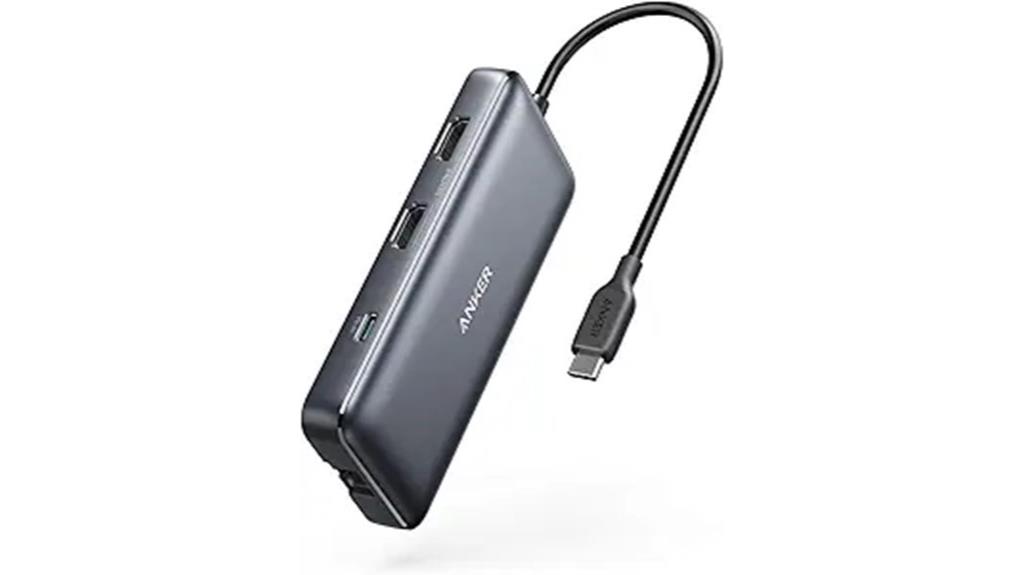
If you’re looking to expand your laptop’s connectivity without sacrificing performance, the Anker Dual Monitor Laptop Docking Station is an excellent choice. It offers 8-in-1 functionality, supporting dual 4K monitors via two HDMI ports—either mirrored at 60Hz or extended at 30Hz. It also includes a 1 Gbps Ethernet port, SD/microSD card reader, and USB-A data ports. With USB-C Power Delivery up to 85W, it can charge compatible laptops efficiently. Designed for broad compatibility—MacBook, Dell XPS, and more—it turns a single USB-C port into a versatile hub for professional and everyday use.
Best For: professionals and everyday users seeking to expand their laptop’s connectivity with dual 4K display support, fast data transfer, and high-power charging in a compact, versatile hub.
Pros:
- Supports dual 4K monitors with both mirroring and extended display options at 60Hz or 30Hz.
- Includes multiple ports such as Ethernet, SD/microSD card reader, and USB-A data ports for comprehensive connectivity.
- Compatible with a wide range of devices including MacBook, Dell XPS, and more, with up to 85W Power Delivery for efficient charging.
Cons:
- Charger not included, requiring an external power adapter for full functionality.
- Limited to USB-C, USB4, and Thunderbolt devices; not compatible with Linux systems.
- External monitors operate at lower refresh rates (30Hz) when extended, which may not suit high-refresh-rate needs.
Anker USB C Hub 5-in-1 USBC to HDMI & Data Ports
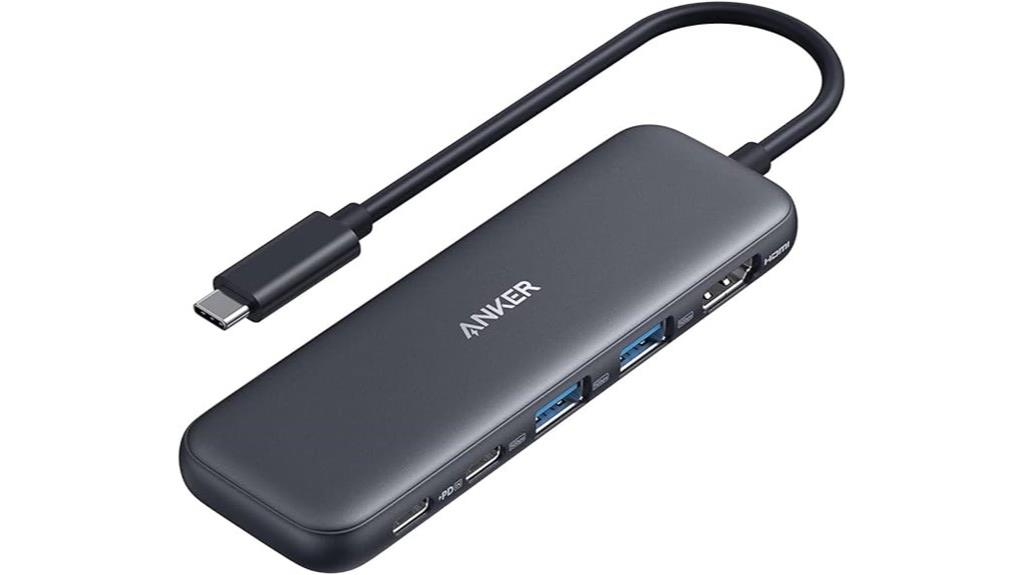
The Anker USB C Hub 5-in-1 USBC to HDMI & Data Ports is an excellent choice for professionals and students who need a compact, versatile docking solution that supports high-resolution displays and fast data transfer. It features a 4K HDMI port (up to 30Hz), USB-C and USB-A ports for quick data transfer, and a 100W pass-through charging port to keep your laptop powered. Compatible with MacBook, Dell, Windows, and ChromeOS devices, it offers reliable performance with USB4, Thunderbolt, and DP Alt Mode support. Its sleek design and 18-month warranty make it a practical, user-friendly accessory for everyday productivity.
Best For: professionals and students seeking a compact, versatile docking station that supports high-resolution displays, fast data transfer, and reliable charging for a variety of devices.
Pros:
- Supports 4K HDMI display at up to 30Hz, ideal for high-resolution visuals
- Offers multiple ports including USB-C, USB-A, and 100W pass-through charging for convenience
- Compatible with a wide range of devices including MacBook, Dell, Windows, and ChromeOS
Cons:
- HDMI port limited to 30Hz, which may not satisfy users needing higher refresh rates
- USB-C ports do not support video output, restricting some display options
- Not compatible with Linux operating systems
Acer USB C Docking Station Dual Monitor
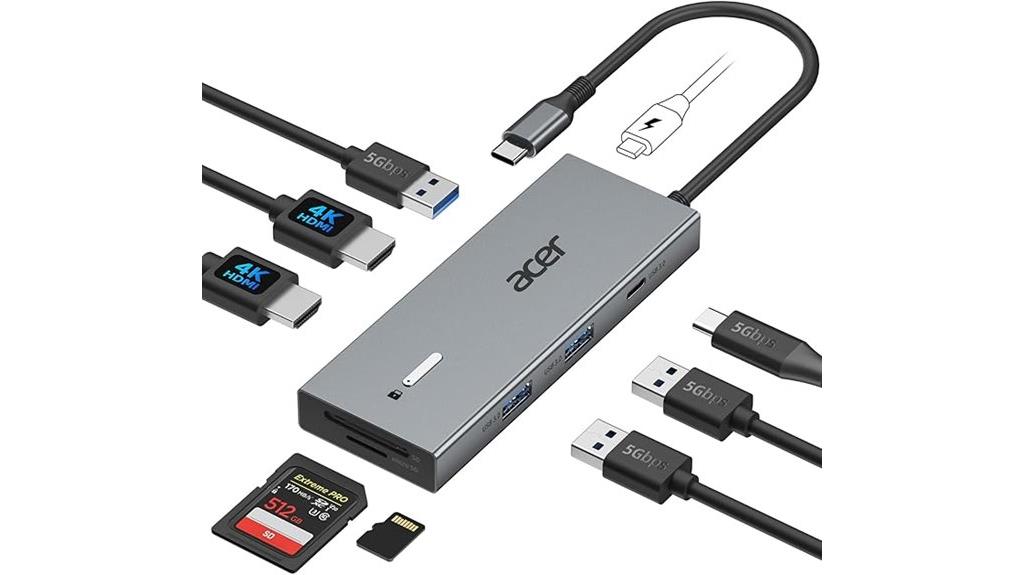
Looking for a reliable docking station that transforms your laptop into a powerful workstation? The Acer USB C Docking Station Dual Monitor is a solid choice. It features 9-in-1 connectivity, supporting dual 4K@60Hz HDMI outputs, so you can extend or mirror screens easily. Compatible with various devices like Acer, Dell, Mac, and more, it offers fast data transfer and 100W charging, ensuring your laptop stays powered. The sleek aluminum design adds durability, and the lock button enhances security. Just remember, Mac users can only run one external monitor in extended mode. Overall, it’s a versatile, efficient dock for boosting productivity.
Best For: professionals and students seeking a versatile docking station to enhance productivity with dual 4K displays and fast data transfer.
Pros:
- Supports dual 4K @ 60Hz HDMI displays for extended or mirrored screens
- Compatible with a wide range of devices including Acer, Dell, Mac, and more
- Offers 100W power delivery to keep your laptop charged during use
Cons:
- Mac users are limited to one external monitor in extended mode
- Requires a 65W+ power adapter (not included) for optimal charging performance
- External monitor support in Extend mode may vary depending on OS and device capabilities
Anker Prime Docking Station, 14-Port with 160W Max Output
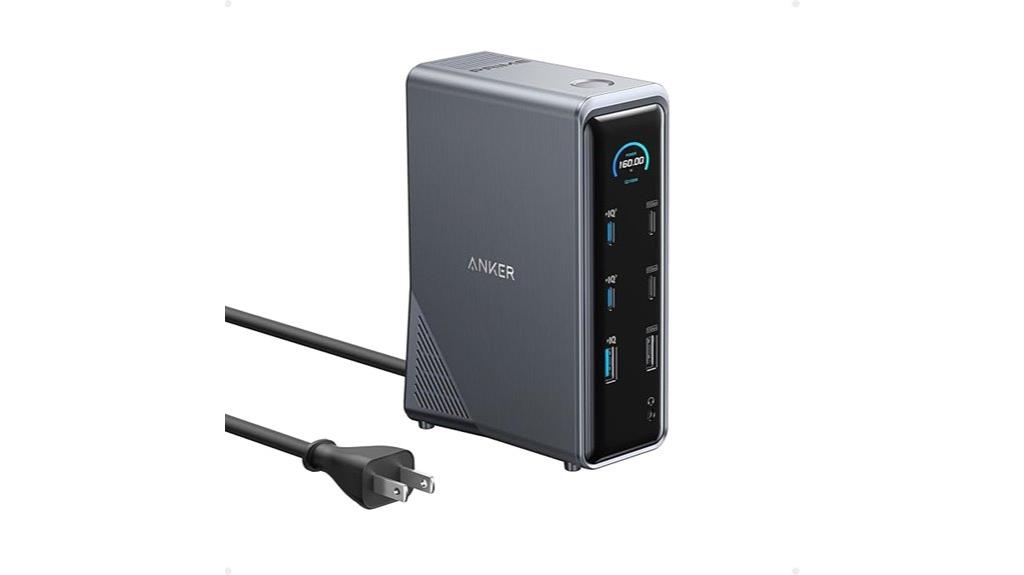
For professionals who need a versatile docking solution, the Anker Prime Docking Station stands out with its impressive 14-in-1 connectivity and 160W power output. It supports USB-C, USB4, and Thunderbolt interfaces, making it compatible with Windows 10/11 and ChromeOS laptops that support DP Alt Mode and Power Delivery. You can connect dual 4K displays or full HD setups easily, and charge up to four devices simultaneously with high-wattage ports. With 11 ports offering up to 10Gbps transfer speeds, it handles data swiftly. Its compact design and reliable customer support make it a solid choice for those seeking power, connectivity, and efficiency in one dock.
Best For: professionals and power users who need a versatile, high-capacity docking station to connect multiple displays and devices with fast data transfer and reliable charging.
Pros:
- Supports 14-in-1 connectivity including USB-C, USB4, and Thunderbolt interfaces for broad device compatibility.
- Delivers a powerful 160W total output, capable of charging multiple devices simultaneously.
- Enables dual 4K display setup with high refresh rates for crisp visuals and multimedia use.
Cons:
- Not compatible with Linux operating systems.
- Does not support 5120*1440 monitor resolution.
- Requires devices to support DP Alt Mode and Power Delivery for full functionality, limiting some older or incompatible laptops.
USB C Laptop Docking Station Stand with 8-in-1 USB C Hub
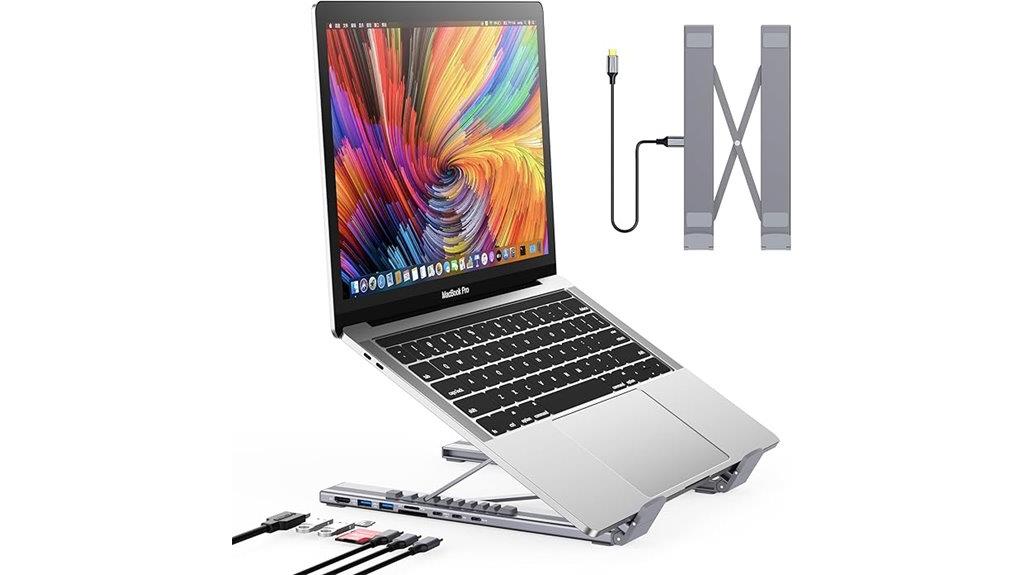
If you need a versatile solution that combines a sturdy laptop stand with a powerful USB C hub, this 8-in-1 USB C Laptop Docking Station Stand is an excellent choice. It supports laptops from 10 to 17 inches, including MacBook, Dell, HP, Surface, and Lenovo. With ports for 4K HDMI, USB 3.0, USB-C PD 3.0, SD, and TF cards, it covers all your connectivity needs. The stand offers adjustable height, stability, and ventilation, ensuring comfort and cooling during long work sessions. Its lightweight, foldable design makes it perfect for travel, and the premium aluminum build guarantees durability.
Best For: professionals and students who need a portable, versatile docking solution that combines multiple connectivity options with ergonomic support for laptops 10-17 inches.
Pros:
- Supports a wide range of laptops including MacBook, Dell, HP, Surface, and Lenovo, ensuring universal compatibility.
- Features 8 ports including 4K HDMI, USB 3.0, USB-C PD 3.0, SD, and TF cards, covering diverse connectivity needs.
- Lightweight, foldable design with adjustable height and stability, ideal for travel and ergonomic workspace setup.
Cons:
- Requires the computer’s Type-C port to support “video output” or “DisplayPort Alt Mode” for the HDMI port to function properly.
- Can only support 4K resolution at 30Hz, which may not be ideal for high-refresh-rate display needs.
- Limited to laptops up to 17 inches; might not accommodate larger devices or desktops.
13-in-1 USB C Docking Station with Dual Monitor and Multiple Ports
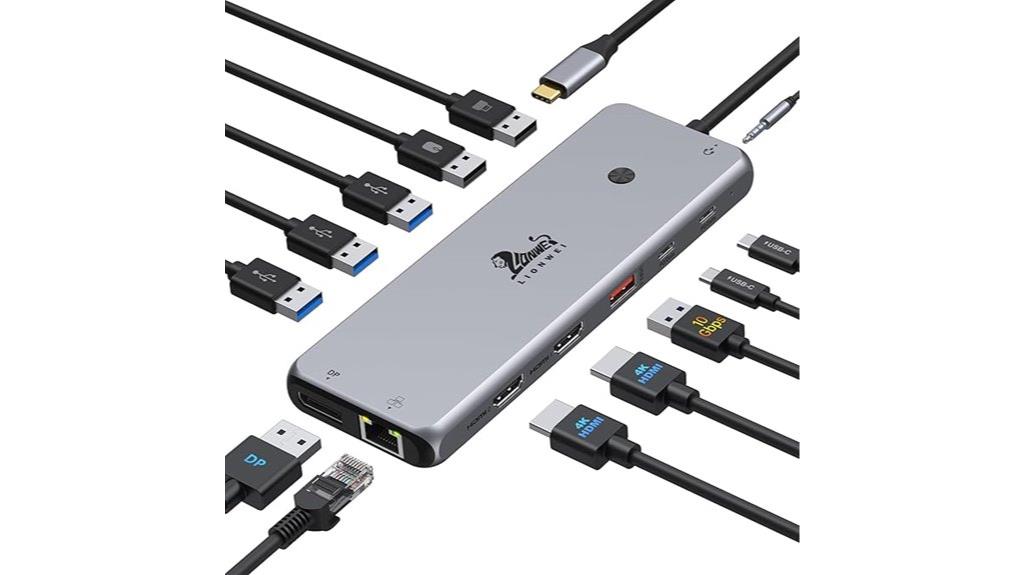
The 13-in-1 USB C Docking Station with dual monitors and multiple ports is an excellent choice for professionals who need seamless, versatile connectivity to boost productivity. It supports dual 4K HDMI and DisplayPort, enabling triple display setups on Windows, with mirror or extend modes. The dock offers a Gigabit Ethernet port, audio jack, and numerous USB ports, including USB-C with 100W Power Delivery and fast data transfer at 10Gbps. Its plug-and-play design works with MacBook, Dell, HP, and others, simplifying setup. With an 18-month warranty and reliable customer support, this dock guarantees efficient, all-in-one connectivity for demanding work environments.
Best For: professionals and power users who require versatile, multi-monitor connectivity and high-speed data transfer for demanding work environments.
Pros:
- Supports triple display setup with dual 4K HDMI and DisplayPort for enhanced productivity
- Includes multiple USB ports, Ethernet, and audio jack for comprehensive connectivity
- Supports 100W Power Delivery to charge laptops efficiently while connected
Cons:
- MacOS users are limited to extending only one monitor at 4K@60Hz
- Dock consumes 13W, leaving 87W for laptop charging, which may be insufficient for high-power devices
- Requires compatible USB-C port with Thunderbolt or DP Alt Mode for optimal performance
Anker 14-in-1 USB C Laptop Docking Station
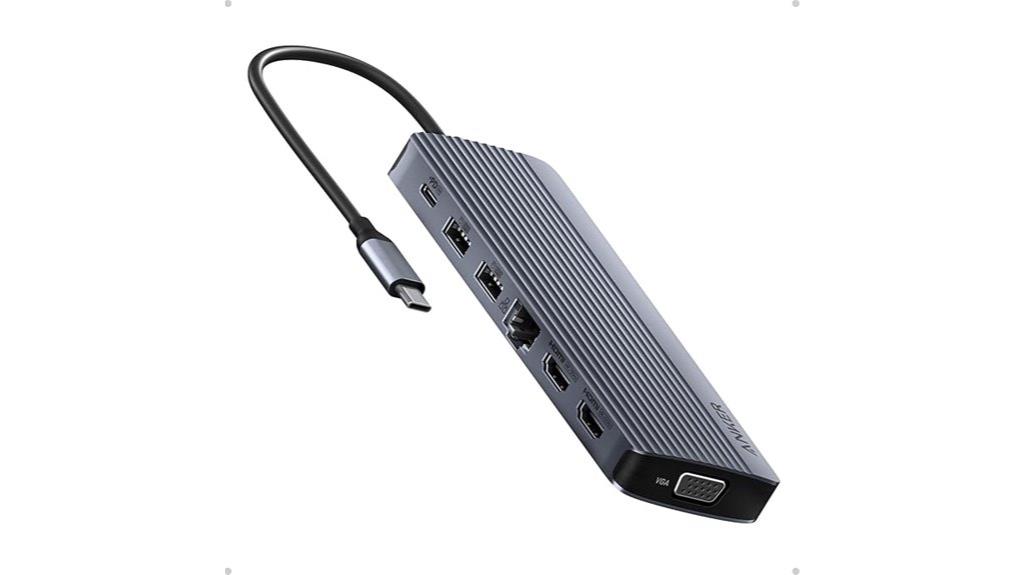
Designed for those who need to connect multiple peripherals and extend their display workspace, the Anker 14-in-1 USB C Laptop Docking Station offers an all-in-one solution with 14 versatile ports. It includes two 4K HDMI ports, a VGA port, five USB-A ports, a USB-C port, Ethernet, SD/micro SD card slots, and an AUX port, covering all your connectivity needs. It supports triple display setups, enabling multitasking across three monitors at once. With 80W pass-through charging and compatibility with MacBook, Windows, and ChromeOS devices, it’s a powerful, flexible hub. Whether for work or entertainment, it simplifies your setup and boosts productivity.
Best For: professionals and multitaskers who need to connect multiple peripherals and run multiple displays simultaneously for work or entertainment.
Pros:
- Offers a comprehensive 14-in-1 port selection including dual 4K HDMI, VGA, Ethernet, SD/micro SD, and multiple USB-A ports.
- Supports triple display setup with high-resolution 4K output via HDMI, enhancing multitasking capabilities.
- Provides 80W pass-through charging to keep devices powered during use, compatible with various laptops and operating systems.
Cons:
- May be bulky or heavy for portable use due to its extensive port layout.
- Not compatible with Linux systems, limiting flexibility for some users.
- The charger is not included, requiring an additional purchase for power delivery.
Selore USB C Docking Station with Dual Monitors and Multiple Ports
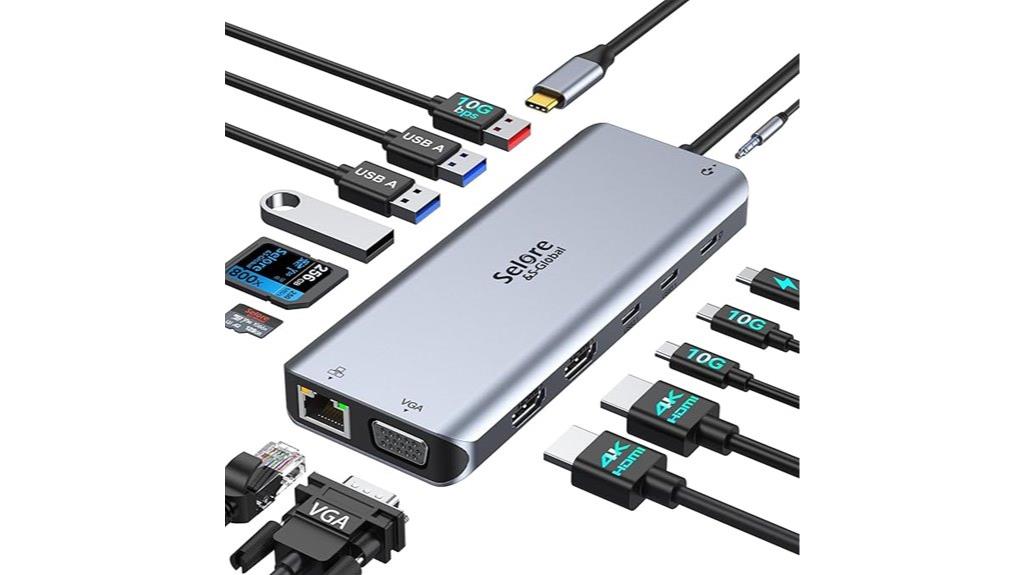
For professionals who need to expand their laptop’s connectivity, the Selore USB C Docking Station offers a thorough solution with dual monitor support and multiple ports. It supports three displays—two HDMI and one VGA—ideal for extended or mirrored screens, especially on Windows devices with Thunderbolt 3 or DisplayPort Alt Mode. It also features 14-in-1 connectivity, including USB-C/USB-A ports, SD card readers, and a gigabit Ethernet port. The dock delivers 100W power delivery, supporting fast charging for compatible laptops, and offers plug-and-play convenience. Its versatile design simplifies workspace setup, making it perfect for multitasking and enhanced productivity.
Best For: professionals and power users seeking to expand their laptop’s connectivity with dual monitors, fast data transfer, and comprehensive port options in a compact, plug-and-play device.
Pros:
- Supports triple display setups with dual HDMI and VGA outputs, ideal for multitasking and extended workspaces
- Provides 100W Power Delivery for rapid charging of compatible laptops and tablets
- Offers versatile connectivity with multiple USB ports, SD card readers, and a gigabit Ethernet port
Cons:
- Requires a Thunderbolt 3 or USB-C port supporting DisplayPort Alt Mode for full display functionality
- Power output limited to 87W for safety, which may be insufficient for some high-demand laptops
- All modes and configurations depend on compatible hardware, so some setups may have limitations or require specific specifications
Lemorele USB C Docking Station with Dual Monitors and Multiple Ports
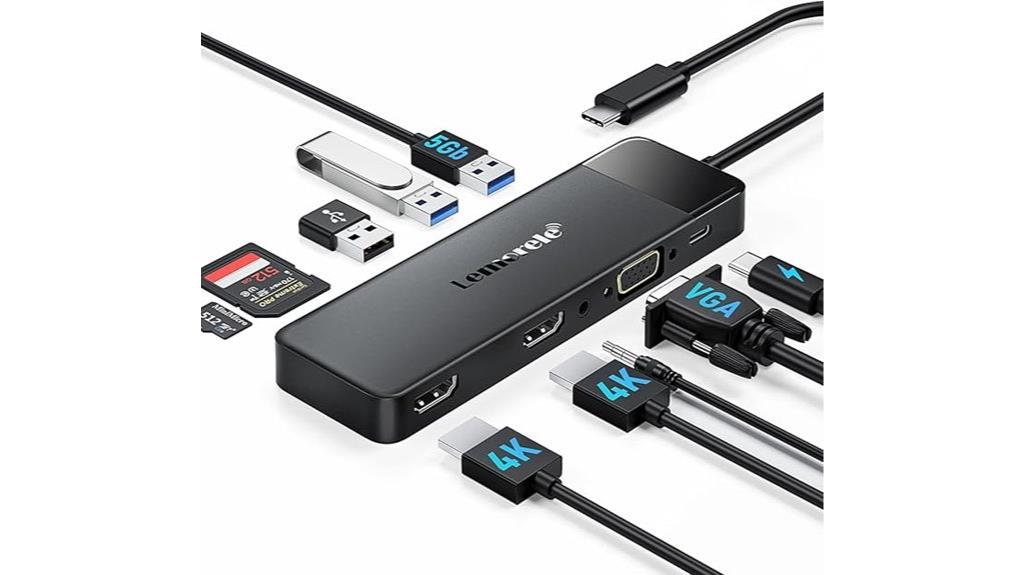
If you need to expand your laptop’s connectivity and support dual external monitors, the Lemorele USB C Docking Station is an excellent choice. It’s a 10-in-1 device compatible with MacBook Pro, MacBook Air, Dell XPS, Lenovo Yoga, Surface, and other Thunderbolt 3 laptops, as long as your USB-C port supports DisplayPort Alt Mode. It offers dual monitor support with two HDMI ports and one VGA, delivering up to 4K resolution on Mac OS and 1080p on Windows. With multiple USB ports, SD/TF card readers, and audio jacks, it handles peripherals easily. Plus, it supports 100W Power Delivery, ensuring your laptop stays charged during use.
Best For: professionals and students seeking a versatile docking station to expand connectivity and support dual external monitors on Thunderbolt 3 or USB-C laptops.
Pros:
- Supports dual monitor extension with high resolutions up to 4K on Mac OS and 1080p on Windows.
- Multiple ports including HDMI, VGA, USB 3.0, USB 2.0, SD/TF card readers, and audio/mic jacks for comprehensive device compatibility.
- Supports 100W Power Delivery, ensuring fast charging and power supply for high-performance laptops.
Cons:
- Requires USB-C port to support DisplayPort Alt Mode; incompatible laptops cannot utilize HDMI/VGA ports.
- No included power adapter; users need to purchase a compatible 65W or higher charger separately.
- Maximum resolution on dual HDMI outputs is limited to 4K@30Hz, which may be insufficient for some professional uses.
USB C Hub Docking Station with Dual 4K HDMI, 100W Power Delivery, 3 USB-A, and USBC

A USB-C docking station with dual 4K HDMI, 100W Power Delivery, and multiple USB ports is ideal for professionals who need to maximize productivity and multitasking. It supports dual 4K@60Hz displays, perfect for extending or mirroring screens across Windows and Mac devices. With 100W PD, it charges your laptop while you work, ensuring uninterrupted sessions. The three USB-A ports provide quick access for peripherals and external drives, while USB-C data transfer speeds up file sharing. Compatible with a wide range of USB-C laptops, this docking station combines high performance, versatile connectivity, and portability, making it a reliable hub for demanding work or creative projects.
Best For: professionals, creatives, and gamers who require dual 4K display support, fast data transfer, and high-power charging for their USB-C laptops.
Pros:
- Supports dual 4K@60Hz HDMI output for extended or mirrored displays
- Provides up to 100W Power Delivery for simultaneous charging and device use
- Compact and plug-and-play design for easy portability and setup
Cons:
- Charger not included, requiring an external power adapter
- Limited to USB-C laptops with DisplayPort Alt Mode compatibility
- Only three USB-A ports may be insufficient for users with multiple peripherals
Factors to Consider When Choosing a Usb C Docking Station for Laptop
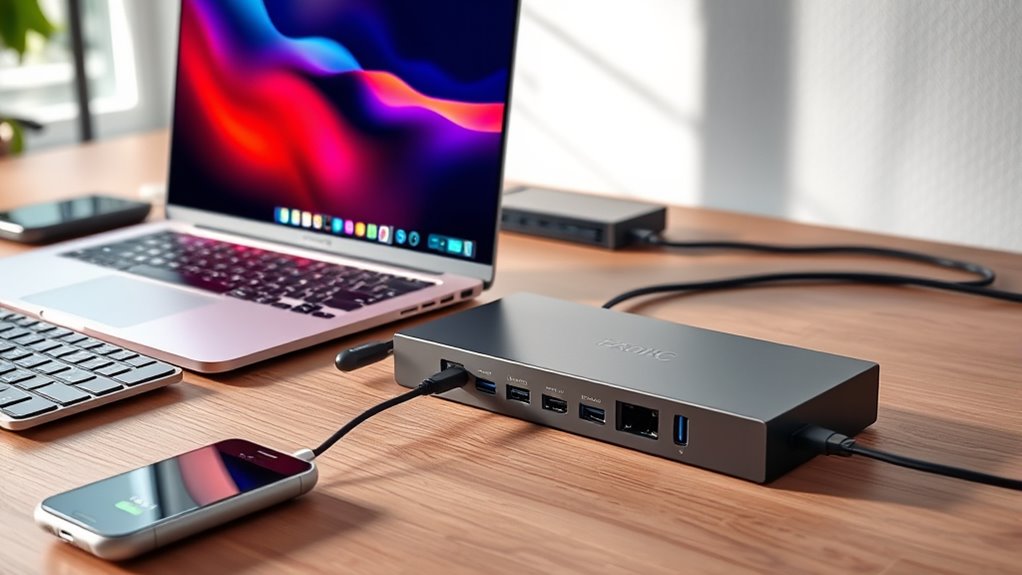
When choosing a USB-C docking station, I consider compatibility with my devices to guarantee everything connects seamlessly. I also look at the number of ports and display support to match my specific needs, along with power delivery capacity to keep my laptop charged. Finally, size and portability matter, especially if I need a setup that’s easy to carry around.
Compatibility With Devices
Choosing a compatible USB-C docking station requires careful attention to your device’s specifications and supported features. First, make sure it supports your laptop’s operating system, whether Windows, macOS, or ChromeOS, for smooth functionality. Check if your USB-C port supports DisplayPort Alt Mode for video output and Power Delivery to ensure it can charge your laptop while connected. It’s also important to confirm that the docking station matches your device’s USB-C version, like USB 3.1, USB4, or Thunderbolt 3/4, for peak performance. Additionally, verify that the power requirements align with your laptop’s charging specs to prevent issues. Finally, review manufacturer compatibility lists or specifications to ensure the dock supports your specific model and hardware configuration.
Number of Ports Needed
To select the right USB-C docking station, you need to assess how many devices you’ll connect and what types of ports they require. Think about monitors, external drives, and peripherals—how many of each do you need? If you’re running multiple monitors, guarantee the dock offers enough HDMI or DisplayPort outputs for dual or triple setups. Consider whether you need extra USB-A or USB-C ports for data transfer or charging, and check for additional features like Ethernet, SD card slots, or audio jacks if they’re relevant to your workflow. Balancing port quantity with size and portability is vital; a dock packed with ports may be less portable or clutter your workspace. Focus on your specific device and accessory needs to choose a dock that’s both functional and convenient.
Display Support Capabilities
Evaluating a docking station’s display support capabilities is vital to ensuring your setup works smoothly. First, consider how many external displays you need—some docks support dual or even triple monitor setups, which is essential for multitasking. Next, check if the dock offers high-resolution output, like 4K at 60Hz, to match your display quality needs. Compatibility with DisplayPort Alt Mode or HDMI 2.0/2.1 is essential for supporting your monitors’ resolution and refresh rate. Also, review the maximum resolution and refresh rate supported per port to avoid bottlenecks during video editing or streaming. Keep in mind OS limitations, as some docks may only support certain configurations or resolutions on Windows versus macOS. Ensuring these capabilities align with your workflow guarantees a smooth, high-quality visual experience.
Power Delivery Capacity
Have you ever wondered if your docking station can keep up with your laptop’s power needs? It’s vital to guarantee it supports at least 85W or more for ideal charging. Check if the Power Delivery (PD) port matches your charger’s wattage and can deliver enough power without overloading. Supporting fast charging standards like USB PD 3.0 or higher ensures rapid, efficient recharging. Be aware that some docks have multiple PD ports; confirm which port is designated for your laptop to avoid performance issues. Additionally, consider the overall power output capacity of the dock—whether it’s 85W, 100W, or even 160W—to make sure it can power your laptop and peripherals simultaneously. A well-matched PD capacity keeps your workflow seamless and your device charged.
Size and Portability
Choosing the right USB-C docking station involves considering its size and portability, especially if you frequently move between workspaces or travel. I look for a compact, lightweight design that fits easily into my bag without adding bulk. The dimensions should suit my usage—slim profiles work best for travel, while larger setups may be better for desktop use. Foldable or detachable components are a big plus, making transport more convenient. I also check the build quality to guarantee durability and stability during frequent movement. A sturdy yet portable dock helps me stay connected without fuss, whether I’m commuting or working remotely. Balancing size, weight, and functionality ensures I don’t sacrifice performance for portability, making my setup versatile and travel-friendly.
Data Transfer Speeds
When selecting a USB-C docking station, it’s vital to pay attention to data transfer speeds to guarantee your devices communicate efficiently. Look for docks supporting USB 3.0 or higher, offering at least 5 Gbps speeds, which is adequate for most tasks. For faster transfers, ports with Thunderbolt 3 or 4 support up to 40 Gbps, ideal for large files and high-resolution workflows. Don’t forget to check the SD and microSD card readers—they should support transfer rates of 200 Mbps or more for quick access to media. Be mindful that some docks limit bandwidth when charging via USB Power Delivery, so make sure your setup balances power and data needs. Also, consider the overall bandwidth capacity if connecting multiple high-speed devices simultaneously to avoid bottlenecks.
Build Quality and Durability
The build quality of a USB-C docking station directly impacts its reliability and lifespan. I look for stations made from sturdy materials like aluminum alloy or reinforced plastic, which can withstand daily wear and tear. Well-constructed ports with secure connections prevent loose contacts and reduce wear over time, ensuring consistent performance. A robust build design also minimizes wobbling, providing stable connections during use. Durable internal components contribute to the station’s longevity and lower the risk of failure or malfunction. Additionally, features like vents or heat sinks are essential for proper heat dissipation, helping maintain device integrity during extended use. Overall, investing in a well-built docking station means better durability, fewer issues, and greater peace of mind over time.
Price and Warranty
Are you aware that price and warranty are key factors when selecting a USB-C docking station for your laptop? A longer warranty, typically between 12 and 24 months, ensures support for potential defects or issues. Check if it covers both hardware problems and technical support to get thorough protection. Usually, more expensive models offer better warranty coverage, sometimes including accidental damage or priority customer service. Carefully review the warranty’s terms, such as the claim process and whether registration or proof of purchase is needed. Balancing cost with warranty benefits helps avoid unexpected expenses later. A higher upfront price might mean better peace of mind, so consider both factors to choose a docking station that offers reliable support and value over time.
Frequently Asked Questions
How Do I Ensure Compatibility Between My Laptop and the Docking Station?
To make certain of compatibility between your laptop and a docking station, I recommend checking your laptop’s USB-C port specifications first. Look for Thunderbolt 3 or 4 support if needed, and verify the docking station’s compatibility list. I also read reviews and manufacturer details to confirm it works seamlessly with my laptop model. This way, I avoid connection issues and get the most out of my setup.
What Is the Maximum Power Output My Laptop Needs From a Dock?
The maximum power output your laptop needs from a dock depends on its specifications, but most modern laptops require around 60 to 100W for ideal performance. I recommend checking your laptop’s power adapter or manual to find the exact wattage. Ensuring the dock can deliver at least that amount guarantees your laptop charges efficiently and runs smoothly while connected. Always opt for a dock that meets or exceeds your laptop’s power requirements.
Can I Connect Multiple External Displays With a Single Dock?
Imagine you’re in a sci-fi movie, and yes, you can connect multiple external displays with a single dock. I’ve done it myself, and many modern docks support dual or even triple monitor setups. Just make sure your dock has the right ports—like HDMI or DisplayPort—and your laptop’s graphics can handle the extra screens. Check compatibility beforehand to guarantee smooth, seamless multi-display connectivity without any hiccups.
Are There Security Features Included in High-End Docking Stations?
Yes, high-end docking stations often include security features like hardware encryption, secure firmware, and sometimes physical security options like Kensington locks. I find these features reassuring because they help protect sensitive data and prevent unauthorized access. When choosing a premium dock, I always check for these security options to guarantee my laptop and data stay safe, especially in shared or corporate environments.
How Do I Troubleshoot Connectivity Issues With My Docking Station?
When facing connectivity issues with my docking station, I start by unplugging all cables, then reconnecting them one by one. I make sure my laptop’s drivers are up-to-date, especially for USB-C and display adapters. Sometimes, restarting my laptop helps reset the connection. If problems persist, I test the dock with another device to identify if the issue is with the dock or the laptop itself.
Conclusion
Choosing the right USB-C docking station feels a bit like finding a lost sock—unexpectedly perfect when you least expect it. After exploring these options, I realize that the best fit depends on your needs, whether it’s dual monitors, power delivery, or multiple ports. Sometimes, the simplest choice surprises you, just like that missing sock turning out to be exactly what you needed all along. Happy docking, and may your setup be seamless and hassle-free!