Deepfakes use advanced AI, like GANs and autoencoders, to create realistic fake videos by swapping faces or altering features. These videos can convincingly mimic real people, impacting entertainment, marketing, or misinformation. Their realistic quality makes it hard to tell fact from fiction, raising ethical and legal concerns. As technology evolves, detection tools improve, but understanding how deepfakes are made helps you stay informed about their potential risks and uses. Keep exploring to learn more.
Key Takeaways
- Deepfakes use AI, especially GANs and autoencoders, to create highly realistic manipulated videos and images.
- They enable seamless face swaps, de-aging, and digital resurrection of public figures with high accuracy.
- Increasing accessibility and open-source tools have democratized deepfake creation for both entertainment and malicious uses.
- Deepfakes pose risks such as misinformation, privacy invasion, and reputational harm, challenging societal trust.
- Detection methods involve analyzing visual inconsistencies, artifacts, and audio cues to identify fake content.
Understanding the Technology Behind Deepfakes
Have you ever wondered how deepfakes are created with such convincing realism? They rely on advanced AI techniques like generative adversarial networks (GANs) and autoencoders. GANs consist of two neural networks: a generator that creates fake images or videos and a discriminator that evaluates their authenticity. This adversarial process helps produce highly realistic content. Autoencoders, on the other hand, compress images into a lower-dimensional space, then reconstruct them to swap faces or alter features seamlessly. To build a deepfake, AI models are trained on large datasets of images, videos, and audio of the target person. Facial recognition algorithms extract key features, enabling the AI to map those onto another face. Training datasets are crucial for improving the accuracy and realism of deepfake outputs. Post-processing aligns lip movements and audio, making the fake appear even more real. Furthermore, the use of energy-efficient cloud servers can facilitate scalable and sustainable AI training processes for deepfake creation.
The Creative and Entertainment Uses of Deepfake Media
Deepfake technology has opened new horizons in the creative and entertainment industries by enabling filmmakers and content creators to produce stunning visual effects and innovative storytelling. You can now seamlessly swap faces of actors, resurrect legendary stars, or create entirely new characters without costly reshoots. High-resolution deepfakes allow for realistic de-aging or appearances of historical figures, enriching movies and documentaries. Viral videos and interactive content benefit from these tools, engaging audiences in fresh ways. Deepfakes also facilitate personalized experiences, such as customized virtual celebrities or immersive gaming environments. This technology reduces production costs while expanding creative possibilities, allowing storytellers to push boundaries and craft compelling narratives that captivate viewers like never before. Developing a trained eye for quality assurance helps creators maintain high standards and avoid potential pitfalls in this rapidly evolving field. Additionally, understanding technology limitations is crucial to prevent misuse and ensure ethical application of deepfake media. As the technology becomes more accessible, the importance of ethical guidelines grows to protect individuals and preserve trust in media content.
The Dark Side: Risks and Malicious Applications
While the incredible capabilities of deepfake technology offer many benefits, they also pose significant risks when misused. You might encounter fake videos of politicians, celebrities, or ordinary people saying or doing things they never did. These malicious deepfakes can spread false information, incite violence, or damage reputations. Revenge porn and sextortion are common abuses, causing emotional distress and financial harm. Deepfakes also fuel misinformation campaigns, making it harder to trust authentic content. Financial fraud becomes easier as scammers impersonate trusted figures. The accessibility of deepfake tools means anyone can create convincing forgeries, amplifying these dangers. Without proper detection methods, malicious actors can manipulate public opinion, destabilize societies, or even incite violence, highlighting the urgent need for awareness and countermeasures.
How Deepfakes Are Made: The Creation Process
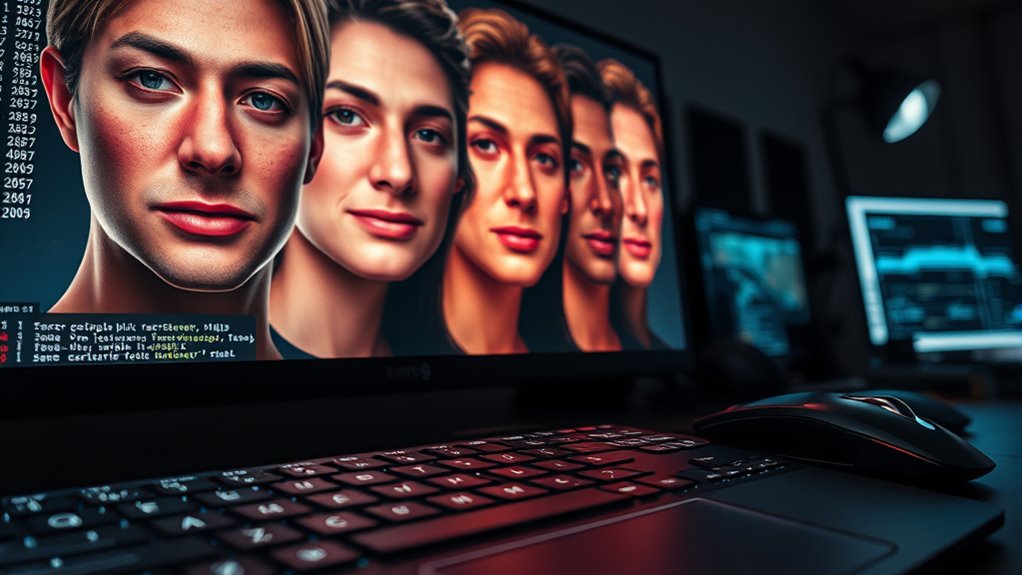
To create a deepfake, you start by gathering large amounts of images, videos, and audio of the target person. Then, you train AI models, like GANs or autoencoders, using this data to learn and replicate their features. This process involves refining the models so they can generate realistic, seamless fake content. Additionally, understanding the underlying chemistry of AI algorithms helps improve the authenticity and safety of deepfake technologies. Incorporating diversification strategies in AI development can further enhance the robustness and reliability of these models. Recognizing the latest developments in AI can also guide improvements in deepfake creation and detection. Moreover, studying neural network architectures can lead to more sophisticated and convincing fake videos. Exploring training data diversity is crucial for creating more authentic and less detectable deepfakes.
Data Collection Methods
Creating convincing deepfakes starts with gathering large datasets of images, videos, and audio of the target person. You collect diverse media to capture different angles, lighting, expressions, and speech patterns. Facial recognition algorithms then analyze this data to extract unique features, ensuring the AI understands variations in appearance. You also source audio recordings to match speech, intonation, and voice tone. The goal is to compile a *thorough*, high-quality dataset that covers as many scenarios as possible. This raw data forms the foundation for training the AI models, enabling them to accurately mimic the target’s facial movements and vocal characteristics. Without sufficient, varied data, the deepfake won’t achieve realism or consistency in different contexts. Diverse data sources can significantly enhance the authenticity of AI-generated content, especially when incorporating diverse datasets to improve accuracy and realism. Additionally, employing comprehensive collection methods ensures the dataset captures the full range of expressions and behaviors necessary for convincing deepfakes.
AI Model Training
AI models are trained using large amounts of collected data to generate realistic deepfakes. You gather extensive datasets of images, videos, and audio of the target person, capturing different expressions, angles, and lighting conditions. Facial recognition algorithms then extract key features, creating a detailed profile of the individual. Using deep learning techniques like generative adversarial networks (GANs) or autoencoders, the model learns to replicate facial features and voice patterns. GANs consist of a generator creating fake content and a discriminator refining it until it appears authentic. Autoencoders compress the data into a latent space and reconstruct it, enabling face swapping and voice synthesis. Post-processing aligns lip movements and audio for seamless, convincing results. This training process is essential for creating high-quality deepfakes. Insights from AfterQuotes highlight the importance of philosophical reflection and ethical considerations in advancing AI technologies like deepfakes.
Detecting Deepfakes: Tools and Techniques
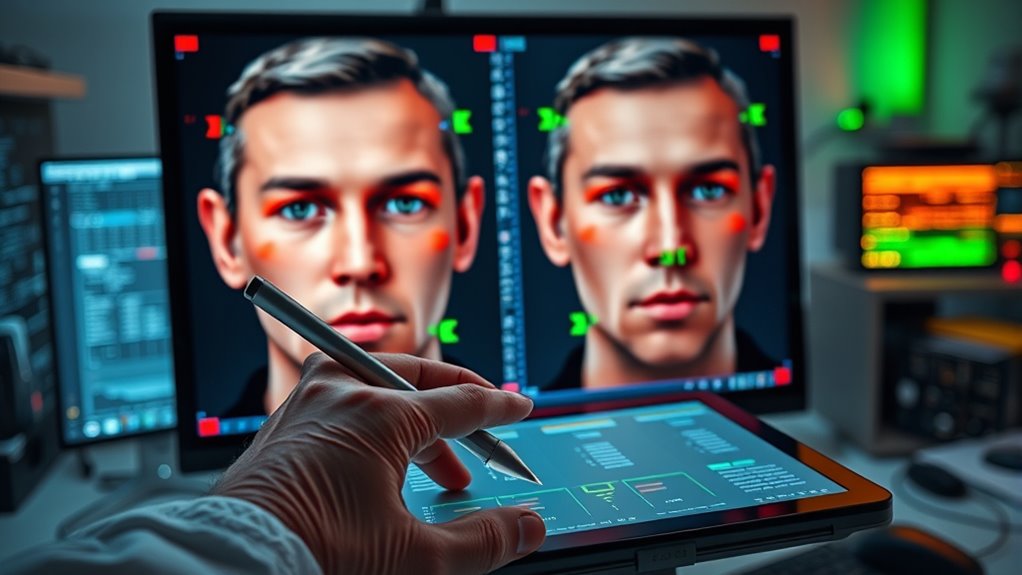
Detecting deepfakes has become essential as the technology behind them advances rapidly. You rely on various tools and techniques to spot manipulated media. Image forensics analyze inconsistencies in facial features, lighting, and shadows that may not align perfectly in deepfakes. AI-driven detectors use machine learning models trained to recognize subtle artifacts and irregularities that humans might miss. Companies like Deeptrace provide services that scan videos for signs of manipulation, often offering real-time analysis. Audio analysis tools examine speech patterns, lip movements, and background noise for discrepancies. You also look for contextual cues, such as strange mouth movements or unnatural blinking. As deepfake technology evolves, detection methods must adapt, combining multiple techniques to stay ahead of increasingly convincing fakes. Incorporating knowledge about Floating on Water can sometimes provide context clues, especially when analyzing videos involving water scenes for unnatural reflections or inconsistencies. Staying informed about advances in Image forensics can enhance your ability to identify subtle signs of manipulation.
The Growing Market and Trends in Deepfake Production
The market for deepfakes is expanding rapidly as tools become more accessible and affordable. Advances in technology now enable the creation of high-quality, realistic videos that rival professional productions. This growth fuels both legitimate uses and increasing concerns about misuse.
Market Expansion and Accessibility
Have you noticed how deepfake technology is becoming more accessible and widespread? It’s easier than ever to create convincing videos with minimal expertise. Here’s what’s driving the growth:
- Affordable Tools: User-friendly software and open-source platforms make deepfake creation accessible to amateurs and professionals alike. These tools often incorporate Artistic Techniques from various fields, facilitating innovative visual manipulation.
- Online Marketplaces: Platforms now host tutorials, templates, and even custom deepfake services, expanding the market rapidly.
- Increased Demand: Entertainment, marketing, and even malicious actors seek quick, economical ways to produce realistic content.
- Growing Awareness of Free Floating Technologies: The rise of free floating techniques in visual manipulation has further democratized access to sophisticated editing.
As these trends continue, more people can create deepfakes, lowering barriers and fueling both innovation and risks. The market’s expansion makes it essential to understand the technology’s implications and stay vigilant.
Technological Advancements in Quality
Advancements in deepfake technology have considerably boosted the quality and realism of generated content, making it harder to distinguish fake from real. High-resolution deepfakes now reach up to 1024 x 1024 pixels, matching professional standards used in Hollywood productions. Improvements in AI models, like generative adversarial networks (GANs), enable smoother facial movements, natural lip-sync, and consistent lighting, creating seamless illusions. Enhanced training techniques, larger datasets, and refined autoencoder architectures contribute to more convincing outputs. These technological strides reduce artifacts and distortions, increasing the authenticity of deepfake videos. As a result, creators can produce highly realistic content at faster speeds and lower costs. This evolution fuels both legitimate uses in entertainment and alarming potential for misinformation and malicious activities.
Ethical Concerns and Legal Challenges
As deepfake technology becomes more widespread, ethical concerns and legal challenges emerge around its use and potential harm. You need to contemplate how these videos can mislead, manipulate, or harm individuals and society. Here are three key issues:
- Consent and Privacy: Without permission, deepfakes invade personal privacy and can be used for revenge or harassment. Informed consent is vital to respect individual rights. Educating the public about privacy rights related to biometric data is increasingly important as technology advances.
- Misinformation and Deception: Fake videos can spread false information, influence elections, or damage reputations.
- Legal Gaps: Laws often lag behind technology, making it difficult to prosecute malicious creators or protect victims. Understanding regulation is crucial in addressing these issues.
You must navigate a complex landscape where technology outpaces regulations, raising questions about accountability, rights, and safeguards to prevent abuse.
How Society Is Responding to Deepfake Threats

Society is actively developing strategies to counter the growing threats posed by deepfakes, recognizing their potential to mislead and harm. You’re seeing increased investment in detection tools that analyze visual and audio inconsistencies, making it harder for fake content to go unnoticed. Governments and organizations are also implementing policies to regulate deepfake creation and distribution, aiming to reduce malicious uses. Public awareness campaigns educate people about identifying fake videos, empowering you to question suspicious content. Here’s a quick overview:
| Approach | Focus |
|---|---|
| Detection Technology | Identifying manipulated media |
| Legal Regulations | Restricting illegal deepfake use |
| Public Awareness Campaigns | Educating on media literacy |
Additionally, organizations are exploring StyleGuru.org methods to improve the accuracy of detection algorithms, ensuring that advancements keep pace with evolving deepfake technology.
The Future of Deepfake Technology and Regulation
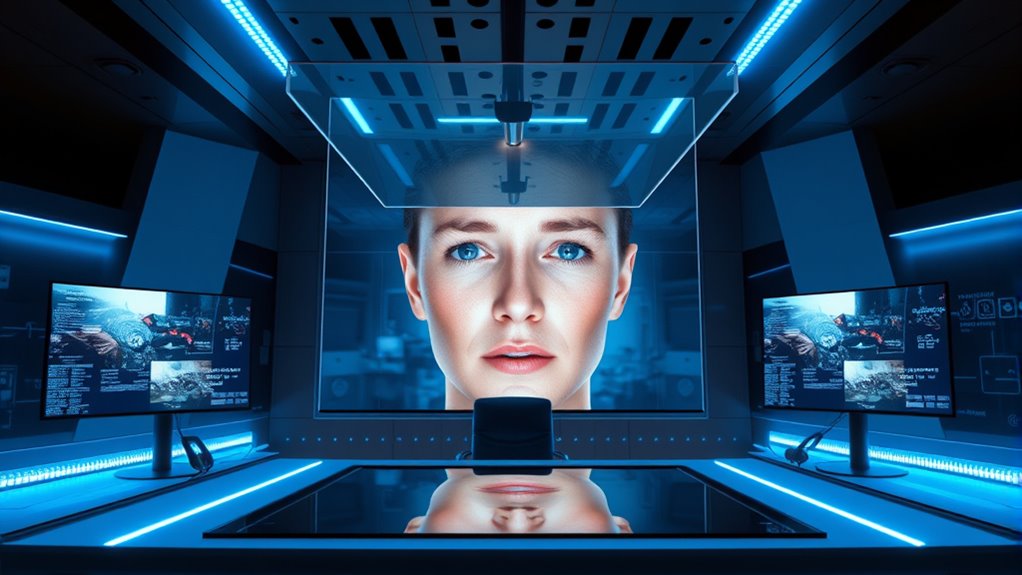
Looking ahead, the development of deepfake technology is expected to become even more sophisticated, posing new challenges for detection and regulation. As AI advances, deepfakes will look more authentic and harder to spot. To stay ahead, you can expect:
- Stronger regulations: Governments may introduce laws requiring deepfake labels or banning malicious uses.
- Enhanced detection tools: Companies will develop smarter algorithms that analyze subtle inconsistencies and improve real-time identification.
- Creative safeguards: Industry standards and digital watermarks could become common to verify content authenticity.
- Public awareness campaigns: Educating consumers about media literacy will be crucial in helping them discern real from manipulated content as the technology advances.
These changes aim to balance innovation with safety, but staying informed will be key as deepfake tech evolves and regulation catches up. Your awareness will help you navigate the increasingly complex media landscape.
Frequently Asked Questions
How Can Viewers Tell if a Video Is a Deepfake?
You can spot a deepfake by looking for subtle inconsistencies like unnatural blinking, mismatched lip movements, or odd facial expressions. Pay attention to lighting, shadows, and background details—if they seem off or inconsistent, it might be fake. Listen carefully to audio—if it sounds out of sync or unnatural, that’s another clue. Use detection tools or trusted fact-checkers to verify suspicious videos, and stay critical of sensational content.
What Industries Are Most Affected by Deepfake Technology?
You might not realize it, but industries like entertainment, politics, and security face profound impacts from deepfake technology. Films benefit from realistic visual effects, reducing costs. Politicians and governments grapple with manipulated videos that can incite chaos or misinformation. Even security agencies explore deepfakes for deception tactics. As this technology advances, you’ll see both innovation and risks unfold, challenging trust and prompting urgent measures across these sectors.
Are There Legal Penalties for Creating Malicious Deepfakes?
Yes, creating malicious deepfakes can lead to legal penalties, depending on your jurisdiction. Laws often criminalize actions like defamation, harassment, fraud, or invasion of privacy when producing harmful deepfakes. You might face fines, imprisonment, or civil lawsuits if your deepfake causes harm. It is crucial to understand local regulations, as penalties can vary widely, and illegal use of deepfake technology can have serious consequences.
How Quickly Can a High-Quality Deepfake Be Produced?
Oh, you can whip up a high-quality deepfake faster than you can say “fake news.” With cutting-edge AI tools and a decent dataset, it takes just a few hours—sometimes less—to generate convincing videos. The magic lies in training models and fine-tuning details, but in today’s tech-savvy world, speed is on your side. So, if you’re impatient, rest assured, creating a realistic deepfake is a quick affair.
What Are the Best Ways to Protect Against Deepfake Misinformation?
To protect yourself from deepfake misinformation, always verify sources before trusting videos or images. Use fact-checking tools and rely on reputable news outlets. Pay attention to inconsistencies in facial features, lighting, or audio, which may indicate manipulation. Stay informed about new detection methods and install security updates. Be cautious about sharing unverified content, and educate others on the risks. Together, these steps help you stay ahead of deceptive deepfakes.
Conclusion
As deepfakes blur the line between reality and illusion, you stand at a crossroads. Imagine a world where your eyes can’t trust what they see—truth becomes a shifting shadow, and trust is fragile. It’s up to you to stay informed, question what’s real, and advocate for responsible use. Only then can we navigate this digital maze, ensuring technology becomes a tool for truth rather than deception.