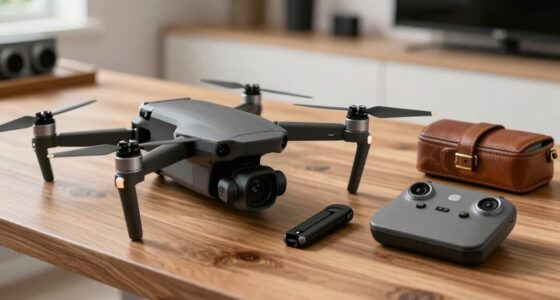
Obstacle avoidance has greatly boosted your confidence in flying drones by enabling real-time navigation and preventing collisions in challenging environments. With advanced sensors like LiDAR, cameras, and ultrasonic detectors, your drone can perceive obstacles clearly and react instantly. This technology reduces your worries about accidents in tight or unpredictable spaces, making your flights safer and more reliable. As you explore further, you’ll discover how these innovations continue to shape the future of autonomous drone capabilities.

Get the latest gadgets delivered free — and shop member deals
- Fast, free delivery on millions of items
- Access to Prime Big Deal Days deals on October 6–7
- Prime Video, Amazon Music and more included
Key Takeaways
- Obstacle avoidance enables drones to navigate complex environments safely, reducing reliance on manual control.
- Integration of multiple sensors improves environmental perception, increasing drone reliability and operator confidence.
- Advanced algorithms allow real-time decision-making, minimizing collision risks and enhancing trust in autonomous operation.
- Improved safety features expand drone use into challenging areas like indoors, forests, and urban spaces.
- Technological advancements in sensor fusion and autonomous systems continuously boost drone safety and operational confidence.

Obstacle avoidance is a crucial feature that enables drones to navigate safely in complex environments. It’s no longer just about flying straight or following a pre-programmed path; now, your drone can make real-time decisions, thanks to advancements in autonomous navigation and sensor integration. These technologies work together, allowing your drone to interpret its surroundings accurately and respond instantly to obstacles, whether they’re trees, power lines, or buildings. This integration of sensors—such as LiDAR, ultrasonic, infrared, and cameras—creates an all-encompassing understanding of the environment, giving you confidence that your drone can handle unpredictable scenarios.
With autonomous navigation at the core of obstacle avoidance, your drone doesn’t rely solely on manual control. Instead, it uses sophisticated algorithms to continuously analyze sensor data and chart a safe path forward. This means that even if you encounter sudden obstacles, your drone can detect and avoid them autonomously without your intervention. As a result, you can focus more on capturing images or completing tasks, trusting that the drone’s systems will keep it clear of hazards. This shift toward autonomous navigation has transformed how you approach drone flying, especially in tight or cluttered spaces.
Sensor integration is what makes this all possible. Rather than depending on a single sensor type, your drone combines data from multiple sources for a layered understanding of the environment. For example, LiDAR provides precise distance measurements, while cameras offer visual context. Ultrasonic sensors detect nearby objects at close range, and infrared sensors can help in low-light conditions. By integrating these sensors, your drone gains a more detailed and reliable perception of its surroundings. This all-encompassing data collection allows the onboard computer to make smarter decisions about obstacle avoidance, increasing safety and reducing the risk of collisions.
Because of these advancements, your confidence in flying drones has greatly increased. You no longer have to worry about sudden obstacles or complex environments because the drone’s autonomous navigation systems are designed to handle such challenges. You can venture into more demanding applications, like indoor inspections, dense forests, or urban settings, with reassurance. This technological progress not only enhances safety but also opens up new possibilities for drone use—whether for commercial surveys, search and rescue, or creative filmmaking. Ultimately, obstacle avoidance, driven by sensor integration and autonomous navigation, has made flying drones more reliable, safe, and accessible, instilling confidence in every flight. Additionally, sensor fusion plays a key role in improving the drone’s ability to interpret complex environments accurately. Advancements in sensor technology continue to push the boundaries of what autonomous drones can achieve.
drone obstacle avoidance sensors
As an affiliate, we earn on qualifying purchases.
As an affiliate, we earn on qualifying purchases.
Frequently Asked Questions
How Does Obstacle Avoidance Impact Drone Battery Life?
Obstacle avoidance can decrease your drone’s battery life because it increases power consumption. When the drone actively detects and navigates around obstacles, it uses additional sensors and processing power, which affects battery efficiency. However, this trade-off often results in safer, more reliable flights, preventing crashes that could drain or damage the battery. So, while it may slightly reduce flight time, obstacle avoidance ultimately helps you fly smarter and safer.
Can Obstacle Avoidance Systems Work in All Weather Conditions?
Obstacle avoidance systems don’t work perfectly in all weather conditions. Weather adaptability can be limited by sensor durability, especially in rain, snow, or fog. Moisture and debris can impair sensors, reducing their effectiveness. While advancements are ongoing, you should be cautious flying drones equipped with obstacle avoidance in harsh weather. Ensuring your drone’s sensors are weather-resistant helps, but don’t rely solely on obstacle avoidance during extreme conditions.
Are Obstacle Avoidance Sensors Safe for Wildlife and Humans?
Obstacle avoidance sensors are generally safe for wildlife and humans, as they’re designed to detect objects and prevent collisions. However, they can sometimes cause wildlife disruption if drones suddenly change direction or hover unexpectedly near animals. To guarantee human safety, use these sensors responsibly and follow guidelines. Being mindful of wildlife and maintaining safe distances helps minimize disruption and keeps both humans and animals safe during drone operations.
What Are the Limitations of Current Obstacle Avoidance Technology?
You might think obstacle avoidance tech is flawless, but it’s not. Current sensors often struggle with accuracy in complex environments, risking missed obstacles or false alarms. System integration can be tricky, causing delays or failures in real-time responses. Shadows, dust, or reflective surfaces can throw off sensor readings. So, while impressive, this tech still has limits—meaning your drone might not always navigate perfectly through the chaos.
How Does Obstacle Avoidance Influence Drone Training and Certification?
Obstacle avoidance greatly influences drone training and certification by emphasizing the importance of drone navigation and understanding sensor accuracy. As you train, you’ll focus on mastering how sensors detect obstacles, ensuring safe flight paths. Certification processes now test your ability to operate drones with reliable obstacle avoidance systems, making you more confident in complex environments. This technology pushes you to develop better skills, ultimately increasing safety and competence in drone operations.
LiDAR drone for obstacle detection
As an affiliate, we earn on qualifying purchases.
As an affiliate, we earn on qualifying purchases.
Conclusion
With flawless flight and fearless freedom, obstacle avoidance has truly transformed drone technology. You now confidently conquer complex conditions, trust in technology, and tackle tough terrains with tranquility. This breakthrough boosts your drone’s bravery, broadening boundaries and bringing boundless possibilities. As obstacles are outsmarted and outmaneuvered, your drone’s daring dives and daring discoveries become daily delights. Embrace this evolution, and let your drone’s dynamic development drive your adventurous ambitions forward!
As an affiliate, we earn on qualifying purchases.
autonomous drone navigation system
As an affiliate, we earn on qualifying purchases.
As an affiliate, we earn on qualifying purchases.
Fall Picks
fall essentials
As an affiliate, we earn on qualifying purchases.