
TL;DR

Get the latest gadgets delivered free with Prime
- Fast, free delivery on millions of items
- Prime Video, Amazon Music and more included
- Member-only deals all year
An open-source GitHub project uses the Gemtek W1700K Wi-Fi 7 router’s MediaTek MT7996 radio as a software-defined receiver, capturing 14-bit IQ data at up to 320 Msps and sending it to a Linux host over 10 GbE. The project says its custom firmware is receive-only and replaces the router’s stock operating system; it requires compatible hardware and a 10 GbE host connection.
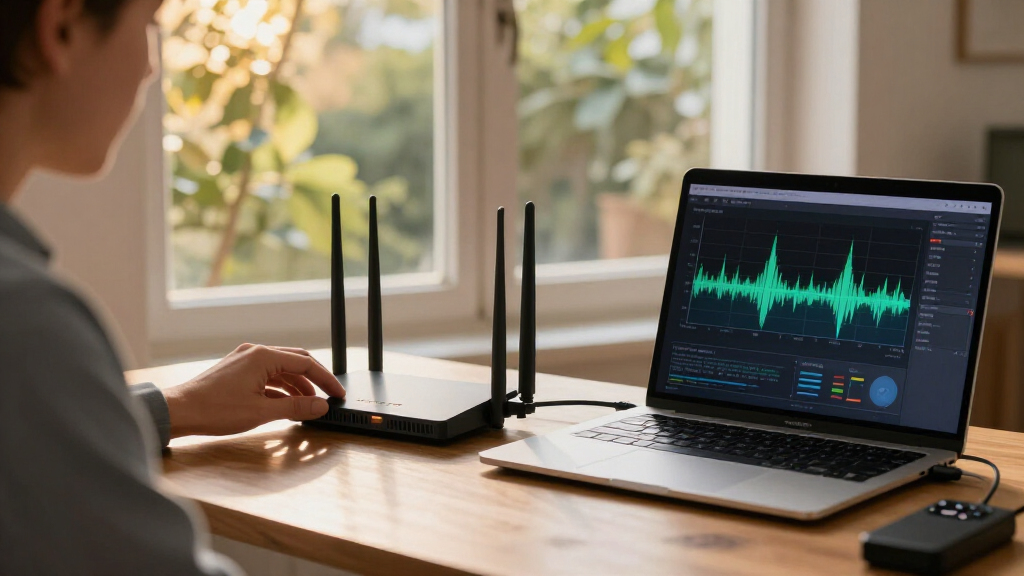
A project on GitHub describes software that turns compatible Gemtek W1700K Wi-Fi 7 routers into wideband, receive-only software-defined radio receivers, capturing 14-bit in-phase and quadrature (IQ) samples at up to 320 million samples per second. It sends the data over the router’s 10-gigabit Ethernet port to a Linux host, where project software can display a live spectrum and waterfall or record the stream.
The project identifies the router’s MediaTek MT7996 radio as the receiver and its Airoha AN7581 system-on-chip as the processor that moves captured data onto the network. The published software supports sample rates of 40, 80, 160 and 320 Msps across the listed 2.4 GHz, 5 GHz and 6 GHz bands. It also describes a 640 Msps mode on the 2.4 GHz band that uses every other sample; the project says that mode is flat to ±155 MHz but can fold signals farther away into the captured range.
According to the repository, radio data is placed in a 1 GiB ring buffer in the router’s memory and sent in 8 KiB UDP datagrams. At 320 Msps, half the slices are packed to fit the Ethernet link, which the maintainers describe as lossless. On the host, w1700k-stream makes the IQ stream available to other programs; a spectrum server can produce a 262,144-point FFT and a browser-based waterfall, while a separate tool records samples. The project says the spectrum software can generate 100 spectra per second, although the supplied recording runs at 50 frames per second.
The repository says the radio runs a custom firmware stack, including a ROM patch and radio-control components built from the project, rather than MediaTek firmware. The project describes its firmware as receive-only: it keeps the transmit path disabled and does not run MediaTek’s transmit calibrations. Its installation instructions warn that setup replaces the stock operating system and requires a serial adapter, an Ethernet connection for installation, and a host with a 10 GbE network interface for the IQ stream.
A Router Becomes a Wideband Receiver
The project could make wideband radio experimentation possible with hardware originally sold as a Wi-Fi router, rather than a purpose-built SDR. Its stated 320 Msps ceiling and access to multiple frequency bands offer a way to observe a broad slice of spectrum at once, while the browser display and shared host stream provide several ways to inspect or record the captured data.
That capability comes with demanding practical requirements. A 10 GbE connection is needed to carry the data, and installation requires replacing the router’s stock software with a custom system. This is therefore a specialized hardware and software project, not a plug-and-play router feature or a firmware update for ordinary users. The repository’s receive-only design is also relevant to radio safety, but users still need to follow its warning not to connect an antenna port directly to sensitive test equipment without suitable attenuation.
As an affiliate, we earn on qualifying purchases.
Custom Firmware and Hardware Support
The repository supports the W1700K hardware revision 1.x and W1700K2 revision 2.1, and says the same images run on both. Its software spans the router’s bootloader and Linux system, an MT7996 driver and custom radio firmware, and Linux-host programs for control, streaming, spectrum display and recording. The maintainers say the firmware brings the radio up from a cold start and that they reconstructed initialization and calibration behavior by decoding register activity against a trace of MediaTek firmware.
The project describes tuning as independent of Wi-Fi channels: the local oscillator can be set to frequencies the radio synthesizer supports, and retuning can happen during a stream. It also lists adjustable gain and analog filters from 20 to 320 MHz. Those are repository specifications, not independently verified performance findings in the supplied material. Installation instructions include backing up the router’s NAND and saving radio calibration data; they also flag an incompletely tested NAND variant on some W1700K2 units.
“Our firmware is receive-only.”
— The project’s GitHub repository
As an affiliate, we earn on qualifying purchases.
Independent Testing and Hardware Risks
The supplied material is the project’s own repository description and does not include independent validation of its sample rates, data integrity, tuning behavior or receive-only operation. The report also does not establish how the receiver performs in different operating conditions or how much processing capacity a host needs beyond the stated 10 GbE link and software dependencies.
Hardware caveats remain. The maintainers say a NAND chip found in some W1700K2 units is supported but has not been run on a unit, and installation stops on that variant unless the user passes a warning override. The project also says its installation replaces the stock operating system. The source does not provide details about warranty implications, long-term support or how often the firmware and installation process will be updated.
WiFi 7 router with high-speed Ethernet
As an affiliate, we earn on qualifying purchases.
As an affiliate, we earn on qualifying purchases.
Build, Install and Verify Locally
The repository directs users to build the software from public sources, run its test suite, install it on a supported router, and connect the device’s WAN port to a host’s 10 GbE NIC. Once the host streaming and spectrum services are running, users can open the browser interface and start the radio. The maintainers list architecture and roadmap documents alongside installation and recovery instructions.
For the project’s claims to be assessed beyond its own demonstrations, the next useful evidence would include independent measurements of bandwidth, sample integrity, receiver performance and transmit-path behavior, plus testing across the supported hardware revisions and NAND variants. The repository does not state when such tests, additional releases or broader hardware support will be available.
As an affiliate, we earn on qualifying purchases.
Key Questions
What does the project do?
It uses custom software and firmware to operate compatible Gemtek W1700K routers as wideband SDR receivers, sending captured IQ samples to a Linux host for display or recording.
What is the maximum sample rate?
The repository lists 320 Msps of 14-bit complex IQ data across its supported bands. It also describes a 640 Msps mode on the 2.4 GHz band that keeps every other sample and has stated limits on its flat frequency range.
What equipment is required?
The project lists a supported W1700K or W1700K2, a 3.3 V USB serial adapter, an Ethernet connection for installation, and a host with a 10 GbE NIC connected to the router’s WAN port for streaming.
Does the project transmit radio signals?
The maintainers say their firmware is receive-only and keeps the radio’s transmit path disabled. That is a claim in the repository; the supplied material does not include independent verification.
Will installation keep the router’s original software?
No. The project’s installation instructions say setup replaces the stock operating system. The repository describes backup and recovery steps, but prospective users should read those instructions and hardware warnings before proceeding.
Source: hn
Columbus Day / Indigenous Peoples' Day Picks
long weekend sales
As an affiliate, we earn on qualifying purchases.