
TL;DR
Mistral is betting on sovereignty, open weights, and control over data, targeting regulated European industries. This isn’t about beating giants like OpenAI on size but about serving a niche that values independence and flexibility.
What if the biggest AI race isn’t just about size? Mistral’s recent moves point to a different game: sovereignty, control, and open weights. This isn’t about building the world’s largest model but about serving customers who want to keep their data inside their own walls. At the recent AI Now Summit in Paris, Mistral made it clear: it’s not just a model company anymore. It’s a full-stack provider, emphasizing control and sovereignty as core strategies.
Why does this matter? Because in Europe, especially, the conversation is shifting. Governments and regulated industries are beginning to prefer models they can own and operate themselves. Mistral’s approach could redefine what winning in AI really looks like — not just scale, but sovereignty and control.
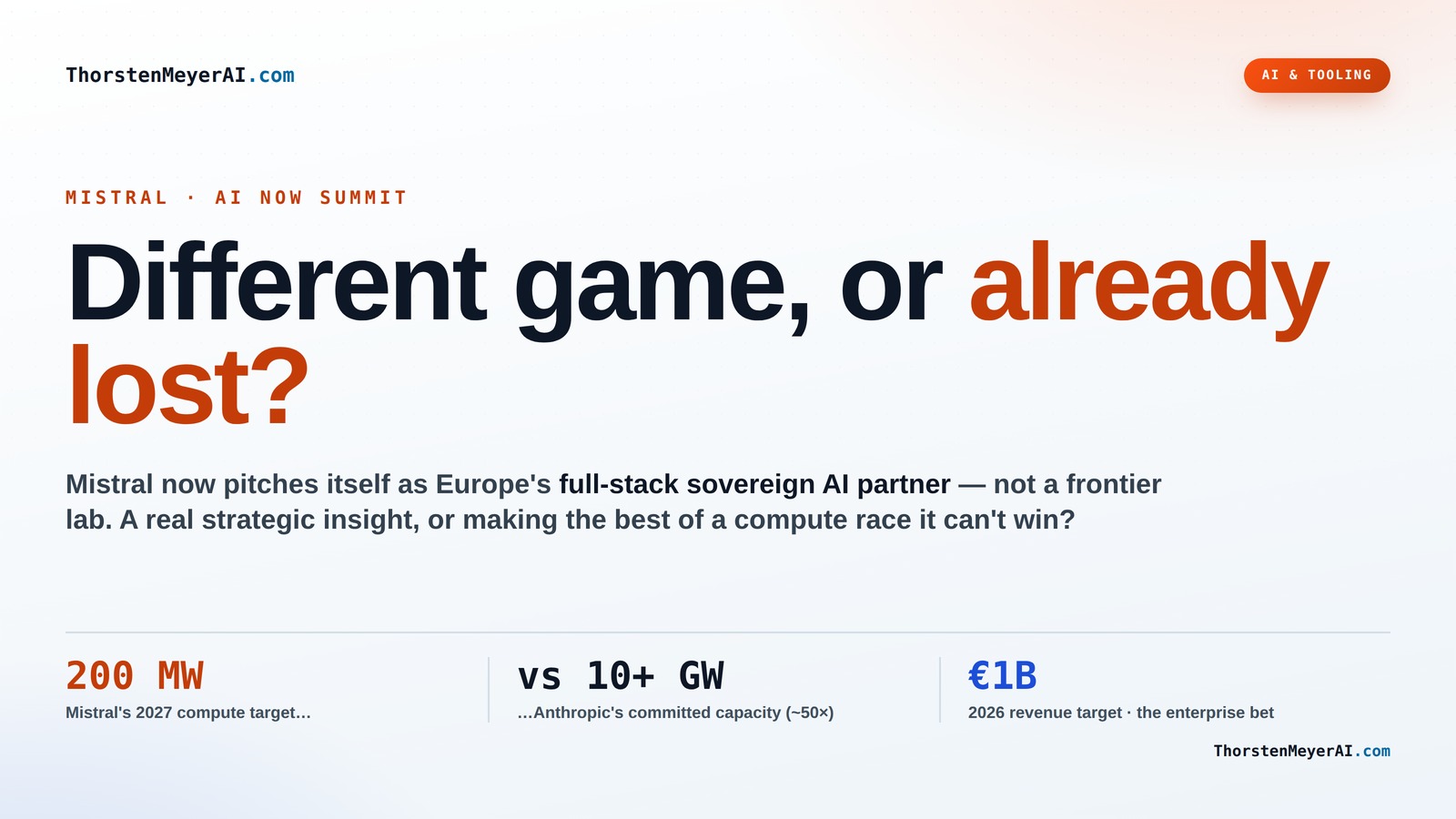
Different game, or already lost?
Mistral now pitches itself as Europe’s full-stack AI provider — compute, models, platform, consultancy — not a frontier-model lab. Is that a real strategic insight, or making the best of a race it can’t win? Both readings fit the same facts.
From model lab to full-stack provider
The clearest signal from the summit wasn’t a model — it was a posture. Heavy on enterprise logos and partnerships (ASML, BNP Paribas, Alexa+), light on new-model announcements. That absence is exactly what skeptics seized on.
Compute
40MW Paris DC + Sweden build · 200MW target by 2027
Models
Open & custom · efficient · you own and run them
Platform
Forge for custom models · Vibe for Work agent
Consultancy
Sales teams, integrators, EU provenance & support

Unified AI and Machine Learning with Microsoft Fabric: From Lakehouse to Model Deployment for Scalable Enterprise Systems
As an affiliate, we earn on qualifying purchases.
As an affiliate, we earn on qualifying purchases.
Small & focused, or large & general?
Mistral bets on specialized small models. The claim isn’t that they win a reasoning leaderboard — they don’t. It’s that on the metrics that matter in production agent systems, a purpose-built small model wins. Flip the metric to see the case reverse.
Small specialized vs large general — by what you measure
In token-heavy agentic apps making hundreds of calls, speed/energy/cost compound. Toggle the metric.
Self-Hosted AI Infrastructure: Deploy, Manage, and Scale LLMs on Proxmox, Docker, and NAS (Developer guides)
As an affiliate, we earn on qualifying purchases.
As an affiliate, we earn on qualifying purchases.
Narrow models doing real work
Each is one model doing one thing efficiently — the tangible version of the strategy. Strong on their own terms; the open question is whether the bundle beats a free Chinese open-weight download.
On-prem KYC compliance
Mistral models run inside the bank’s walls for know-your-customer checks. Sensitive financial data never leaves. (BNP was Mistral’s first customer, 2023.)
Voxtral multilingual voice
A focused voice model powering Alexa+ across Europe — speed and efficiency over raw size.
Robostral industrial robotics
Plus a “physics AI” push (via the Emmi acquisition) into aerospace, automotive & semiconductor design and simulation.
Document AI / OCR at scale
Large-scale text extraction — the unglamorous, high-volume enterprise work small models excel at.

The Challenges of Artificial Intelligence for Law in Europe (Data Science, Machine Intelligence, and Law, 6)
As an affiliate, we earn on qualifying purchases.
As an affiliate, we earn on qualifying purchases.
The strategy is downstream of the compute gap
Once you see the raw numbers, “why is Mistral behind?” answers itself — and the specialized-small-model strategy starts looking partly like a smart adaptation to a binding constraint, not a pure philosophical choice.
Compute & capital · Mistral vs a frontier leader, this same week
Not a knock — it’s the constraint that forces the efficiency-first, sovereignty-wedge strategy. Adapting intelligently to your position is what good strategy is.
Agentic AI Full-Stack Development: A Practical Guide to Building Autonomous AI Agents, LLM-Powered Applications, Tool-Using Systems, and End-to-End Intelligent Products Across the Modern Tech
As an affiliate, we earn on qualifying purchases.
As an affiliate, we earn on qualifying purchases.
“I want them to win, but I’m worried”
That ambivalence is the most accurate read of where Mistral sits. The enterprise pivot gets read two opposite ways — and both deserve airing.
On-prem, real sales teams, the Koyeb deployment acquisition, EU provenance — exactly what regulated enterprises want, and stickier than consumer mindshare. Targeting €1B revenue in 2026 with 1,000 staff, up from 15 people and one customer in 2023. US closed-API labs structurally can’t match the sovereignty axis.
“Software consultancy with a data center,” not a foundation-model moat. Enterprise B2B is where European startups go when they can’t win consumer or world-scale SaaS. Why pay Mistral on-prem when you could run Qwen free? One paying Le Chat Pro user said the quality gap with frontier labs is now hard to ignore.
Key Takeaways
- Mistral is pioneering a sovereignty-focused AI approach, emphasizing control and open weights for regulated industries.
- European regulation and data residency concerns are driving demand for on-prem, self-hosted models, giving Mistral a strategic edge.
- Playing a different game than giants like OpenAI, Mistral’s success depends on its ability to serve enterprise needs for independence and customization.
- Tradeoffs include higher costs and complexity, but for regulated sectors, sovereignty often outweighs raw performance.
- Long-term, Mistral’s focus on sovereignty could reshape enterprise AI, making control just as vital as model size.
What Does ‘Sovereign AI’ Really Mean? Think Control, Not Just Data
Sovereign AI isn’t just about keeping data on European soil. It’s about total control: owning the models, tuning them for local needs, and avoiding dependence on non-EU providers. For example, BNP Paribas runs Mistral models on-premise in Belgium to keep sensitive financial data within their own walls. That’s sovereignty in action — a bank choosing control over convenience, especially when regulations tighten.
This approach is a game-changer for regulated industries. It shifts the focus from API convenience to full ownership. Think of it like owning your own power plant versus buying electricity from a utility. You get stability, security, and the ability to customize.
Why does this matter? Because control over AI models and data isn’t just a technical feature—it’s a strategic asset that can influence compliance, security, and even competitive advantage. In tightly regulated sectors, the ability to operate independently without reliance on external cloud services means reduced risk of outages, data breaches, or regulatory penalties. However, this approach also introduces tradeoffs: higher costs due to infrastructure investments, increased complexity in management, and potentially slower deployment cycles. Organizations must weigh the benefits of sovereignty against these operational challenges, but for many, the guarantee of control and compliance outweighs these hurdles.

Open Weights vs Closed APIs: Why Mistral’s Approach Holds Water
Mistral’s reputation was built on downloadable, fine-tunable models like Mistral 7B and Mixtral. Unlike OpenAI or Anthropic, which offer only API access, Mistral gives companies the tools to host, modify, and keep their models private. This appeals to organizations needing transparency and customization, especially in Europe where regulation favors control.
Consider a large European bank. Instead of relying on a cloud API, they download a Mistral model, tweak it for their needs, and run it inside their secure network. This flexibility isn’t just a perk — it’s a strategic shield against dependency and regulatory pushback.
Choosing open weights over closed APIs isn’t just about flexibility; it’s about strategic independence. Organizations can avoid vendor lock-in, tailor models to specific compliance needs, and respond swiftly to regulatory changes. However, this approach also entails higher upfront costs for infrastructure, ongoing maintenance, and technical expertise. While API-based models offer simplicity and lower initial investment, they often come with restrictions on customization and data control. Mistral’s approach signals a deliberate shift toward empowering enterprises with full ownership, which can be a decisive factor in heavily regulated environments where control and transparency are paramount.

Europe’s Drive for AI Independence: Why It Matters More Than Ever
Europe is increasingly pushing for AI independence. After years of reliance on US and Chinese tech, the continent now champions sovereignty—especially in sensitive sectors like banking, defense, and healthcare. Mistral’s focus on local compute, open models, and regulatory compliance aligns perfectly with this shift.
Imagine a European defense contractor needing AI that stays within national borders. They prefer models they can host themselves, with no risk of data leaks or regulatory conflicts. This demand fuels Mistral’s growth, making it more than just a model provider — it’s a regional pillar for sovereignty.
Why does this matter? Because this geopolitical and regulatory landscape creates unique opportunities and challenges. On one hand, it limits the global dominance of US-based cloud giants; on the other, it fosters a fertile ground for regional players like Mistral who prioritize local infrastructure and compliance. This environment encourages a redefinition of what success looks like in AI: not just technical prowess, but alignment with national security, legal frameworks, and local economic interests. The tradeoff is that Mistral and similar firms must invest heavily in regional infrastructure and navigate complex regulatory environments, but the long-term payoff is a sustainable competitive advantage rooted in trust and sovereignty.

Can Mistral Win Without the Scale of Giants? The Real Strategy Question
Mistral isn’t chasing the same size targets as Google or OpenAI. Instead, it focuses on serving clients who prioritize control, compliance, and customization. Companies like BNP Paribas or Abanca don’t want a black-box API; they want transparency and ownership. That’s a niche, but a growing one.
Think of it like a boutique hotel in a world dominated by mega-resorts. The question is: can this smaller, specialized approach sustain itself? The answer depends on whether enterprises see enough value in sovereignty and control to pay a premium. For now, Mistral’s bet is that they do.
This strategy challenges the conventional wisdom that scale alone determines success. By focusing on niche needs, Mistral aims to carve out a sustainable position, but it must balance the risk of limited growth potential with the benefits of deep specialization. The long-term viability hinges on whether regulated industries continue to prioritize control and sovereignty over raw size, and whether Mistral can keep innovating within this niche without being overshadowed by larger players entering the same space.

Tradeoffs: Control, Cost, and Performance in the Sovereign AI Arena
Playing the sovereignty game isn’t free. Self-hosting models, maintaining infrastructure, and tuning open weights cost more upfront than relying on APIs. But for regulated industries, the tradeoff is worth it. They get compliance, security, and customization, which can outweigh raw performance.
For example, a European insurer running Mistral models on-prem can meet strict GDPR rules and avoid dependency on US-based cloud giants. They might sacrifice a few percentage points of raw model accuracy, but gain peace of mind and legal clarity.
These tradeoffs are significant. Higher costs and increased complexity mean organizations need to carefully evaluate whether the benefits of sovereignty—such as legal compliance, data security, and operational independence—justify the investment. In many cases, especially in sectors where data privacy and regulatory adherence are non-negotiable, these tradeoffs favor sovereignty. Conversely, for less regulated industries, the cost and complexity might outweigh the benefits, pushing them toward more scalable but less controlled solutions. Ultimately, the decision hinges on balancing immediate operational costs against long-term strategic advantages in control and compliance.

Is Playing a Different Game a Long-Term Win? Or Just a Niche Fix?
Playing a different game might seem like a niche move now, but it could be a long-term strategy. As data residency and sovereignty become more critical, Mistral’s approach could become the default for regulated industries. The question is: does this niche expand enough to sustain growth?
It’s like early days of cloud. Those who prioritized control and compliance built a foundation that later became the backbone of enterprise cloud adoption. Mistral might be doing the same for sovereign AI — a bet on future demand for control, not just current size.
Long-term success depends on the trajectory of regulation, geopolitical stability, and enterprise priorities. If data sovereignty becomes a non-negotiable standard, Mistral’s early focus on these issues could position it as a dominant force in the next era of AI. However, if the market shifts towards more open, cloud-based solutions, this niche might remain limited. The key implication is that early investment in sovereignty may yield strategic advantages, but it also requires patience and resilience as the broader AI ecosystem evolves.

The Real Measure of Success: Control, Independence, and Customer Trust
For Mistral, winning isn’t about beating OpenAI on scale. It’s about building trust with clients that need control. Their success will be measured in how many regulated companies choose sovereignty over convenience. This shift could redefine the AI landscape, making control as important as raw performance.
Imagine a European government deploying Mistral models for critical infrastructure. That’s a vote of confidence in sovereignty and a sign that this approach works.
This redefinition of success emphasizes the importance of trust, compliance, and strategic independence. As enterprises and governments become more conscious of data sovereignty, Mistral’s focus on control could become a competitive advantage. The implication is that future AI leadership may be less about size and more about the ability to deliver secure, compliant, and controllable solutions—an evolution driven by regulatory, geopolitical, and strategic considerations.
Frequently Asked Questions
What exactly is ‘sovereign AI’?
Sovereign AI means owning and controlling your models and data locally, without relying on external cloud providers. It’s about independence, security, and compliance, especially for regulated industries.
Why do companies prefer open weights over API access?
Open weights give companies the ability to host, customize, and audit their models. This control is critical for sensitive data, compliance, and avoiding vendor lock-in, especially in Europe where regulation is strict.
Is Mistral just a niche player, or can it grow?
While currently serving a specialized market, Mistral’s focus on sovereignty could position it as a major player in regulated and security-conscious industries, especially as data residency becomes a global priority.
What are the risks of Mistral’s strategy?
The main risks include higher costs, complexity, and slower innovation compared to giants pushing scale. If regulation relaxes or enterprise demand shifts, Mistral’s niche could shrink.
Can sovereignty-focused models match the performance of giants?
They might not always match the raw power, but for many enterprise uses, control, security, and compliance outweigh the slight performance gap. It’s a tradeoff that’s increasingly valuable.
Conclusion
Mistral’s focus on sovereignty and control isn’t just a tactical move; it’s a strategic stance that might redefine AI’s future. In a world where data and trust matter more than ever, playing a different game could be the smartest move of all.
Think of it like a fortress — it might not be the biggest castle, but it’s built on firm ground, resilient against storms. For enterprises valuing independence, that’s a game they’re willing to pay for.