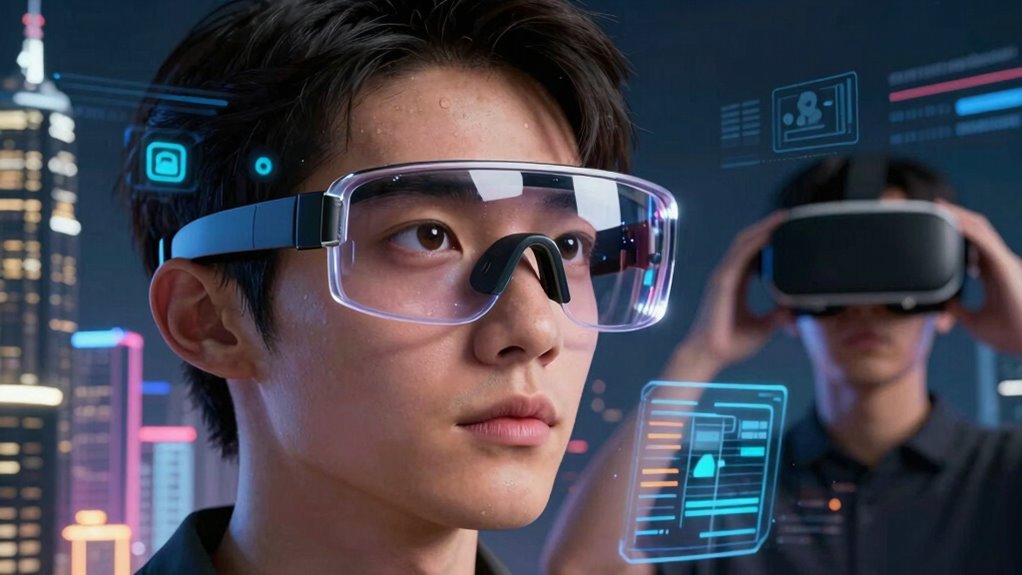
Mixed reality blends digital content with the real world, so you can interact with virtual objects anchored in your physical environment while staying aware of your surroundings. In contrast, virtual reality completely immerses you in a separate, simulated world, blocking out everything around you. The key difference is that MR enhances your perception of reality and allows seamless interaction, whereas VR transports you elsewhere entirely. Continue exploring to discover how these technologies are shaping different experiences and industries.
Key Takeaways
- Mixed Reality (MR) overlays digital content onto the real world, maintaining environmental awareness, unlike VR which immerses users in a completely virtual environment.
- MR enables interaction with digital objects anchored to real-world locations, while VR focuses on fully simulated environments.
- MR allows users to see and interact with physical surroundings alongside digital overlays, whereas VR isolates users from real-world stimuli.
- MR enhances practical tasks like collaboration and training through seamless blending of digital and physical spaces.
- VR offers full immersion and escape from reality, primarily used for gaming, entertainment, and virtual simulations.
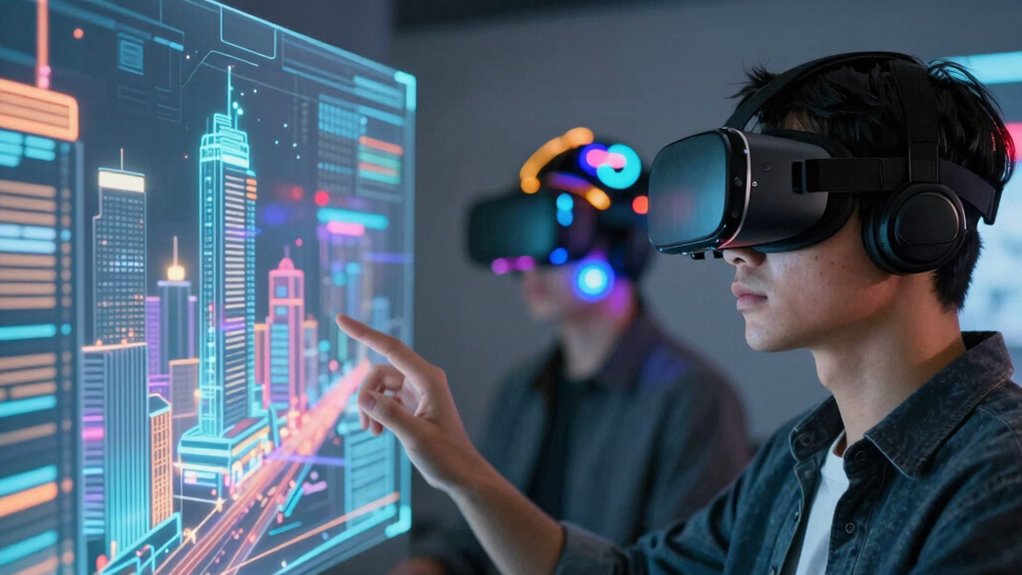
Mixed reality (MR) and virtual reality (VR) are two cutting-edge technologies transforming how we interact with digital content, but they serve different purposes and experiences. When you use MR devices, you’re engaging with augmented overlays that blend digital elements seamlessly into the real world. This means you can see your actual environment while digital objects are overlaid, allowing for interactions that feel natural and integrated. In contrast, VR immerses you completely in a virtual environment, shutting out the physical world entirely. You put on a headset, and suddenly, you’re transported to a different place—whether it’s a simulated landscape, a game universe, or a virtual workspace.
MR blends digital overlaid elements with reality, while VR fully immerses you in a separate virtual environment.
With MR, the goal is to enhance your perception of reality by adding digital information to your surroundings. You might see virtual tools floating in your workshop or digital characters interacting with you in your living room. These augmented overlays are designed to complement what’s around you, enabling more practical applications like collaboration, design, or training. You can move around your environment while digital objects stay anchored to real-world locations, creating a sense of continuity between the physical and digital worlds. This hybrid experience makes MR ideal for scenarios where you want to stay aware of your surroundings but still access digital enhancements. Additionally, MR’s ability to incorporate digital content into real-world settings makes it particularly useful in interactive applications such as remote assistance and immersive design. The seamless blending of real and virtual elements offers a more natural interaction compared to traditional digital interfaces. This integration of digital content into the physical environment also opens up new opportunities for enhanced learning and skill development. As the technology advances, it is becoming increasingly affordable and accessible for various industries and consumers.
VR, on the other hand, immerses you in entirely simulated environments that can be tailored for various purposes—from gaming and entertainment to education and therapy. When you wear a VR headset, your senses are fully engaged with the virtual setting, blocking out external stimuli. This creates a sense of presence, making you feel as if you’re truly somewhere else. In VR, your movements are tracked and reflected within the virtual space, allowing for interactions that are often more dynamic and engaging than in MR. However, because VR isolates you from the physical environment, it’s less suited for tasks that require real-world awareness or interaction with physical objects.
Ultimately, the key difference lies in the level of immersion and integration with reality. MR enhances your view of the real world with digital overlays, making it perfect for practical, interactive experiences that benefit from awareness of your surroundings. VR offers a fully immersive escape into digital worlds, ideal for entertainment, training, or simulations where total immersion enhances the experience. Both technologies are powerful, but they cater to different needs—one blending digital with reality, the other transporting you away entirely.
As an affiliate, we earn on qualifying purchases.
Frequently Asked Questions
Can Mixed Reality Be Used Outdoors?
Yes, mixed reality can be used outdoors. You can experience augmented navigation, where digital overlays help you find your way, or enjoy outdoor gaming that blends real-world surroundings with virtual elements. The technology relies on sensors and cameras to adapt to your environment, making it suitable for outdoor use. Just make certain you’re in a well-lit area with good connectivity for the best experience.
What Are the Hardware Requirements for Mixed Reality?
Imagine stepping into a world where your surroundings come alive—mixed reality hardware makes this possible with devices like HoloLens or Magic Leap. You need powerful processors, spatial tracking sensors, and a display system that blends digital content seamlessly with your environment. These components guarantee precise interaction. Without proper hardware, your experience falls flat, like trying to see a masterpiece through fog. Quality mixed reality demands sophisticated, well-calibrated tech.
How Affordable Is Mixed Reality Technology?
Mixed reality technology can be quite costly, with the cost comparison to VR often favoring VR for affordability. As a user, you might find accessibility barriers due to high prices and specialized hardware requirements. While prices are decreasing, mixed reality still remains less accessible for many, especially compared to more affordable VR options. However, as technology advances, expect mixed reality to become more budget-friendly and accessible over time.
Is Mixed Reality Suitable for Education Purposes?
Yes, mixed reality is highly suitable for education because it enables augmented interaction and virtual collaboration. You can immerse students in interactive lessons, making learning more engaging and hands-on. With mixed reality, learners can explore complex concepts in a 3D environment, fostering deeper understanding. It also encourages teamwork through virtual collaboration, allowing students to work together seamlessly, regardless of their physical location.
How Does Mixed Reality Impact User Safety?
Think of mixed reality as a shield that enhances user safety by blending real and virtual worlds. It actively reduces hazards by allowing you to see your surroundings clearly, preventing accidents and injuries. With hazard prevention features, mixed reality keeps you alert to environmental risks while immersed in digital content. This balance helps you explore new experiences confidently, knowing your safety remains a top priority in every virtual interaction.

RayNeo Air 4 Pro AR/XR Glasses, HDR10 201" Virtual Display, 120Hz 3D Movie & Gaming Video Display, USB-C Plug & Play for iPhone 17/16/15, Android, Switch 2, PS5, Steam Deck
- HDR10 Virtual Display: 201-inch immersive virtual screen with 10B colors
- AI SDR-to-HDR Upscaling: Enhances color, sharpness, and motion clarity
- 120Hz 3D Video Playback: Smooth 3D movies and gaming visuals
As an affiliate, we earn on qualifying purchases.
As an affiliate, we earn on qualifying purchases.
Conclusion
So, now you see, mixed reality and VR dance to different tunes—one blending the real with the virtual, the other immersing you completely. Think of mixed reality as a bridge connecting worlds, while VR is a portal into an entirely new universe. Both hold incredible potential, but it’s your choice to decide which melody resonates with you. After all, in this symphony of innovation, you’re the conductor—guiding your journey through endless possibilities.
As an affiliate, we earn on qualifying purchases.
As an affiliate, we earn on qualifying purchases.