
Mixed reality blends your physical environment with digital elements that interact naturally, while virtual reality immerses you completely in a virtual, isolated world. With MR, you can see and interact with real objects alongside digital ones, enhancing tasks and collaboration. VR, on the other hand, transports you to entirely virtual spaces where everything is virtual and separate from your surroundings. If you keep exploring, you’ll discover how each technology offers unique ways to experience and engage with digital content.
Key Takeaways
- Mixed Reality (MR) overlays digital content onto the real world, while VR immerses users in a fully virtual environment.
- MR allows interaction with virtual objects within real surroundings, unlike VR which isolates users from physical space.
- MR enhances real-world tasks with digital data, whereas VR primarily focuses on entertainment or simulated training.
- MR utilizes spatial mapping and natural gestures, offering more intuitive interactions compared to VR controllers.
- MR maintains user awareness of their physical environment, unlike VR which isolates users from real-world surroundings.
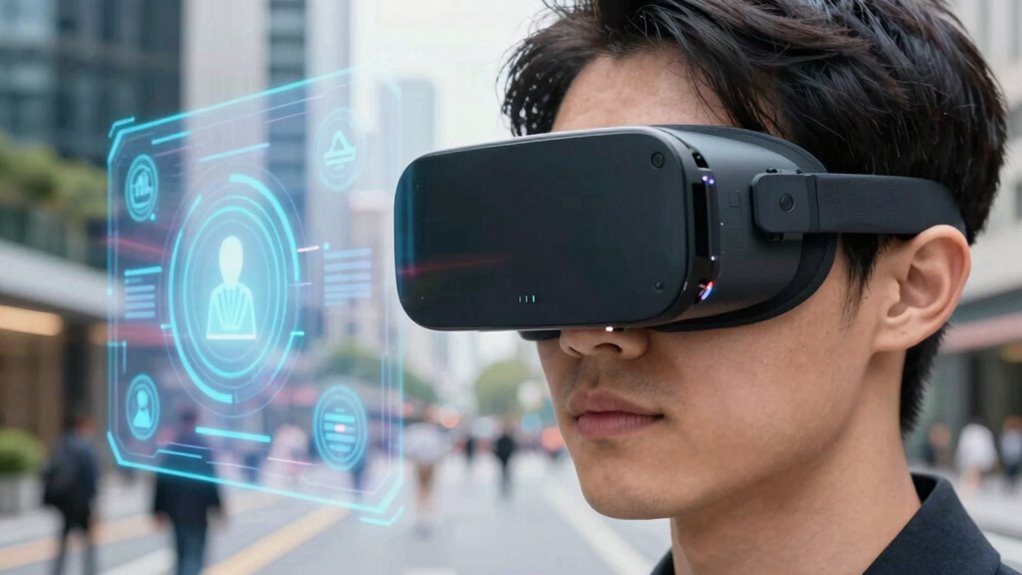
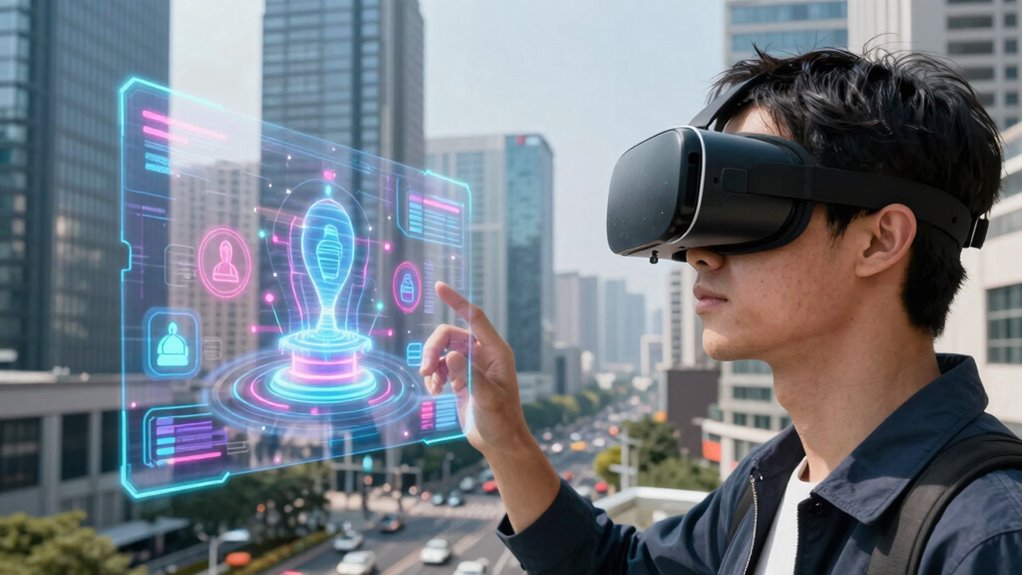
As virtual reality (VR) continues to evolve, many people wonder how it compares to mixed reality (MR), which blends real and virtual environments seamlessly. With MR, you’re not just confined to a completely digital world; instead, you experience an augmented overlay that enhances your real-world surroundings. This means you stay grounded in your physical environment while digital elements interact with it in real time. Unlike traditional VR, which immerses you in a fully virtual environment, mixed reality creates an immersive environment where digital objects coexist with the real world, allowing for more natural interactions.
Mixed reality seamlessly blends real and virtual environments for natural, interactive experiences that enhance your physical surroundings.
You might find that MR offers a different kind of engagement. For example, in VR, you’re transported to a new world, often isolated from your physical surroundings, which can be great for immersion but limiting when it comes to real-world tasks. With mixed reality, you stay aware of your actual environment while digital elements—like virtual tools, information, or characters—are overlaid onto it. This augmented overlay helps you perform tasks more efficiently because you can see relevant virtual data without removing yourself from the physical space. Whether you’re working on complex machinery or collaborating with team members, MR enhances your ability to interact with both worlds simultaneously.
Another key difference is how each technology handles interaction. In VR, your interactions are confined to controllers or hand-tracking within a completely virtual space, often requiring you to learn new gestures or control schemes. MR, however, leverages your natural movements and gestures, making interactions more intuitive. You can reach out, grab, or manipulate digital objects as if they were part of your physical environment, thanks to an immersive environment that reacts seamlessly to your actions. This makes MR particularly useful for applications like design, training, or remote assistance, where real-time interaction with both physical and virtual elements is essential. As smart home technology becomes more integrated with MR, users can control and monitor household devices through natural gestures and voice commands, creating a more seamless experience. Furthermore, advancements in visual fidelity and display technology continue to improve the realism and effectiveness of MR experiences, making them increasingly practical for everyday use. Additionally, the development of spatial mapping technology allows MR devices to better understand and interact with the physical layout of a space, enhancing immersion and interaction quality.
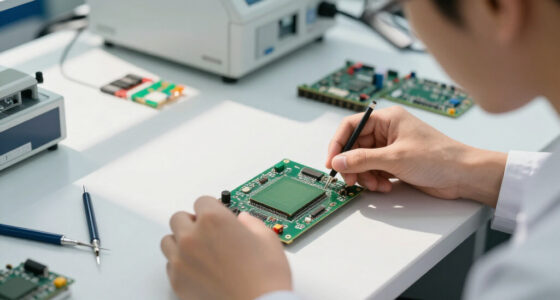
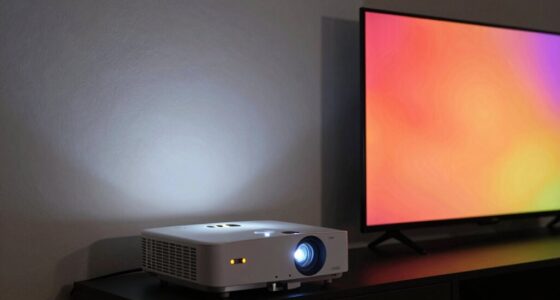
Moreover, the contrast ratio in projectors plays a crucial role in creating realistic and detailed images, which enhances visual fidelity much like how MR devices blend digital and real-world visuals seamlessly. Another important aspect is how hardware specifications such as sensors and processing power influence the performance and accuracy of MR systems, making them more reliable for complex tasks. Ultimately, the main distinction comes down to purpose and experience. VR transports you away from reality for entertainment or training, creating a fully immersive environment that isolates you from your surroundings. Mixed reality, on the other hand, enhances your real-world experience by adding digital layers that interact with your physical space, creating a hybrid environment. You get the best of both worlds—digital augmentation that complements your everyday activities, all while maintaining awareness of your physical environment. This unique blend of real and virtual makes MR a powerful tool for diverse applications, setting it apart from traditional VR.
As an affiliate, we earn on qualifying purchases.
Frequently Asked Questions
Can Mixed Reality Be Used Outside of Gaming?
Yes, mixed reality can be used outside of gaming. You can explore virtual environments while still interacting with the real world, making it perfect for virtual exploration in education, training, or design. It enhances real world interaction, allowing you to see and manipulate digital objects within your physical space. This technology offers practical applications beyond gaming, like remote collaboration, architectural visualization, and immersive learning experiences.
What Devices Are Required for Mixed Reality Experiences?
To experience mixed reality, you’ll need devices that combine hardware compatibility and advanced sensor technology. A mixed reality headset, like Microsoft HoloLens or Magic Leap, provides the necessary sensors to map your environment and integrate digital objects seamlessly. These headsets often connect to compatible computers or mobile devices, ensuring smooth interaction. The key is choosing hardware that supports precise sensor technology for an immersive, realistic mixed reality experience.
Is Mixed Reality More Expensive Than Virtual Reality?
Mixed reality is often more expensive than virtual reality because of its higher technological complexity and advanced hardware requirements. You might think you’re investing in just a headset, but the cost includes sensors, cameras, and powerful processors that create seamless integration between real and digital worlds. This technological sophistication drives up the price, making mixed reality a pricier but more immersive experience — like stepping into another universe, but with a bigger price tag.
How Do Mixed Reality Applications Impact Education?
Mixed reality applications revolutionize education by creating immersive learning experiences and transforming traditional classrooms into interactive environments. You can engage students more deeply, making lessons memorable through hands-on exploration and real-time interaction. These applications foster collaboration, boost motivation, and cater to diverse learning styles. As a result, students develop critical thinking skills and retain information better, making mixed reality a powerful tool for enhancing education and preparing learners for the future.
Can Mixed Reality Be Integrated With Augmented Reality?
Yes, mixed reality can be integrated with augmented reality to create immersive training experiences. You can interact with digital objects overlaid on the real world, enhancing learning through real-world interaction. This combination allows you to seamlessly blend virtual elements with your environment, making training more engaging and practical. By integrating these technologies, you gain a richer, more interactive experience that improves understanding and skill development in various fields.
As an affiliate, we earn on qualifying purchases.
Conclusion
So, savvy in the sphere of simulations, you see that mixed reality melds the real and the virtual, creating a captivating, cohesive connection. Virtual reality, meanwhile, immerses you entirely in an artificial arena. The distinction is dynamic; MR melds the material with the magical, while VR plunges you purely into a virtual void. Decide which digital domain delights you more, and explore the diverse depths of digital discovery!

RayNeo Air 4 Pro AR/XR Glasses, HDR10 201" Virtual Display, 120Hz 3D Movie & Gaming Video Display, USB-C Plug & Play for iPhone 17/16/15, Android, Switch 2, PS5, Steam Deck
- HDR10 Virtual Display: 201-inch immersive virtual screen with 10B colors
- AI SDR-to-HDR Upscaling: Enhances color, sharpness, and motion clarity
- 120Hz 3D Video Playback: Smooth 3D movies and gaming visuals
As an affiliate, we earn on qualifying purchases.
As an affiliate, we earn on qualifying purchases.
As an affiliate, we earn on qualifying purchases.