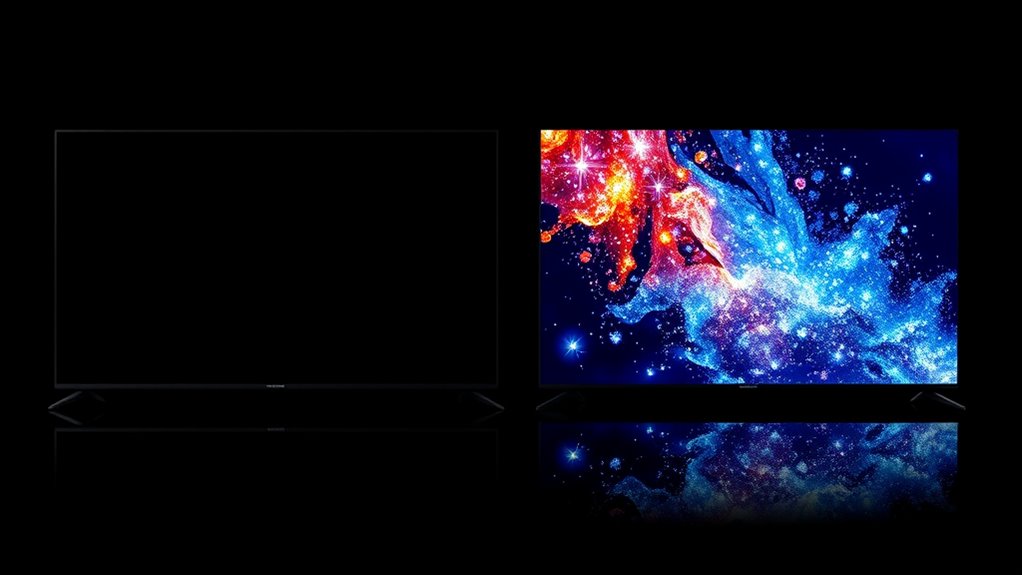

When choosing between OLED and QLED, you should consider how each technology works. OLED offers perfect black levels and exceptional contrast because each pixel lights up individually, while QLED uses a backlight with quantum dots to produce brighter images and more vibrant colors. If black detail and wide viewing angles matter most, OLED excels. But if brightness and durability are priorities, QLED might be better. Keep exploring to see which fits your viewing style best.

Get the latest gadgets delivered free with Prime
- Fast, free delivery on millions of items
- Prime Video, Amazon Music and more included
- Member-only deals all year
Key Takeaways
- OLED pixels emit their own light, enabling perfect blacks and superior contrast, while QLED uses backlight and quantum dots for brightness.
- OLED offers excellent color accuracy and wider viewing angles; QLED provides higher peak brightness and vibrant colors.
- OLED TVs are more expensive and susceptible to burn-in; QLEDs are more durable and cost-effective with longer lifespan.
- OLED excels in dark-room viewing with deep blacks; QLED performs better in bright environments with higher brightness levels.
- The choice depends on priorities: contrast and black levels favor OLED; brightness and affordability favor QLED.
OLED TV with perfect black levels
As an affiliate, we earn on qualifying purchases.
As an affiliate, we earn on qualifying purchases.
How OLED and QLED Technologies Work

OLED and QLED technologies achieve their stunning visuals through different methods of producing light and color. With OLED, each pixel emits its own light when an electric current passes through organic compounds. This self-emitting feature means you get perfect blacks and high contrast because individual pixels can turn off completely. QLED, on the other hand, uses an LED backlight combined with a quantum dot layer. The backlight shines through the liquid crystal layer, which adjusts to control brightness and color. The quantum dots then enhance color accuracy by converting the backlight’s light into precise hues. This method relies on a powerful backlight, unlike OLED’s self-emission. Both technologies focus on producing vibrant images, but they do so with fundamentally different light sources and color generation techniques. Additionally, contrast ratio plays a significant role in how vivid and detailed images appear on each type of display. Understanding the light emission process helps consumers make informed choices based on their viewing preferences and environment. For instance, energy efficiency varies between the two, with OLED generally consuming less power during darker scenes. Moreover, manufacturing process influences the overall durability and cost of each display type. Furthermore, the cost difference between OLED and QLED models can impact consumer purchasing decisions.
As an affiliate, we earn on qualifying purchases.
Picture Quality and Visual Performance

When comparing picture quality, you’ll notice differences in color accuracy and range, which affect how vibrant and true-to-life images appear. Contrast and black levels also play a big role in how deep and immersive your viewing experience is, especially in dark scenes. Additionally, brightness and HDR performance influence how well the displays handle bright highlights and detailed shadows. Proper display calibration can further enhance these aspects, ensuring optimal image quality. For those seeking a more connected viewing environment, understanding these display differences can help optimize your home entertainment setup. Recognizing how display technology impacts overall image quality can guide you toward the best choice for your needs. Furthermore, the integration of smart features can enhance the user experience by providing more intuitive control and connectivity options. Being aware of visual performance characteristics can also assist in customizing your viewing setup to match your preferences.
Color Accuracy and Range
While both OLED and QLED displays offer impressive color performance, OLED panels generally deliver superior color accuracy and a wider color range. With OLED, each pixel emits its own light, allowing for precise color reproduction without relying on a backlight. This results in more accurate hues and subtle gradations, especially in complex scenes. The self-emissive nature of OLED technology contributes significantly to this advantage, as each pixel independently controls its brightness and color. QLEDs use quantum dots to enhance color brightness and saturation, producing vivid images that pop. However, they may struggle slightly with color accuracy in darker scenes due to their reliance on a backlight. Additionally, OLED panels tend to maintain better color stability over time, ensuring consistent picture quality. Thanks to their self-emissive technology, OLED screens are less affected by color shifting during viewing, which enhances long-term viewing satisfaction. Moreover, OLED’s ability to turn off individual pixels enables true blacks, further improving overall picture quality.
Contrast and Black Levels
Because of their self-emitting pixels, OLED displays can produce perfect black levels and exceptional contrast ratios, making images appear more vivid and immersive. When a scene requires deep blacks, OLED screens turn off pixels completely, resulting in pitch-black backgrounds that enhance detail in bright areas. This capability allows for precise control of contrast, giving images a more lifelike quality. This contrast allows you to see subtle differences in shading, giving depth and realism to images. Additionally, OLED technology’s self-emitting pixels enable faster response times, reducing motion blur during fast-paced scenes. The organic nature of OLED pixels also means they can be more susceptible to burn-in, which is an important consideration for long-term use. Moreover, OLED displays typically have better viewing angles, ensuring consistent picture quality from different positions in the room. The ability of OLED to turn off pixels completely is what truly sets it apart from other display types. QLEDs, on the other hand, use a backlight, which can cause light bleed and prevent true blacks, especially in dark scenes. As a result, OLEDs deliver superior contrast and black levels, making your viewing experience more dynamic. Whether watching movies or playing games, you’ll notice richer shadow details and more striking color differentiation, heightening the overall visual impact.
Brightness and HDR Performance
OLED displays generally excel in brightness and HDR performance, delivering stunning highlights and vibrant colors that make images pop. You’ll notice how bright scenes look more dynamic, with well-defined details even in challenging lighting conditions. While OLEDs excel at contrast and deep blacks, they can sometimes struggle with maximum brightness levels compared to QLEDs. However, modern OLEDs have improved profoundly, providing ample brightness for most HDR content. Well-sourced coverage ensures that these technological differences are accurately represented and understood by consumers. Additionally, OLEDs tend to have less light bleed, which enhances their contrast capabilities and overall picture quality. These improvements also reduce issues like image retention, contributing to a better viewing experience over time. In addition, advancements in peak brightness have allowed OLEDs to approach or even surpass QLEDs in certain high-dynamic-range scenarios, making them more versatile for different viewing environments. QLEDs typically offer higher peak brightness, making them ideal for bright rooms and HDR formats like Dolby Vision or HDR10+. Your viewing experience benefits from these differences: OLEDs deliver rich, nuanced highlights, while QLEDs excel in bright environments with more intense, punchy visuals. Both technologies support impressive HDR performance, but your preference depends on your lighting environment and content style.
As an affiliate, we earn on qualifying purchases.
Brightness and HDR Capabilities

When comparing OLED and QLED TVs, brightness and HDR performance are key factors to contemplate. QLEDs typically offer higher peak brightness levels and a wider HDR color range, making bright scenes pop. However, screen uniformity can vary, affecting how evenly light is distributed across the display. For those seeking a safe and comfortable viewing environment, understanding these differences can help prevent eye strain and improve overall viewing comfort.
Peak Brightness Levels
Peak brightness levels are a key factor in distinguishing OLED and QLED displays, especially for HDR performance. QLEDs typically reach higher peak brightness, often exceeding 1,500 nits, enhancing HDR highlights and making scenes pop. OLEDs usually top out around 700-1,000 nits, which still offers impressive contrast but less brightness for bright scenes. Here’s a quick comparison:
| Feature | OLED | QLED | Best for |
|---|---|---|---|
| Peak Brightness | Up to 1,000 nits | Up to 2,000+ nits | Bright HDR content |
| Contrast Ratio | Infinite (perfect blacks) | Slightly lower but high | Deep blacks & shadows |
| HDR Performance | Excellent, limited brightness | Superior brightness for highlights | Bright rooms & HDR scenes |
Your choice impacts HDR vividness and viewing experience in bright rooms.
HDR Color Range
HDR color range determines how vividly a display can reproduce colors during high dynamic range content, substantially impacting your viewing experience. With a wider color range, you’ll see more saturated, lifelike hues, making scenes feel more immersive. OLED panels excel here because they can produce deeper blacks and richer colors, especially in dark scenes. QLEDs also offer impressive color volume, thanks to quantum dot technology, which enhances color brightness and accuracy. The key difference lies in how each technology handles color in bright environments: QLEDs typically display brighter, more vibrant colors due to higher peak brightness, while OLEDs focus on accurate color reproduction in darker settings. Ultimately, a broader HDR color range ensures more dynamic and realistic visuals, elevating your overall viewing quality.
Screen Uniformity
Screen uniformity affects how consistently a display delivers brightness and HDR performance across its entire surface. With OLED screens, you usually get excellent uniformity because each pixel emits its own light, avoiding issues like blooming or clouding. This results in even brightness levels and consistent HDR performance, especially in dark scenes. QLEDs, on the other hand, can sometimes show uneven brightness, especially in larger screens or when displaying dark images. Backlight bleeding and panel inconsistencies can cause patches of brightness or shadowy areas. When watching HDR content, uniformity impacts how well you see details in bright and dark areas without distracting spots or dimmer zones. Overall, OLEDs tend to offer superior screen uniformity, enhancing your viewing experience with consistent brightness and HDR delivery.
As an affiliate, we earn on qualifying purchases.
Black Levels and Contrast Ratios

When it comes to black levels and contrast ratios, OLED displays typically outperform QLEDs because each pixel emits its own light and can turn off completely to produce true blacks. This ability results in deeper blacks and more dynamic contrast, especially in dark scenes. With OLED, you won’t see any glow or light bleed around dark areas, giving you a more immersive viewing experience. QLEDs can produce high contrast ratios too, but they often rely on local dimming, which may cause blooming around bright objects in dark backgrounds. If you value perfect blacks and high contrast, OLED is usually the better choice.
- OLED pixels turn off completely for true blacks
- No light bleed or blooming with OLED
- QLEDs may show slight glow in dark scenes
- Contrast ratios are generally higher with OLED
Color Accuracy and Vibrancy

While both OLED and QLED displays deliver vibrant colors, OLEDs generally excel in color accuracy and subtle gradations due to their precise pixel control. This allows OLED screens to produce more natural and true-to-life hues, especially in complex scenes. QLEDs, on the other hand, often display brighter colors, making them pop more in well-lit environments. However, they might sometimes oversaturate certain shades, reducing color fidelity. Your viewing experience depends on your priorities: if you prefer realistic colors and smooth progressions, OLED is the better choice.
| Feature | OLED | QLED |
|---|---|---|
| Color Accuracy | High, natural tones | Slightly exaggerated, vibrant |
| Color Vibrancy | Subtle, nuanced gradations | Bright, eye-catching colors |
| Ideal for | Accurate color representation | Bold, vivid display |
Viewing Angles and Screen Uniformity

OLED displays generally offer superior viewing angles because each pixel emits light directly, allowing you to see consistent colors and contrast from almost any position. This means you won’t experience color shifts or dimming when you view the screen off-center. In contrast, QLED screens can suffer from reduced image quality at wider angles, with colors fading or becoming less vibrant. Screen uniformity is also a key factor—you might notice uneven brightness or clouding on some displays. With OLEDs, uniformity is typically better since each pixel is self-emitting. However, QLEDs can sometimes show slight backlight bleed, especially in darker scenes. Overall, OLEDs provide a more consistent, immersive viewing experience, especially if you often watch from different angles in your room.
OLEDs deliver better viewing angles with consistent colors and contrast from nearly any position.
- Better color consistency from side angles
- Less brightness loss when viewing off-center
- Fewer issues with backlight bleed or clouding
- More uniform appearance across the screen
Lifespan and Durability of Displays

Although OLED and QLED displays are both designed for long-term use, they differ considerably in their durability and lifespan. OLED screens tend to have a shorter lifespan because their organic materials degrade over time, which can lead to image retention or burn-in if static images stay on the screen too long. However, modern OLEDs have improved markedly, reducing these issues. QLED displays generally last longer since they use inorganic quantum dots, which are more resistant to wear and degradation. They’re less prone to burn-in and can handle continuous use better. That said, QLEDs can still experience brightness reduction over many years. Overall, if durability and longevity are your priorities, QLEDs often provide a more robust, long-lasting option, but OLEDs can still serve well with proper care.
Price Range and Value for Money

When comparing OLED and QLED displays, their price points can considerably influence your decision. OLED TVs tend to be more expensive upfront but offer superior contrast and deeper blacks, which many find worth the extra cost. QLEDs, on the other hand, usually come at a lower price and provide bright images suitable for well-lit rooms. Your choice depends on your budget and viewing preferences. Consider these factors:
OLED offers superior contrast but at a higher price; QLED provides brighter images at a lower cost.
- OLEDs are generally pricier but deliver better picture quality.
- QLEDs are more affordable and brighter, ideal for bright rooms.
- Budget models of both types are available, but premium OLEDs often cost more.
- Value for money depends on how much you prioritize contrast versus brightness and price.
Frequently Asked Questions
Which Technology Consumes More Energy During Extended Viewing?
During extended viewing, OLED TVs tend to consume more energy than QLEDs, especially when displaying bright scenes. This is because each OLED pixel emits light individually, requiring more power for brighter images. In contrast, QLEDs use a backlight system that’s generally more energy-efficient over long periods. So, if you watch a lot of bright content, expect OLEDs to use more energy than QLEDs.
Are OLED and QLED Screens More Susceptible to Burn-In?
Yes, OLED screens are more susceptible to burn-in because static images can leave permanent marks on the organic pixels. QLED screens are less prone to burn-in since they use inorganic quantum dots, which resist image retention. To protect your TV, avoid leaving static images on-screen for long periods, especially with OLEDs. Regularly changing content or using screen savers can help reduce the risk of burn-in on both types.
How Do OLED and QLED TVS Compare in Gaming Performance?
You’ll find that OLED TVs offer excellent gaming performance with fast response times and vibrant colors, making gameplay feel more immersive. QLEDs, on the other hand, provide higher brightness levels, which is great for HDR gaming and well-lit rooms. While OLEDs might have slight risks of burn-in with static images, they generally perform well for gaming. Overall, your choice depends on whether you prioritize contrast or brightness for your gaming experience.
Can QLED Displays Be Made Flexible or Curved?
Yes, QLED displays can be made flexible or curved. Manufacturers can bend the Quantum Dot layers along with the LCD panels, allowing for curved or slightly flexible screens. This flexibility enhances immersion and aesthetic appeal, especially in large TVs. However, fully flexible or foldable QLEDs are less common and still in development, as maintaining durability and image quality in flexible formats remains a technological challenge.
What Is the Environmental Impact of Manufacturing OLED Vs QLED TVS?
You should know that manufacturing OLED TVs generally has a higher environmental impact due to the use of rare, potentially toxic materials like indium and heavy metals. QLED production tends to be less harmful, but still involves energy-intensive processes and plastic components. Both types consume energy during use, but OLEDs are more energy-efficient when displaying darker images. Minimizing waste and recycling materials can help reduce their environmental footprints.
Conclusion
Choosing between OLED and QLED depends on what you prioritize—whether it’s stunning contrast, brightness, or affordability. Both technologies have their strengths, and your perfect match might just be a coincidence of your viewing habits and preferences. As you explore, remember that the right screen can transform your experience, making every scene feel more real. Ultimately, your ideal TV is waiting to be discovered, blending innovation and personal choice in a seamless, almost destined way.
Halloween Picks
halloween
As an affiliate, we earn on qualifying purchases.