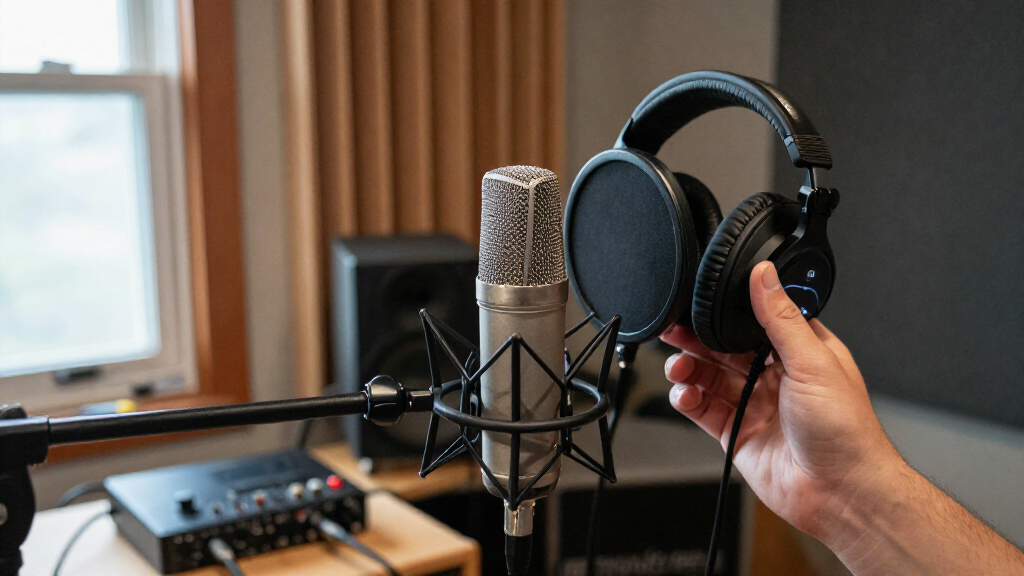

TL;DR

Get the latest gadgets delivered free with Prime
- Fast, free delivery on millions of items
- Prime Video, Amazon Music and more included
- Member-only deals all year
A supplied buying guide compares 10 studio condenser microphones across connectivity, noise figures, loud-source handling and included gear. It names the RØDE NT1 5th Generation as its most flexible pick, while the AT2020 and Shure SM4 are highlighted for different recording needs. The material does not provide test methods, prices or independent verification of its rankings.
A supplied 2027 studio condenser microphone guide compares 10 models and names the RØDE NT1 5th Generation its most flexible pick, citing its combination of XLR and USB-C connections, as described in the original analysis. The roundup also points to the Audio-Technica AT2020 as a lower-cost XLR option and the Shure SM4 for users recording in rooms where sound from the sides and rear is a concern.
The guide frames the main choice as a match between recording setup, budget and intended use, a focus shared by this home recording guide. XLR microphones generally require an audio interface or preamp, and several models in the list also require phantom power. USB models can connect directly to a computer, while the NT1 5th Generation is presented as supporting both analog XLR and digital USB-C workflows.
Its recommendations include the AKG P120 for loud sources, with the guide citing a 150 dB maximum sound pressure level and a -20 dB pad. It describes the MAONO A04 Gen2 as a ready-to-use kit with a shock mount, pop filter and adjustable microphone arm, and the FIFINE T669 as a plug-and-play USB option. Those are the guide’s descriptions; the supplied material does not document comparative testing.
The roundup lists the RØDE NT1 Signature Series at 4 dB self-noise and the NT1 5th Generation at an 80 dB signal-to-noise ratio. It also notes practical limitations: the AT2020 has no onboard pad or high-pass filter, while the MAONO’s listed noise-reduction and DSP features work only in USB mode. Because the figures use different measures and the source gives no test protocol, they should not be treated as a direct performance ranking.
Studio condenser microphones in 2027
The guide compares 10 microphones by connection, noise specifications, loud-source handling and included gear. Its recommendations reflect the guide’s descriptions, not documented comparative testing.
Match the microphone to your setup
Connection type affects what else you need for recording.
- Generally needs an audio interface or preamp.
- Several models also require phantom power.
- AT2020 is highlighted as a lower-cost XLR option.
- Can connect directly to a computer.
- FIFINE T669 is described as plug-and-play.
- NT1 5th Generation supports USB-C and XLR.
Recommendations by recording need
RØDE NT1 5th Generation
The guide’s most flexible pick, with USB-C and XLR workflows.
AKG P120
The guide cites a 150 dB maximum SPL and a −20 dB pad.
Shure SM4
Highlighted for rooms where sound from the sides and rear is a concern.
MAONO A04 Gen2
Listed with a shock mount, pop filter and adjustable microphone arm.
Check the tradeoffs
Check whether your setup supports XLR, USB, an interface or phantom power.
Pickup behavior and loud-source handling may matter for untreated rooms or loud instruments.
Check current specifications, included accessories, compatibility and prices.
Choosing for Your Recording Setup
The comparison matters to home musicians, podcasters and voiceover users because the microphone’s connection and included equipment affect what else they need to buy. An XLR model can fit an existing interface-based studio, while a USB option may reduce setup steps for computer recording. A microphone offering both connections can accommodate either workflow, according to the guide.
The roundup also underscores that room conditions and sound source can shape the choice. A high maximum SPL rating may be useful for loud instruments, while pickup pattern and off-axis behavior matter when the recording environment is not acoustically treated. The source does not provide standardized test results to establish how much better one model performs in those situations.
Products Worth Considering

Amazon Kindle Scribe (3rd Generation), 64GB, 11-inch Display, Graphite, with Premium Pen

Logitech MX Ergo S Advanced Wireless Trackball Mouse USB-C – Graphite

Amazon Kindle Paperwhite Signature Edition (12th Generation, 2024), 32 GB, Metallic Raspberry
As an affiliate, we earn on qualifying purchases.
Ten Models, Different Workflows
The listed microphones span entry-level XLR, hybrid USB/XLR and USB kit formats. Alongside the models described above, the roundup includes the Audio-Technica AT2035, Shure SM4 and Mackie EM-91C. The guide says the AT2035 uses a cardioid pattern to reduce side and rear pickup, and that the SM4 includes shielding intended to block radio-frequency interference.
The article’s headline promises 10 options, but the supplied details are incomplete: the product cards and comparison notes repeat the RØDE NT1 Signature Series, and no full breakdown is provided for every model. The material also includes affiliate-commerce language, so its recommendations should be read as a buying guide rather than independent laboratory findings.
Testing and Rankings Remain Unspecified
The supplied material does not state when the guide was published, how its microphones were tested, or how prices were compared. It gives no baseline or measurement protocol for several noise and signal-to-noise figures, which can depend on differing specifications and test conditions.
It is also unclear whether the product lineup and availability were checked for 2027. The source lists 10 models but repeats one RØDE model in its summary, and its details do not fully cover all 10. The rankings and product descriptions are therefore attributable to the guide, not independently confirmed findings.
Verify Fit Before Buying
Readers comparing these microphones should check current manufacturer specifications, included accessories, interface requirements and compatibility with their recording setup. For a meaningful sound comparison, they would need samples or measurements made under consistent conditions. The supplied source gives no announced follow-up testing or update schedule.
Key Questions
Which microphone does the guide rank as most flexible?
The guide selects the RØDE NT1 5th Generation, citing its USB-C and XLR outputs. That ranking is the source’s assessment, and no comparative test method is supplied.
Which option does it recommend for loud sources?
It highlights the AKG P120, citing a 150 dB maximum SPL rating and a -20 dB pad. The source does not provide independent measurements to verify performance.
Does the guide establish which microphone sounds best?
No. It lists specifications and use cases, but the supplied material does not describe controlled listening tests or a standardized comparison.
What remains unclear about the roundup?
The publication date, test protocol, price comparisons and complete details for all 10 listed models are not provided. One model is also repeated in the supplied summary.
Source: Thorsten Meyer AI