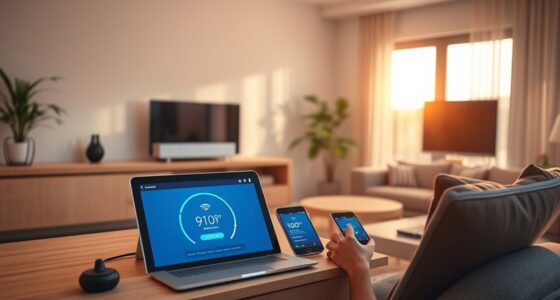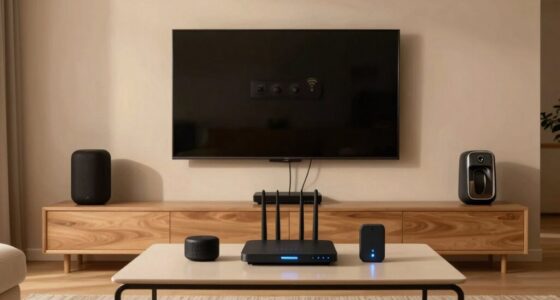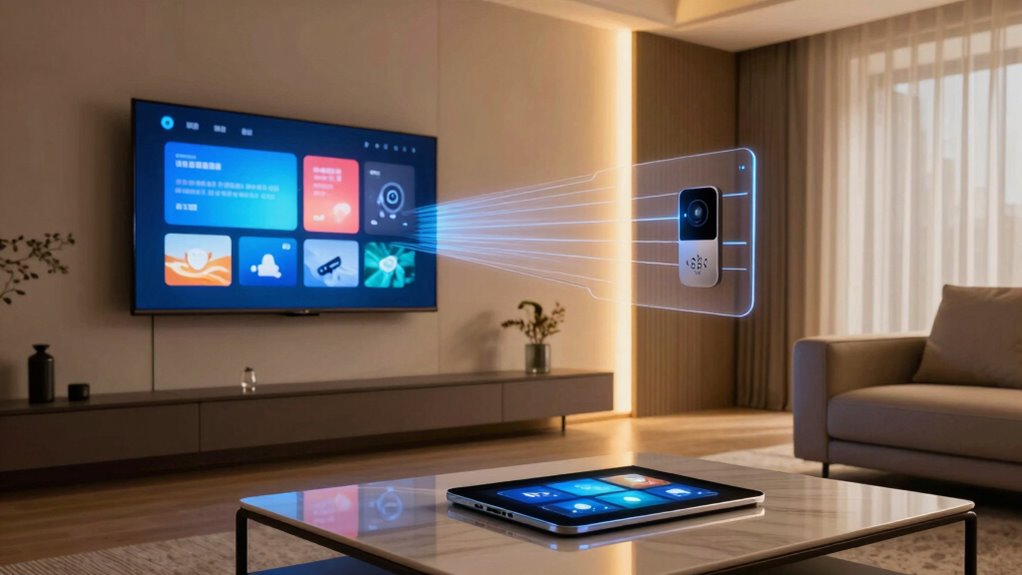

Smart homes rely on better networking more than you might realize because all your devices depend on a strong, high-speed connection to work seamlessly. A reliable network guarantees instant responses to your voice commands, keeps energy management efficient, and prevents delays or failures in automation. As the number of connected devices increases, so does the need for a robust setup. Keep exploring to discover how upgrading your network can enable your smart home’s full potential.
Key Takeaways
- Reliable networking ensures seamless communication and instant response for voice commands and automation routines.
- Increasing connected devices demand higher bandwidth and stable connections to prevent sluggishness.
- Strong networks are essential for real-time energy management and device synchronization.
- Upgraded infrastructure like mesh Wi-Fi enhances coverage, reliability, and supports smart home expansion.
- Secure, resilient networks prevent disruptions, security breaches, and optimize overall smart home performance.

Smart homes are transforming the way you live by seamlessly connecting devices and systems to make everyday tasks easier and more efficient. But behind the scenes, this relies heavily on robust networking. Without a strong, reliable network, your smart home’s features—like voice control and energy management—can falter or become frustratingly inconsistent. Think about voice control: it’s a core feature that allows you to operate lights, thermostats, or even appliances with simple commands. For voice control to work smoothly, your devices need to communicate instantly and accurately through your network. If your Wi-Fi is weak or congested, commands may lag or fail, reducing the convenience you expect from your smart home system. That’s why a dependable network isn’t just a luxury; it’s vital for voice control to be effective and reliable.
Energy management is another critical aspect that depends heavily on your home’s networking quality. When you have smart thermostats, lighting systems, or appliances that adjust based on your habits or preferences, they all need to stay connected and synchronized. A strong network ensures these devices can communicate in real time, allowing you to optimize energy use without manual intervention. For example, you can set your smart thermostat to lower the temperature when you leave the house or turn off lights automatically when rooms are unoccupied. If your network isn’t stable, these automations might not trigger correctly, leading to higher energy bills and reduced system efficiency. Better networking guarantees your energy management strategies execute seamlessly, conserving resources and saving you money.
Moreover, the growing number of connected devices in your smart home amplifies the importance of a solid network. Every smart light, security camera, door lock, and sensor consumes bandwidth and requires stable connections. If your network struggles to handle this load, your entire smart ecosystem can become sluggish or unreliable. This can make voice commands less responsive, disrupt energy-saving routines, and even compromise home security. Upgrading your networking setup—such as installing mesh Wi-Fi systems or high-speed routers—becomes a vital step in ensuring all these devices work harmoniously. It’s not just about faster internet; it’s about creating a resilient backbone that supports your smart home’s expanding needs. Additionally, integrating AI-driven devices enhances automation but demands even more reliable connectivity to function properly.
In essence, better networking is the foundation that allows your smart home to operate effortlessly. It ensures voice control responds instantaneously, energy management functions accurately, and all connected devices perform at their best. Without it, your smart home’s convenience and efficiency are compromised. So, investing in a high-quality network isn’t just technical fluff—it’s the key to opening the full potential of your smart home and truly making your everyday life easier.

EVEO Screen Cleaner Spray - Large Screen Cleaner Bottle - TV Screen Cleaner, Computer Screen Cleaner, for Laptop, Phone, Ipad - Computer Cleaning kit Electronic Cleaner (1 Pack)
- Versatile Electronic Device Cleaner: Suitable for TVs, laptops, phones, and tablets
- Effective Streak-Free Cleaning: Removes dust, fingerprints, and smudges
- Gentle on Sensitive Screens: Safe for LCD, LED, OLED, CRT screens
As an affiliate, we earn on qualifying purchases.
Frequently Asked Questions
How Does Network Speed Affect Smart Home Device Performance?
Network speed directly impacts your smart home device performance—faster speeds mean smoother operation. With fiber optics providing high bandwidth, your devices run seamlessly, reducing lag and buffering. Mesh networks enhance coverage, preventing dead zones and ensuring consistent connection throughout your home. When your network is quick and reliable, smart devices respond instantly, making your smart home more efficient, secure, and enjoyable to use.
Can a Weak Wi-Fi Signal Compromise Smart Home Security?
Absolutely, a weak Wi-Fi signal can compromise your smart home security. Just like a leaky ship, wireless interference undermines your connection, making devices more vulnerable to hacking. Poor signals can cause security vulnerabilities, allowing cybercriminals to exploit gaps in your network. You risk unauthorized access, data breaches, and even control loss over your smart devices. Strengthening your Wi-Fi guarantees your smart home stays secure, reliable, and protected from digital pirates.
What Is the Best Router for a Smart Home Setup?
The best router for your smart home guarantees device compatibility and ideal router placement. Look for a model that supports the latest Wi-Fi standards like Wi-Fi 6 for faster connections and better device support. Place your router centrally, away from obstructions, to maximize coverage. This setup minimizes dead zones and guarantees all your smart devices stay connected reliably, giving you seamless control and enhanced security throughout your home.
How Many Devices Can a Typical Smart Home Network Support?
A typical smart home network can support dozens to hundreds of devices, depending on your router’s capabilities. You need good device compatibility and network scalability to handle this growth seamlessly. As you add smart gadgets like security cameras, thermostats, and lights, make certain your network can expand without slowdowns or disconnects. Upgrading your router and optimizing your setup helps maintain reliable connectivity across all your smart devices.
Does Upgrading My Internet Plan Improve Smart Home Reliability?
Upgrading your internet plan can improve your smart home’s reliability by reducing network congestion, which often causes device compatibility issues and lag. A faster, more robust connection handles multiple devices better, ensuring smoother operation for smart lights, thermostats, and security cameras. With better bandwidth, your network becomes more resilient, minimizing disruptions and making your smart home more dependable and responsive.

iO CLEAN Screen Cleaner Spray (16oz - 473ml) – Best Large Cleaning Kit
- Versatile Screen Compatibility: Works on all electronic screens and devices
- Gentle, Scratch-Free Formula: Removes dust, fingerprints, grime safely
- Protective, Anti-Static Coating: Leaves a streak-free, smudge-free shine
As an affiliate, we earn on qualifying purchases.
Conclusion
To truly enjoy the benefits of a smart home, you need more than just smart devices—you need a smarter network. You need reliability, speed, and security. You need a connection that keeps your home running smoothly, your family safe, and your technology thriving. Because when your network is strong, your smart home is seamless. When your network is reliable, your life becomes simpler. And when your network is secure, your peace of mind is guaranteed.

KIC CrystalVu Screen Cleaner Spray Kit (16oz) with Microfiber Cloth
- Streak-Free Cleaning Formula: Removes fingerprints and smudges without residue
- Multi-Device Compatibility: Suitable for phones, tablets, and screens
- Safe for Delicate Screens: Protects LCD, LED, and OLED displays
As an affiliate, we earn on qualifying purchases.

WHOOSH Screen Cleaner and Wipe Kit Duo, 3.7 fl oz + 0.3 fl oz
- Safe for All Screens: Compatible with all screen types and coatings
- Streak-Free Cleaning: Leaves no smudges or residue
- Two Convenient Sizes: Large and travel-sized bottles included
As an affiliate, we earn on qualifying purchases.