
Voice assistants have changed your home expectations by making controls more seamless and personalized. You now expect to manage lighting, thermostats, and locks with just your voice, reducing the need for multiple apps and manual switches. This shift creates a more intuitive and efficient living environment. While convenience has increased, privacy concerns also grow, prompting you to seek better data control. If you keep exploring, you’ll discover how these changes are shaping the future of smart homes.
Key Takeaways
- Voice assistants have made home automation more centralized and intuitive, replacing multiple apps and physical controls.
- They set new standards for convenience, enabling instant, voice-activated control of home devices.
- Privacy concerns have increased, leading users to expect transparent data management and control over listening features.
- Users now demand stronger privacy safeguards and easy options to review or delete voice recordings.
- Technological advancements have raised expectations for smarter, more secure, and responsive home environments.

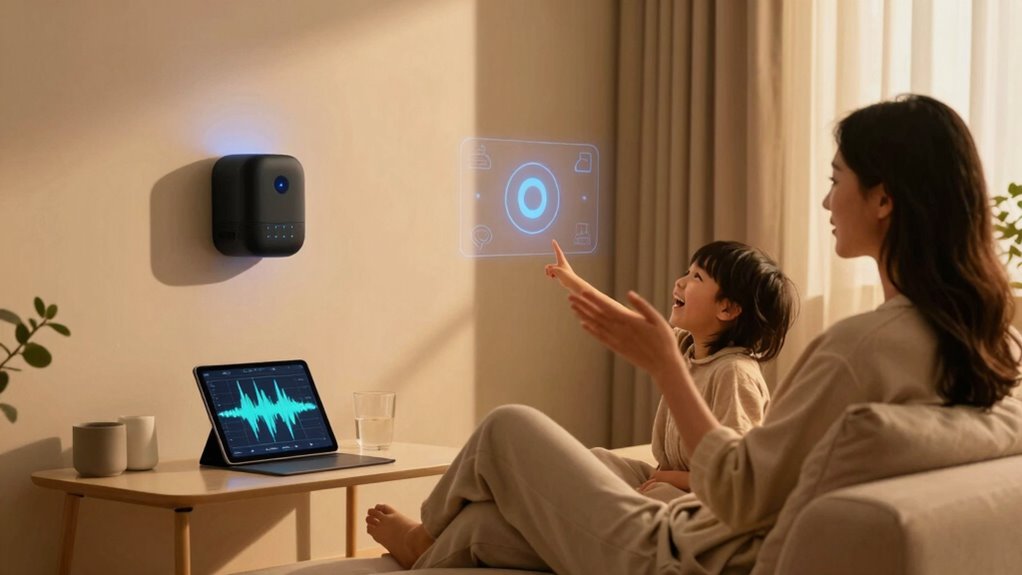
Voice assistants have become a common fixture in many homes, transforming the way you interact with technology daily. They’re no longer just gadgets; they’re central to how you manage your smart home, control devices, and access information. With voice commands, you can adjust your thermostat, turn on lights, play music, and even lock doors—all without lifting a finger. This seamless smart home integration has set new expectations for convenience and efficiency. You no longer need to navigate multiple apps or physical switches; your voice becomes the control center. This shift makes your home feel more responsive and personalized, giving you instant access to the features you want, when you want them.
Voice assistants make your home smarter and more responsive with effortless, voice-activated control.
However, as you enjoy this new level of connectivity, privacy concerns naturally come to mind. Voice assistants are always listening for wake words, which means they’re continuously processing ambient sound. This constant listening raises questions about how your data is collected, stored, and used. You might worry about sensitive conversations being inadvertently recorded or accessed by third parties. Companies that develop these voice assistants are implementing stricter privacy controls, but the concern remains that your personal information isn’t entirely in your control. It’s essential to understand how to manage your privacy settings, delete recordings, or disable features that you’re uncomfortable with. As expectations rise around smart home integration, so does the demand for transparency and security from the providers.
Your expectations for privacy and security are evolving alongside your reliance on voice assistants. You want the convenience they offer but also need assurance that your data isn’t being exploited or mishandled. Many users now expect their voice assistants to have robust privacy safeguards and clear policies about data use. Manufacturers are responding by introducing features that allow you to review and delete voice recordings easily or turn off listening capabilities altogether. This balance between smart home integration and privacy is shaping the future of voice assistant technology. You expect these devices to be both helpful and secure, blending cutting-edge convenience with peace of mind. Understanding the role of privacy safeguards can help you make informed choices about your device settings and data management.
Additionally, the integration of natural language processing technology has improved how effectively voice assistants understand and respond to commands, enhancing user experience significantly.
In the end, voice assistants have changed your expectations by making your home smarter and more intuitive. They’ve created a new standard of immediate, voice-activated control. Yet, this convenience comes with a responsibility to stay informed and vigilant about privacy concerns. As technology advances, it’s up to you to leverage the benefits while protecting your personal information. This new era of home automation is about finding the right harmony between seamless integration and safeguarding your privacy, making your smart home experience truly tailored to your needs. Recognizing the importance of secure data handling can help you better understand how to protect yourself in this evolving landscape.
smart home voice assistant with privacy controls
As an affiliate, we earn on qualifying purchases.
As an affiliate, we earn on qualifying purchases.
Frequently Asked Questions
How Secure Are Voice Assistants Regarding Personal Data Privacy?
Voice assistants have improved security, but your personal data isn’t completely private. They use data encryption to protect your information during transmission, yet vulnerabilities remain. You should regularly review and adjust your privacy settings to control what data gets stored or shared. Being aware of these aspects helps you stay informed and secure, ensuring your personal details aren’t easily accessed or misused.
Can Voice Assistants Control All Smart Home Devices Seamlessly?
You might think voice assistants seamlessly control all smart home devices, but the reality is a bit more complex. Device integration varies, and not every gadget responds perfectly. However, with user customization, you can tailor commands for better control. It’s like trying to fit a square peg in a round hole sometimes, but with patience and updates, your voice assistant can become a reliable hub for most smart devices in your home.
What Are the Limitations of Voice Assistants in Complex Tasks?
Voice assistants struggle with complex tasks because of limited contextual understanding and multi-language support. You might find they misinterpret commands or fail to grasp nuanced instructions, especially when switching languages or using slang. These limitations can make performing intricate tasks frustrating, requiring you to simplify commands or repeat yourself. As technology advances, expect better contextual comprehension and broader language compatibility, but for now, complex tasks often still challenge voice assistants.
How Do Voice Assistants Impact Household Energy Consumption?
You might be surprised—voice assistants can both boost and hinder energy savings at home. They influence your behavior, prompting you to adopt energy-saving strategies like turning off unused devices or adjusting thermostats. But, if you’re not careful, they can also lead to increased energy use through frequent commands or keeping devices in standby mode. Your choices shape the overall impact, making your habits more vital than ever in managing household energy consumption.
Are There Accessibility Concerns for Differently-Abled Users?
You might have accessibility concerns with voice assistants, especially if they lack thorough accessibility features. These features are essential for user inclusivity, helping differently-abled users interact more easily. If a voice assistant isn’t designed with diverse needs in mind, it could create barriers rather than facilitate. To guarantee everyone benefits, choose devices that prioritize user inclusivity, offering features like speech recognition, adjustable volume, and visual cues for those with hearing or visual impairments.
best smart thermostats compatible with Alexa
As an affiliate, we earn on qualifying purchases.
As an affiliate, we earn on qualifying purchases.
Conclusion
As voice assistants become your home’s silent symphony, they reshape your expectations like a gentle tide carving new shores. You no longer just ask—they anticipate, listen, and respond, turning your house into a responsive partner. This shift is like planting seeds of convenience that bloom into daily harmony. Embrace this change, for in these quiet moments of connection, your home transforms into a living, breathing entity, forever tuned to the rhythm of your life.
smart lighting voice control system
As an affiliate, we earn on qualifying purchases.
As an affiliate, we earn on qualifying purchases.
home security locks with voice command
As an affiliate, we earn on qualifying purchases.
As an affiliate, we earn on qualifying purchases.