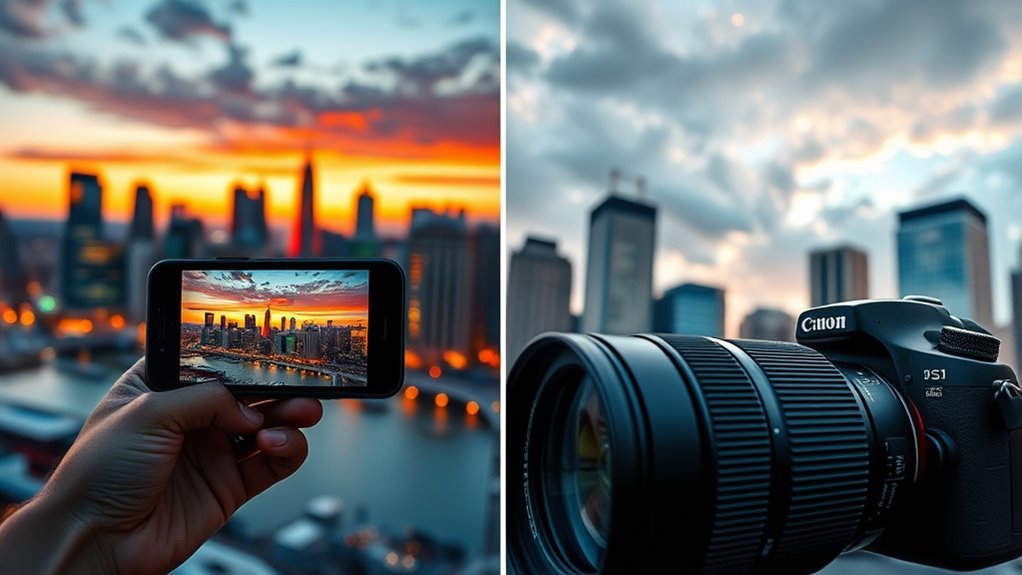

Your smartphone can handle casual shots with ease thanks to advanced sensors and computational features, but it still can’t fully replace a DSLR for professional results. DSLRs offer larger sensors, better dynamic range, true optical zoom, fast autofocus, and manual controls that give you more creative freedom and superior image quality. If you want to see how these differences impact your photos and discover what’s possible, there’s more to explore.

Get the latest gadgets delivered free — and shop member deals
- Fast, free delivery on millions of items
- Access to Prime Big Deal Days deals on October 6–7
- Prime Video, Amazon Music and more included
Key Takeaways
- DSLRs offer superior image quality, dynamic range, and low-light performance thanks to larger sensors and optical controls.
- Professional cameras provide faster autofocus, interchangeable lenses, and manual exposure options for greater creative flexibility.
- Smartphones excel in portability, ease of use, and integrated features like computational HDR and multiple built-in lenses.
- While smartphone technology is advancing, it still cannot fully match the image quality and control of dedicated professional cameras.
- For professional or demanding photography scenarios, DSLRs remain the preferred choice for optimal results.
DSLR camera for professional photography
As an affiliate, we earn on qualifying purchases.
As an affiliate, we earn on qualifying purchases.
Image Quality and Sensor Technology

When comparing image quality between smartphones and DSLRs, sensor technology plays a crucial role. You’ll notice that DSLR sensors, like APS-C or full-frame, capture considerably more light and detail than smartphone sensors. This larger sensor size allows for better low-light performance and more control over depth of field, giving your images a professional look. For example, a Sony A7R V offers over 15 stops of dynamic range, capturing a broad tonal spectrum naturally. In contrast, smartphones like the iPhone 15 Pro rely on software simulations such as Smart HDR4, which blend exposures artificially. DSLR images are true-to-life and easier to edit, making them ideal for professional workflows. Meanwhile, smartphones enhance images with algorithms, creating instant visual appeal but not capturing the full scene’s richness. Sensor size significantly influences the image quality and creative possibilities available to photographers. Additionally, advances in sensor technology continue to narrow the gap, enabling smartphones to produce increasingly detailed images under various conditions. As sensor size and technology improve, smartphones are becoming more capable of capturing high-quality images comparable to traditional cameras in specific scenarios. Moreover, ongoing innovations in sensor design are pushing the boundaries of what mobile devices can achieve in diverse environments. These developments are often driven by the philosophy of technological progress, which emphasizes continual improvement and innovation in digital imaging.
smartphone camera lens attachments
As an affiliate, we earn on qualifying purchases.
As an affiliate, we earn on qualifying purchases.
Dynamic Range and Color Fidelity

You’ll notice that DSLRs capture a wider dynamic range naturally, offering more accurate color and tonal shifts, making editing easier. Smartphones rely on computational HDR, blending multiple exposures to artificially boost dynamic range, which can sometimes alter true colors. Understanding these differences helps you choose the right device for authentic images versus those optimized for instant visual impact. Additionally, sensor capabilities play a crucial role in achieving the desired photographic results, as they determine how much light and detail each device can effectively capture. Recognizing the dynamic range of each device also assists in selecting the best camera for different lighting conditions, ensuring your images maintain their depth and vibrancy. Furthermore, build quality of a camera influences its ability to perform well in various environments, especially in challenging weather conditions. Considering camera ergonomics can also enhance your shooting experience, particularly during extended sessions.
Native vs. Computational HDR
Native HDR captures a scene’s full tonal range directly through sensor technology, resulting in images that preserve natural contrast and color accuracy without relying on post-processing. This method relies on the sensor’s ability to record bright and dark areas simultaneously, maintaining true-to-life details. In contrast, computational HDR combines multiple exposures through software to artificially boost dynamic range. While smartphones excel at quick, vibrant images, their HDR processing can sometimes oversaturate or flatten subtle tonal shifts. Sensor capabilities play a crucial role in determining the effectiveness of native HDR, especially in challenging lighting conditions. Additionally, advancements in sensor technology continue to expand the potential of native HDR in various lighting scenarios, leveraging sensor performance to improve results across different environments. The evolving sensor design also contributes to better handling of high-contrast scenes, further enhancing native HDR quality. Improvements in image processing algorithms help native HDR better preserve natural color fidelity and contrast in complex scenes.
True Color Reproduction
Have you ever noticed how some photos capture colors that look almost real, while others seem oversaturated or washed out? That’s because true color reproduction depends on how well your device handles dynamic range and color accuracy. DSLRs, with their larger sensors, naturally capture a wider tonal range, preserving subtle gradations in shadows and highlights. This results in images with more accurate, natural colors and smoother *passages*. In contrast, smartphones rely heavily on computational HDR to artificially boost dynamic range, which can sometimes oversimplify or distort colors. While modern smartphones do a decent job with color fidelity in bright conditions, they often struggle in challenging lighting, producing images that may look vibrant but lack the true-to-life depth and nuance you get from a DSLR. Understanding sensor size is key to grasping why DSLRs excel at capturing authentic color and detail across various lighting situations. Additionally, the color processing algorithms used by smartphones can influence the final image, sometimes prioritizing vibrancy over accuracy. Recognizing the limitations of mobile sensors can help users set realistic expectations for their smartphone photography. Moreover, advancements in sensor technology continue to narrow the gap, but fundamental differences in size and processing still give DSLRs an edge in true color reproduction. A new development in sensor design is further improving color fidelity and dynamic range in high-end smartphones.
Editing Flexibility
Because of their larger sensors and advanced processing, DSLRs offer greater editing flexibility when it comes to dynamic range and color fidelity. You can extract more detail from shadows and highlights without losing tonal richness, making your edits more natural and precise. DSLRs capture images with true-to-life colors directly from the sensor, giving you a solid foundation for color grading and adjustments. Unlike smartphones, which rely heavily on computational HDR and software enhancements that can distort true tones, DSLR files provide a more authentic starting point. This flexibility allows you to fine-tune exposure, contrast, and color balance during post-processing, ensuring your final image matches your artistic vision. Overall, DSLRs empower you to craft images with superior tonal gradation and color accuracy.
As an affiliate, we earn on qualifying purchases.
Autofocus Performance and Speed

Autofocus performance and speed are crucial factors that differentiate DSLRs from smartphones. With phase-detection autofocus, DSLRs can lock onto subjects quickly and track motion seamlessly, reaching speeds of over 20 frames per second, with some models like the Canon EOS R3 hitting 30fps. This allows you to capture fast-moving action with precision. In contrast, smartphones primarily rely on contrast-detection autofocus, which tends to struggle in low-light conditions and with fast subjects. While recent phones like the iPhone 15 Pro can shoot at 20fps, they often keep focus fixed during burst sequences, limiting their ability to track moving subjects. Overall, DSLRs offer superior autofocus speed and accuracy, making them ideal for dynamic scenarios where quick focus is critical. Additionally, autofocus technology continues to improve, narrowing the gap between smartphones and professional cameras in certain situations. As technology advances, professional-grade autofocus systems are becoming more accessible in compact devices, enhancing their versatility. These advancements are driven by innovations in autofocus sensors, which help improve overall responsiveness and reliability. Moreover, ongoing research into sensor technology aims to further boost autofocus performance in future devices. Furthermore, improvements in autofocus algorithms are also contributing to faster and more accurate focusing capabilities across various camera systems.
As an affiliate, we earn on qualifying purchases.
Optical Control and Zoom Capabilities

You’ll notice that DSLRs use interchangeable lenses to provide true optical zoom, maintaining image quality at any distance. In contrast, smartphones rely on digital or hybrid zoom, which can reduce resolution and detail. Plus, manual controls over exposure and aperture in DSLRs give you precise adjustments that smartphones can’t match.
Optical Vs Digital Zoom
Optical zoom relies on changing lenses to magnify a subject without sacrificing image quality, providing sharp, detailed results even at high magnification levels. Unlike digital zoom, which enlarges pixels and reduces clarity, optical zoom maintains true resolution. Here are key points to contemplate:
- DSLR lenses offer true optical zoom, allowing you to capture distant subjects clearly.
- Smartphone zoom is primarily digital or hybrid, cropping images and losing detail.
- Some smartphones, like Samsung Galaxy S24 Ultra, feature hybrid zoom up to 100x, but image quality diminishes at extreme ranges.
- Manual control over aperture and shutter speed is possible with DSLRs, enhancing zoomed-in shots, unlike smartphones that rely on software adjustments.
Interchangeable Lens Advantage
Interchangeable lenses give DSLR photographers a significant advantage by allowing precise control over focal length, aperture, and depth of field. This flexibility lets you adapt to different shooting scenarios, from wide landscapes to tight portraits, without sacrificing image quality. You can also switch lenses to match lighting conditions or subject distance, maintaining ideal clarity. Here’s a quick comparison:
| Feature | DSLR | Smartphone |
|---|---|---|
| Optical Zoom | Yes, via lens swapping | Digital or hybrid zoom |
| Focal Length Flexibility | Multiple lens options | Fixed lens, limited options |
| Image Quality at Zoom | Maintains resolution | Resolution drops with digital zoom |
This advantage ensures you have full creative control, unlike smartphones that rely mainly on digital enhancements.
Manual Exposure Control
Manual exposure control is a key advantage of DSLR cameras, allowing you to precisely adjust ISO, shutter speed, and aperture to achieve the desired image quality. This flexibility lets you adapt to various lighting conditions and creative needs.
Here’s what you can do with manual control:
- Fine-tune ISO to reduce noise in low-light scenes
- Set shutter speed to freeze motion or create motion blur
- Adjust aperture for depth of field and background separation
- Use optical zoom with interchangeable lenses for sharp, detailed shots
Unlike smartphones, which often rely on software adjustments, DSLRs give you real-time, optical control over your image’s exposure and zoom capabilities, ensuring professional results in any scenario.
Portability and User Convenience

Though DSLR cameras offer exceptional image quality, smartphones excel in portability and user convenience, making them your go-to for everyday moments. You can easily slip a phone into your pocket or bag, allowing quick access whenever inspiration strikes. Multiple built-in lenses—ultra-wide, telephoto, macro—eliminate the need to carry bulky gear, simplifying your setup. Night mode lets you capture clear images in low light without extra equipment. Unlike DSLRs, which require battery management and carry heavier weight, smartphones have integrated batteries that last through casual shoots. No lens swaps or complex settings here—just point, shoot, and share. This convenience means you’re more likely to document spontaneous moments, making smartphones the perfect tool for casual, on-the-go photography.
Suitability for Professional Photography

While smartphones have advanced considerably, they still fall short for professional photography demanding the highest image quality and creative control. To meet professional standards, you need equipment that offers superior sensor technology and flexibility.
- Image Quality: DSLRs capture more light and detail, producing true-to-life images with greater depth.
- Dynamic Range: Professional cameras handle tonal transitions naturally, unlike smartphones that rely on computational HDR.
- Autofocus and Speed: DSLRs track moving subjects accurately at high frame rates, whereas smartphones struggle in low light.
- Optical Control: Interchangeable lenses and manual settings give you precise exposure and focus control, essential for high-quality results.
In short, while smartphones serve casual shooters well, they can’t match the versatility and quality required for professional work.
Frequently Asked Questions
Can Smartphone Sensors Match DSLR Sensors in Low-Light Conditions?
Smartphone sensors can’t match DSLR sensors in low-light conditions. DSLRs have larger sensors that capture more light, giving you better detail and less noise. They also excel at managing dynamic range and maintaining image quality in dim environments. While smartphones use software enhancements like Night mode, they still rely on smaller sensors, limiting their ability to produce images with the same clarity, depth, and natural tones as a professional DSLR in low-light situations.
How Do Smartphone Computational HDR Techniques Affect True Color Accuracy?
You’ll find that smartphone computational HDR techniques can boost dynamic range, but they often compromise true color accuracy. These algorithms blend multiple exposures to create a balanced image, which can lead to oversaturated or slightly altered colors. While this process enhances visual appeal instantly, it doesn’t always reflect the scene’s actual hues. So, if precise color fidelity matters, relying solely on these software adjustments might give you a less authentic representation.
Are Smartphone Autofocus Systems Reliable for Fast-Moving Subjects?
Smartphone autofocus systems can be somewhat reliable for fast-moving subjects, but they don’t match the speed and accuracy of DSLR systems. You might notice lag or focus hunting, especially in low light or challenging conditions. While high-end smartphones like the iPhone 15 Pro perform better with rapid autofocus, for critical sports or wildlife shots, a DSLR with phase-detection autofocus at 30fps offers much more dependable, precise tracking.
Can Smartphone Digital Zoom Replace Optical Zoom Quality?
Smartphone digital zoom can’t match optical zoom quality. When you use digital zoom, your camera enlarges pixels, which reduces resolution and image clarity. Optical zoom, on the other hand, uses physical lens adjustments to magnify the scene without losing detail. While smartphones like the Galaxy S24 Ultra offer impressive hybrid zoom, they still can’t replicate the sharpness and quality of true optical zoom found in professional cameras.
Is Smartphone Battery Life Sufficient for Professional Long-Duration Shoots?
Your smartphone battery life often isn’t enough for professional long-duration shoots. Extended sessions drain your battery quickly, especially if you’re using power-hungry features like night mode or multiple lenses. You’ll likely need extra batteries or a portable charger to keep capturing. Unlike DSLRs with swappable batteries, smartphones limit your shooting time, so planning ahead is essential to avoid missing critical moments during lengthy projects.
Conclusion
While smartphones have come a long way, they’re still like a talented amateur in a world of seasoned professionals. They excel in convenience and everyday moments but can’t fully replace a DSLR’s depth, control, and precision. Think of your phone as a trusty sidekick—great for quick shots, but for those truly special, soul-stirring images, a professional camera still holds the key. Sometimes, you need more than just a snapshot—you need a masterpiece.
Halloween Picks
halloween
As an affiliate, we earn on qualifying purchases.