
Augmented reality gaming blends digital content with your real environment, creating immersive experiences that change how you play. Using smartphones or AR glasses, you interact with virtual objects overlaid on your surroundings, making gameplay more engaging and realistic. This technology is rapidly evolving, fueled by innovations like 5G, enhanced sensors, and environmental mapping. If you want to discover how AR is reshaping gaming and what’s next, explore further to uncover exciting possibilities.
Key Takeaways
- AR gaming seamlessly integrates digital content into real-world environments, enhancing immersion and interactivity.
- Advances in sensors and environmental mapping enable precise virtual object placement in physical spaces.
- 5G connectivity allows for smooth multiplayer experiences and real-time interactions within AR games.
- Wearable AR devices and smart glasses support hands-free gameplay, blending physical and digital worlds.
- Social features and personalized challenges foster collaboration and competition in real-life settings.
The Rise of Mobile AR Gaming and Its Market Impact

The rise of mobile AR gaming has considerably transformed the gaming landscape by making immersive experiences accessible to a broader audience. Today, over 1.7 billion mobile AR users are actively engaged worldwide, driven by widespread smartphone use and advanced technologies like 5G. The market is booming, with the global AR gaming sector valued at USD 14.2 billion in 2024 and projected to reach USD 141.7 billion by 2033, growing at a CAGR of 25.9%. Mobile AR revenue alone is expected to hit USD 13.8 billion in 2025, with the sector surpassing USD 20 billion globally. This rapid growth reflects the increasing popularity of AR games, which blend digital elements with the physical world, creating more engaging and accessible gaming experiences. Additionally, innovative European cloud servers play a critical role in supporting this surge by providing secure and sustainable infrastructure for the high demands of AR applications. As the technology continues to evolve, high-performance projectors are also becoming more relevant for augmented reality setups in dedicated gaming spaces, enhancing immersive experiences. The development of advanced computing hardware is essential for improving responsiveness and realism in AR environments, further attracting users and developers alike. Furthermore, visual and auditory cues are often integrated into AR games to improve user engagement and learning outcomes, making the experiences more intuitive and enjoyable.
How Augmented Reality Is Transforming Player Experiences

Augmented reality revolutionizes how players interact with games by blending digital content seamlessly into the physical environment. You now experience gameplay that’s directly integrated into your surroundings, making every move and decision feel more natural and immersive. With AR, your real-world space becomes part of the game, whether you’re catching virtual creatures in your backyard or solving puzzles on your living room table. This integration creates a sense of presence and immediacy, heightening engagement and emotional investment. AR also enables new forms of social interaction, allowing you to collaborate or compete with others nearby. Plus, it adapts to your environment, making each gaming session unique based on where you are and what’s around you. This transformation makes gaming more personalized, spontaneous, and enthralling than ever before. Drone safety tips can also be integrated into AR experiences, enhancing both entertainment and awareness. Additionally, home environment considerations can improve the safety and comfort of AR gaming setups. Incorporating awareness of your surroundings helps prevent accidents and ensures a more enjoyable experience, especially as AR technology advances towards more realistic and interactive features. Recognizing the importance of environmental awareness can also enhance safety and immersion during gameplay.
Leading Regions and Innovations Shaping the AR Gaming Landscape

You’ll see that North America leads the AR gaming market, fueled by high smartphone penetration and strong developer support. Meanwhile, Asia-Pacific is rapidly expanding, with innovations driven by 5G infrastructure and government initiatives. Technological breakthroughs like advanced device cameras and 5G connectivity are shaping how these regions push the boundaries of AR gaming. Additionally, the focus on Free Floating concepts enhances immersive experiences and encourages creative gameplay, supported by smart home technology that integrates seamlessly with entertainment systems to create more interactive environments.
Regional Growth Drivers
Regional growth in AR gaming is driven by a combination of technological advancements, infrastructure development, and favorable government policies. North America leads due to its strong tech ecosystem, high smartphone penetration, and investments in AR startups. Asia-Pacific is the fastest-growing region, benefiting from expanding 5G networks and widespread mobile device usage, especially in countries like Australia, where government initiatives support AR adoption. In Europe, supportive regulations and increasing consumer demand fuel market expansion. Governments and industry players in these regions are actively investing in AR infrastructure, encouraging innovation and deployment. Additionally, local startups and major tech companies are pushing boundaries with new AR experiences, making these regions hotspots for growth. This environment creates a fertile landscape for AR gaming to thrive across diverse markets.
Technological Breakthroughs
Technological breakthroughs are propelling the AR gaming industry forward, with leading regions at the forefront of innovation. New advancements are transforming how you experience games by blending digital elements seamlessly into your environment. Cutting-edge device-camera tech enhances graphics and sound, making virtual interactions feel real. The rise of 5G infrastructure ensures faster, smoother gameplay with minimal latency, elevating immersion. Regions like North America and Asia-Pacific lead in development, with startups and giants pushing innovations. Mobile AR continues to dominate, making AR gaming accessible worldwide. These breakthroughs empower you to explore richer worlds, interact more naturally, and enjoy gaming experiences that feel genuinely alive.
- Feel the thrill as your surroundings come alive with digital magic
- Experience ultra-realistic graphics blending perfectly with reality
- Enjoy lightning-fast gameplay thanks to 5G connectivity
- Join a global community exploring new AR frontiers
- Witness how innovation makes AR gaming more immersive than ever
Technological Advancements Driving AR Game Development
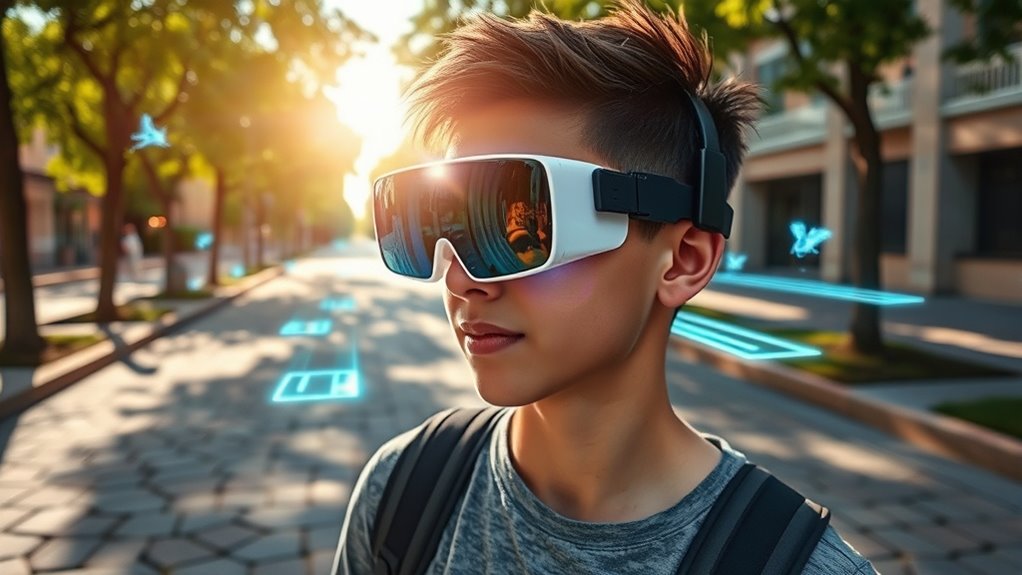
Advancements in device-camera technology and processing power have considerably propelled the development of AR games. Modern smartphones and tablets now feature high-resolution cameras capable of capturing detailed environments, making immersive AR experiences more seamless. Faster processors enable real-time rendering of virtual objects over the physical world without lag, enhancing gameplay fluidity. The integration of sensors like gyroscopes and accelerometers allows precise tracking of device movement, creating more interactive and responsive environments. Additionally, the rollout of 5G networks offers low-latency connections, supporting complex multiplayer AR games and streaming content smoothly. These technological improvements collectively expand the scope of AR game design, allowing developers to craft more realistic, engaging experiences that blend digital and real-world elements effortlessly. The incorporation of sensor technology and other technical concepts from the field of water chemistry and hydraulics further enriches game realism and complexity. Furthermore, advancements in wireless communication protocols continue to drive innovation and user adoption in AR gaming. Enhanced device sensors also enable more accurate environmental mapping, leading to more precise virtual object placement and interaction.
Comparing Revenue Streams: AR vs. VR Gaming Markets

While both augmented reality (AR) and virtual reality (VR) gaming markets are experiencing rapid growth, AR currently generates considerably higher revenues thanks to its broader accessibility and smartphone integration. You’re more likely to encounter AR games that seamlessly blend into your daily life, leading to mass adoption. In 2025, mobile AR revenue is projected to surpass USD 13.8 billion, surpassing VR’s USD 15 billion but with much wider user engagement. This widespread reach fuels steady revenue growth, with AR expected to dominate the gaming financial landscape. Moreover, the cost-effective nature of AR devices and the emphasis on safety and ease of use contribute to its rapid adoption. Additionally, market penetration continues to expand as developers create more innovative AR experiences that appeal to diverse audiences. As technology advances, the ease of integration of AR into everyday activities further accelerates its market growth. This growth is supported by the accessibility of AR platforms, making it easier for new users to participate and enjoy immersive experiences. Furthermore, ongoing developments in content personalization enhance user engagement and retention, driving sustained revenue growth.
Factors Accelerating the Adoption of AR in Entertainment
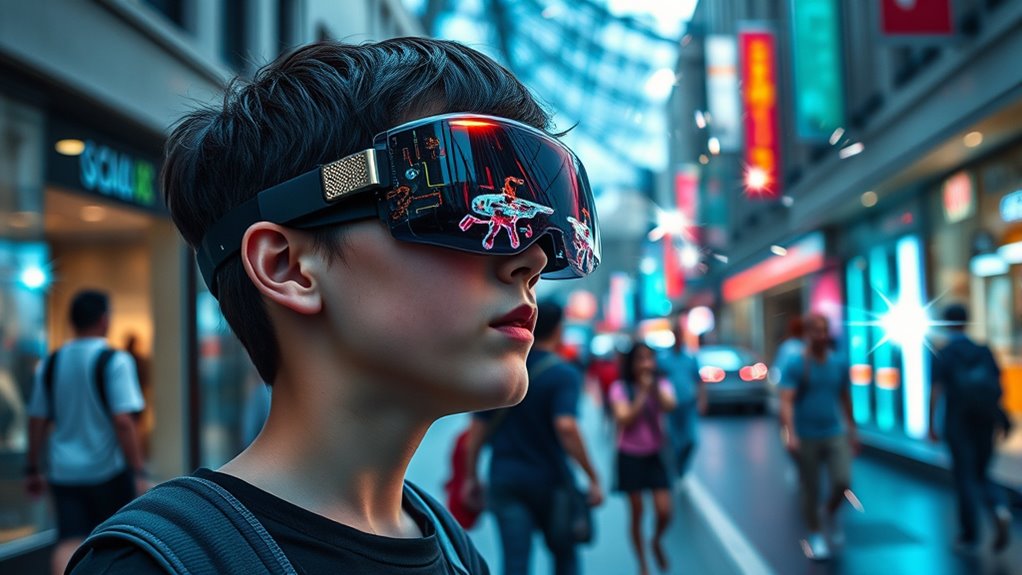
Several key factors are driving the rapid adoption of AR in entertainment, making it more accessible and engaging for users. First, technological advances like 5G and improved device cameras enable seamless, high-quality AR experiences. Second, the widespread use of smartphones ensures mass accessibility, with over 1.7 billion mobile AR users projected by 2025. Third, the entertainment industry’s focus on interactive content fuels demand, supported by innovative apps and games. Additionally, affordable AR devices and government initiatives in regions like Australia accelerate adoption. Here’s a quick comparison:
| Factor | Impact |
|---|---|
| 5G and device tech | Enhances experience quality and reduces latency |
| Smartphone penetration | Makes AR accessible to billions worldwide |
| Industry innovation | Drives engaging, immersive entertainment options |
The Future of AR Gaming: Trends and Opportunities
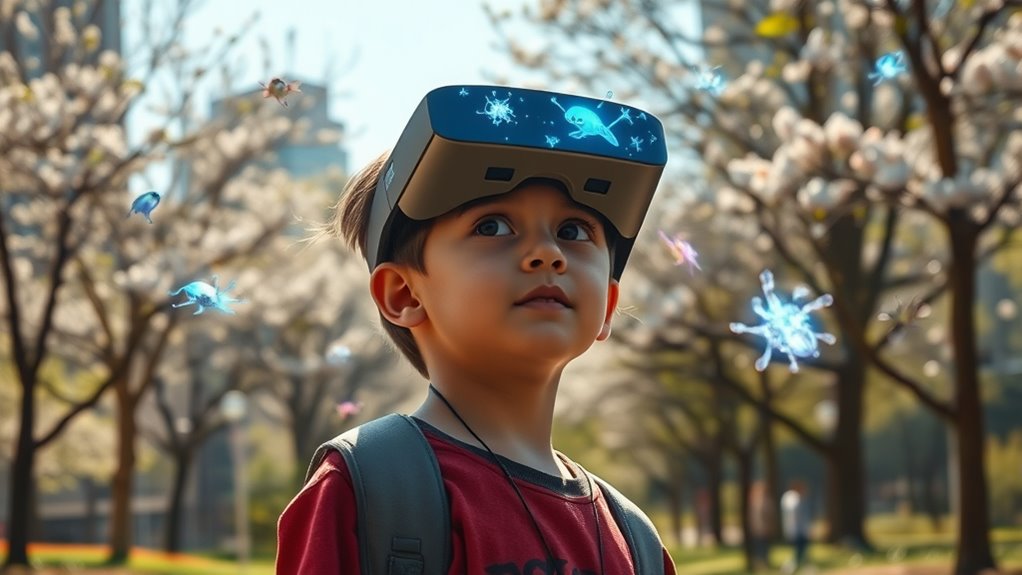
Emerging technological innovations like 5G, advanced device-camera systems, and real-time environment mapping are unlocking new possibilities for AR gaming. As market potential expands globally, companies are exploring novel user engagement strategies to keep players immersed. Staying ahead means embracing these trends and seizing new opportunities to shape the future of AR gaming. Innovative hardware can also enhance the realism and responsiveness of augmented reality experiences, making gameplay more seamless and engaging. Additionally, accessible design can benefit from these advancements, as innovative technologies may improve accessibility and user experience for diverse players.
Emerging Technological Innovations
What technological innovations are shaping the future of AR gaming? You’ll see breakthroughs that make experiences more immersive and seamless. Advances in device-camera technology enable stunning visuals and realistic sound, pulling you deeper into the game. 5G infrastructure dramatically reduces lag, allowing for real-time interactions with minimal delay. Enhanced AR overlays now adapt dynamically to your environment, creating richer, more interactive worlds. Augmented reality glasses and lightweight wearables promise hands-free gameplay, boosting mobility and comfort. Additionally, AI-driven content personalization tailors experiences to your preferences, making every session unique. These innovations combine to blur the line between digital and physical, creating an unparalleled level of immersion that transforms how you play and interact with AR games.
Expanding Market Potential
Technological innovations like advanced device-camera systems, 5G connectivity, and lightweight wearables are revealing new levels of immersion and interactivity in AR gaming. These advancements enable seamless integration of virtual elements into your real environment, making gameplay more engaging and realistic. As AR technology becomes more accessible through smartphones and affordable devices, your potential to explore new gaming experiences grows. The market is expanding rapidly, with projections reaching over USD 141 billion by 2033, driven by increasing user adoption worldwide. Regions like Asia-Pacific and North America lead the growth, supported by infrastructure and investment. With more people actively engaging in mobile AR, chances are you’ll encounter innovative games that blend physical and digital worlds, opening up exciting opportunities for developers and players alike.
New User Engagement Strategies
As AR gaming continues to grow, developers are exploring innovative user engagement strategies to capture and retain players’ attention. You’ll see more personalized experiences that adapt to your gameplay style, making each session unique. Gamers can expect dynamic challenges that evolve in real-time, keeping the excitement fresh. Social features will deepen your connection with others, fostering communities around shared adventures. Gamification elements like rewards and leaderboards motivate ongoing participation. Plus, augmented reality will become more seamless, blending gameplay into your daily environment effortlessly.
- Immersive storytelling that pulls you into a living, breathing world
- Real-world rewards revealing exclusive content and perks
- Collaborative missions that build friendships and teamwork
- Live events and tournaments boosting your competitive spirit
- Adaptive difficulty levels to match your growing skills
Frequently Asked Questions
How Secure ARe AR Gaming Applications Regarding User Data Privacy?
AR gaming applications vary in security, but many prioritize user data privacy through encryption and strict policies. You should always review permissions and privacy settings before installing or playing. Developers are increasingly adopting secure protocols to protect your information, but vulnerabilities can still exist. Be cautious about sharing personal details and stay updated on app security updates to guarantee your data remains safe while enjoying immersive AR experiences.
What ARe the Main Technical Challenges in Developing AR Games?
You face several technical challenges when developing AR games. Ensuring accurate real-world environment mapping is complex, requiring advanced sensors and processing power. You also need to optimize for various devices with different capabilities and hardware constraints. Achieving seamless integration of virtual elements into real-world scenes demands sophisticated software and real-time rendering. Additionally, managing data privacy, reducing latency, and maintaining battery efficiency are critical to delivering smooth, immersive experiences.
How Does AR Gaming Impact Physical Activity and Health?
AR gaming encourages you to move around and engage physically, promoting activity and exercise. It can boost your coordination, spatial awareness, and overall fitness by requiring you to navigate real-world environments while playing. However, it’s important to stay safe and avoid overexertion or accidents. When used responsibly, AR games can make physical activity more fun and immersive, helping you stay active and healthy while enjoying your gaming experience.
What ARe the Environmental Considerations for AR Game Deployment?
When deploying AR games, you should consider environmental impacts like energy consumption and electronic waste. Using energy-efficient devices and recycling old hardware helps reduce your carbon footprint. Be mindful of local ecosystems, avoiding interference with wildlife or natural habitats. Opt for sustainable packaging and support eco-friendly infrastructure. By taking these steps, you contribute to responsible deployment, ensuring AR gaming benefits players without harming the environment.
How Accessible ARe AR Gaming Options for Users With Disabilities?
Can you imagine playing your favorite AR game seamlessly despite visual or mobility challenges? Accessibility options are growing, with features like voice commands, subtitles, and customizable controls making AR gaming more inclusive. Developers are increasingly prioritizing universal design, ensuring users with disabilities can fully enjoy immersive experiences. While progress is steady, ongoing innovation and awareness are key to creating truly accessible AR environments for everyone.
Conclusion
As you explore AR gaming, it’s clear that the market is booming—projected to reach $30 billion by 2025. You’re at the forefront of a revolution where real-world interactions blend seamlessly with virtual worlds. With technological innovations accelerating and regions like Asia leading the charge, you’re witnessing an exciting era of immersive entertainment. Embrace these advancements, because the future of AR gaming promises even more transformative experiences that will redefine how you play and connect.