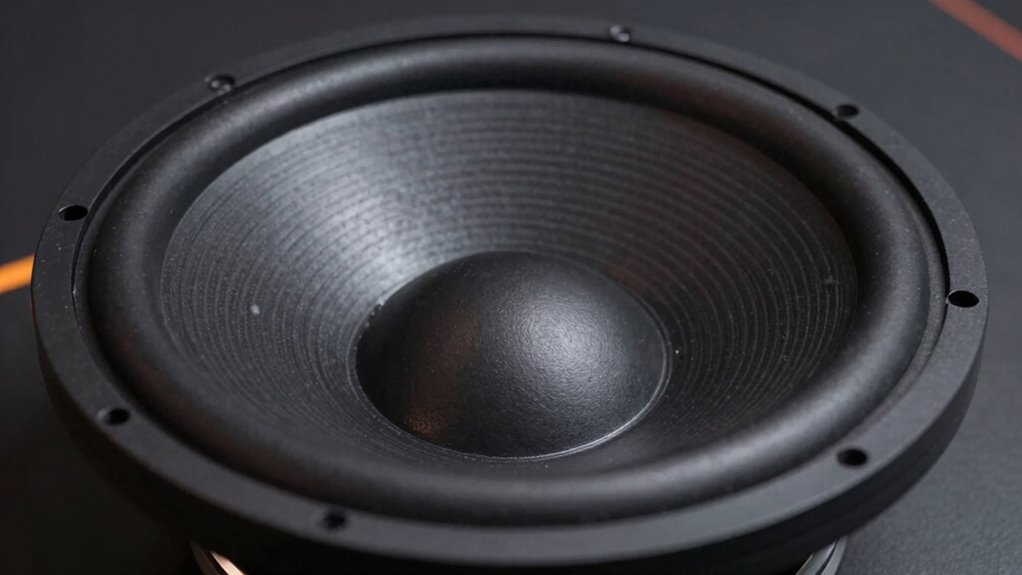

To make your subwoofer feel powerful instead of boomy, focus on its frequency response and enclosure design. A well-balanced response ensures deep, clear bass without muddiness, while a sealed enclosure delivers tight, punchy sound. Avoid overemphasizing certain frequencies, which causes boominess. The quality of the driver and how it interacts with the enclosure also matter—together, they produce precise, impactful bass. Keep these elements in mind, and you’ll discover how to optimize your subwoofer for peak performance.
Key Takeaways
- Opt for a subwoofer with a wide, smooth frequency response to deliver clear, punchy bass without muddiness.
- Choose a sealed enclosure for tight, controlled bass that feels powerful and precise.
- Ensure high-quality driver and proper enclosure matching to maximize bass impact and clarity.
- Balance the system to avoid overemphasizing certain frequencies, preventing boomy, overwhelming sounds.
- Focus on overall setup and tuning to achieve deep, impactful bass that feels strong rather than overly loud.
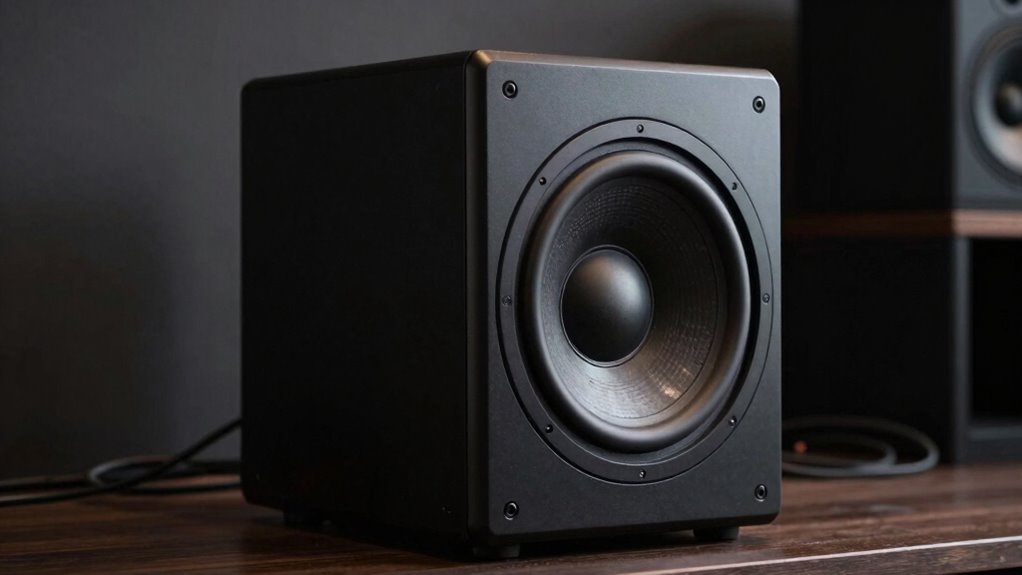
Ever wondered why some subwoofers deliver a punchy, powerful feel while others just produce boomy, muddy bass? It all comes down to a few key factors, and understanding how they work can make a huge difference in your listening experience. One of the most important aspects is the subwoofer’s frequency response. This term describes the range of bass frequencies a subwoofer can accurately reproduce. A wider and well-balanced frequency response guarantees that the subwoofer handles the full spectrum of low sounds without exaggerating or muddling the bass. When your subwoofer is tuned to emphasize certain frequencies too heavily or has a limited frequency response, it can result in that boomy, one-note thump instead of a clear, punchy sound. Ideally, you want a subwoofer with a smooth and extended frequency response that can faithfully reproduce deep bass notes without overemphasizing any particular range. Additionally, the enclosure design plays a vital role in shaping the overall sound quality and feeling of power. Properly designed enclosures can also help reduce unwanted resonances that distort the bass, making the sound even more impactful. Understanding the acoustic properties of different enclosure types can help you select the best setup for your space, ensuring the bass remains tight and controlled.
Another critical factor that influences how powerful your subwoofer feels is its enclosure design. The enclosure acts as the housing for the subwoofer driver and plays a crucial role in shaping the sound. Different enclosure types—sealed, ported, or bandpass—produce distinct sound characteristics. Sealed enclosures tend to deliver tight, accurate bass with quick transient response, making the bass feel more controlled and punchy. Ported enclosures, on the other hand, increase volume and output at specific frequencies, which can add more bass but sometimes at the expense of clarity, leading to boomy sounds. Bandpass enclosures combine elements of both, but if not designed properly, they can cause uneven bass response. The key is choosing an enclosure design that complements your subwoofer’s driver and your listening preferences. Properly designed enclosures minimize unwanted resonances and distortions, allowing the subwoofer to produce clean, impactful bass rather than muddy, overwhelming sounds. When selecting a subwoofer, paying attention to driver quality and how it interacts with the enclosure can significantly influence the overall power and clarity of the bass.
In essence, a powerful-sounding subwoofer isn’t just about cranking up the volume. It’s about how well the subwoofer’s frequency response aligns with your desired sound profile and how effectively the enclosure design enhances clarity and punch. When these elements are balanced, you’ll notice bass that hits hard and feels precise, not just loud and boomy. Taking the time to select a subwoofer with a suitable frequency response and an enclosure tailored to your needs will transform your listening experience, giving you that deep, powerful bass that feels as good as it sounds.
Frequently Asked Questions
How Does Room Acoustics Affect Subwoofer Performance?
Room acoustics profoundly influence your subwoofer’s performance by affecting subwoofer resonance and frequency response. When your room has hard surfaces or irregular shapes, it causes sound reflections that can amplify or cancel out certain frequencies, leading to boomy or dull sounds. To optimize performance, you should place your subwoofer strategically and use acoustic treatments, ensuring a balanced, powerful bass that feels tight and controlled rather than boomy.
What Is the Ideal Placement for a Powerful-Sounding Subwoofer?
Place your subwoofer near a wall, close to a corner, or along a boundary to amplify its power. You’ll want to experiment with subwoofer calibration and listen for the placement that produces deep, punchy bass without boominess. Think of your listening environment as a canvas—position your subwoofer to fill the space with rich, balanced sound. Start there, then fine-tune until it feels powerful and natural.
How Does Subwoofer Enclosure Type Influence Sound Quality?
Your subwoofer’s enclosure type *greatly* influences sound quality through material choices and port configurations. A sealed enclosure uses dense materials like MDF, delivering tight, accurate bass with minimal distortion. Ported enclosures, with carefully designed port configurations, produce louder, deeper bass but can sometimes sound boomy if not tuned properly. Choosing the right enclosure depends on your desired sound, where quality materials and precise port design *guarantee* a powerful, clear subwoofer experience.
Can Adjusting Crossover Settings Improve Perceived Power?
Yes, adjusting crossover frequency can improve perceived bass and make your subwoofer feel more powerful. When you set the crossover correctly, it guarantees the subwoofer handles the right bass range, reducing muddiness and boosting clarity. This targeted frequency range enhances the overall punch and depth, making the bass feel more impactful without sounding boomy. Experiment with the crossover settings to find the sweet spot that delivers tight, powerful sound tailored to your space.
What Role Does Amplifier Power Play in Subwoofer Feel?
Amplifier power plays a vital role in making your subwoofer feel powerful. When you focus on proper subwoofer tuning and amplifier matching, you guarantee the amp provides enough clean power without distortion. This balance allows the subwoofer to produce deep, impactful bass that’s tight and controlled, rather than boomy or muddy. Properly matching your amplifier to your subwoofer helps you achieve that potent, visceral feeling in your music or home theater experience.
Conclusion
Think of your subwoofer as a heartbeat—powerful, steady, and life-giving. When it’s tuned right, it doesn’t just thump; it breathes, filling your space with a controlled pulse that energizes without overwhelming. Remember, a well-calibrated subwoofer is like a steady drumbeat in a grand symphony—felt deeply, yet never drowning out the melody. When you fine-tune it, you’re not just hearing bass—you’re experiencing the music’s soul.